

SUMMARY
Overcoming Language Learning Plateaus
Developer-focused strategies to break through language learning plateaus and accelerate fluency.
Keywords: Language Learning, Plateau Breakthrough, Developer Strategies
TABLE OF CONTENTS
1. Why It Matters — The Developer’s Language Learning Quandary
2. Core Methods — Architecting Your Breakthrough
3. Practical Application — Coding Your Fluency
4. Common Pitfalls & Mistakes — Avoiding Bugs in Your Journey
5. Frequently Asked Questions (FAQ)
6. Wrap-Up — Your Next Sprint Towards Fluency
MOTIVATION
Why It Matters — The Developer’s Language Learning Quandary
Hey there, Kwonglish fam! As developers, we’re wired for logic, systems, and measurable progress. We thrive on clear documentation, reproducible bugs, and well-defined sprints. So, it’s no surprise that many of us are drawn to the challenge of learning a new language. It feels like another complex system to master, right?
You dive in, full of enthusiasm. You crush Duolingo streaks, memorize grammar rules like API endpoints, and maybe even start deciphering simple sentences. The progress is exhilarating! You’re compiling new knowledge, seeing immediate results, and feeling that satisfying dopamine hit of learning something new. But then, it happens. The dreaded language learning plateau.
“It’s like hitting a wall in a coding project where everything seems to compile, but the application just isn’t performing as expected, and you can’t pinpoint why.”
Suddenly, your daily practice feels less impactful. New vocabulary sticks less easily. Conversations feel clunky, and you stumble over basic phrases you thought you knew. You understand a lot, but producing fluent speech feels impossible. This is the plateau, a frustrating period where your perceived progress flatlines, and motivation starts to wane. It’s a common experience, backed by research showing that learners often encounter a dip in perceived progress after the initial rapid gains.
For developers, this can be particularly disheartening. We’re used to seeing clear metrics: lines of code, passing tests, completed features. Language learning, however, is a much more organic, less linear process. It’s not about reaching 100% code coverage; it’s about developing an intuitive understanding and fluid expression, which is hard to quantify. This mismatch between our logical, analytical minds and the messy reality of language acquisition can lead to frustration and, eventually, burnout.
But here’s the good news: just like a complex software bug, a language plateau isn’t a dead end. It’s a signal. It tells you that your current learning approach has reached its limits, and it’s time to refactor your strategy. In 2026, with all the amazing tools and communities available, there’s no reason to stay stuck.
KEY POINT
Language plateaus are natural. They signify that your current learning methods have optimized their initial gains. It’s not a failure, but an invitation to adapt and upgrade your approach, much like iterating on a software project.
This guide is designed specifically for you, the developer who wants to apply that same analytical, problem-solving prowess to language learning. We’ll explore practical, actionable steps to diagnose your plateau, architect new learning strategies, and debug your mindset to finally achieve those breakthroughs you’ve been craving.

STRATEGY
Core Methods — Architecting Your Breakthrough
Just like you wouldn’t jump into refactoring a complex codebase without understanding its current state, overcoming a language plateau requires a systematic approach. Let’s break it down into phases.
Phase 1: Diagnosis — Identify Your Bottlenecks
Before you can fix the “bug,” you need to understand where the system is failing. This means objectively assessing your current language skills.
1
Self-Assess Across Key Skills
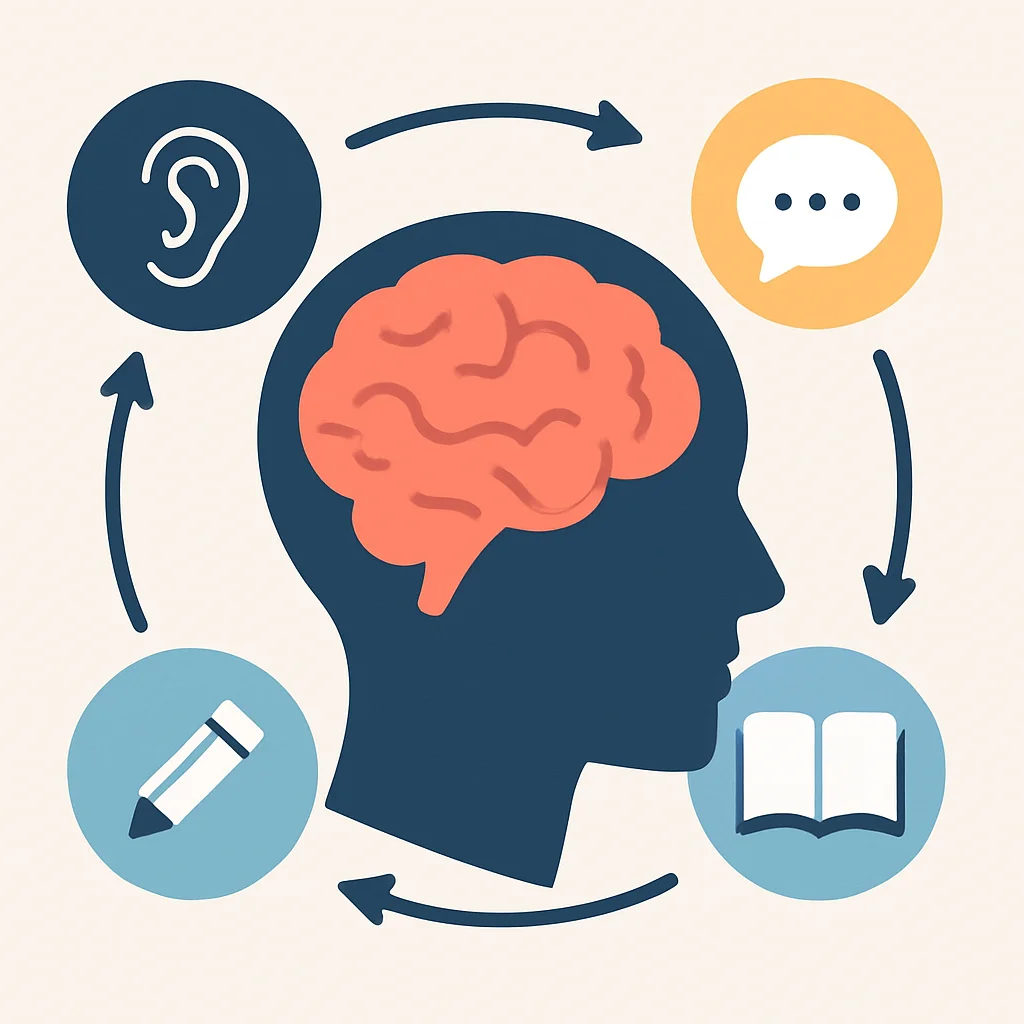
Rate yourself on a scale of 1-10 for listening, speaking, reading, and writing. Be brutally honest. Are you great at reading but freeze up when speaking? Can you understand native speakers but struggle to form coherent sentences? This pinpoints where to focus your refactoring efforts.
2
Track Your Input and Output
How much time are you spending on passive consumption (listening, reading) versus active production (speaking, writing)? Many learners hit plateaus because their input far outweighs their output. Aim for a better balance. Track your hours, similar to how you’d track time on a project. This data-driven approach helps identify imbalances.
Let’s say you’re learning Spanish. You might realize you spend hours watching Netflix in Spanish (input), but only a few minutes a week actually speaking or writing (output). This imbalance is a common culprit for plateaus.
CODE EXPLANATION
This Python script provides a simple way to log your daily language learning activities. You can extend it to include different categories like ‘speaking’, ‘reading’, ‘writing’, and ‘listening’ and then analyze your time distribution to identify areas for improvement.
import datetime

def log_language_activity(language, activity_type, duration_minutes):
    """Logs a language learning activity with timestamp."""
    timestamp = datetime.datetime.now().strftime("%Y-%m-%d %H:%M:%S")
    with open("language_log.txt", "a") as f:
        f.write(f"[{timestamp}] {language} - {activity_type}: {duration_minutes} minutes\n")
    print(f"Logged: {activity_type} for {duration_minutes} minutes in {language}.")

# Example Usage:
log_language_activity("Spanish", "speaking", 30)
log_language_activity("Spanish", "reading", 45)
log_language_activity("Spanish", "listening", 60)
log_language_activity("Spanish", "grammar study", 20)

# To view your log (for analysis):
# with open("language_log.txt", "r") as f:
#     for line in f:
#         print(line.strip())
Phase 2: Refactor Your Learning Strategy
Once you know what’s broken, it’s time to implement targeted changes. Think of these as modular updates to your learning framework.
Immersive Micro-Environments
Concept — You can’t move to Spain, but you can bring Spain to you. Change your phone’s language, subscribe to foreign news sites, listen to podcasts, and watch shows without subtitles. The goal is to make the target language a natural part of your daily digital life, even for just 15-30 minutes at a time.
Developer Angle — Think of it as setting up a virtual machine with a foreign OS. You’re forcing yourself to interact with the system in its native language, even if it’s uncomfortable at first. This builds passive exposure and familiarity.
Contextual Learning & Spaced Repetition
Concept — Stop memorizing isolated vocabulary lists. Learn words and grammar in complete sentences and real-world contexts. Use apps like Anki for spaced repetition, but make sure your flashcards include example sentences, not just single words. This creates stronger neural connections.
Developer Angle — This is like understanding how a function works within a larger program, not just memorizing its signature. The context makes it meaningful and memorable. Spaced repetition is your intelligent caching mechanism for long-term memory retention.
Active Production — The Output Imperative
Concept — This is where many learners get stuck. You must actively produce the language. Speak, write, and interact. Find conversation partners, write short journal entries, or even talk to yourself in the mirror. Quantity over perfection at this stage.
Developer Angle — This is like writing code, not just reading documentation. You need to exercise the syntax, logic, and flow. The first few attempts will be buggy, but each iteration improves your “code.” The more you write, the better you get at identifying and fixing your own errors.
KEY POINT
The transition from understanding (input) to producing (output) is the key to breaking plateaus. Actively creating sentences, speaking, and writing forces your brain to retrieve and synthesize information, solidifying your knowledge.
Phase 3: Debug Your Mindset
Your mindset is as crucial as your methods. Negative self-talk, fear of mistakes, and unrealistic expectations can be the biggest blockers.
1
Embrace Mistakes as Features, Not Bugs
Every mistake is a data point, an opportunity to learn. In software, we debug. In language, we learn from errors. Don’t let the fear of sounding imperfect paralyze you. Native speakers make mistakes too! Focus on communication, not flawless grammar. The more you speak, the more feedback you get, and the faster you improve.
2
Set Micro-Goals, Celebrate Micro-Victories
Instead of “becoming fluent,” aim for “have a 5-minute conversation with a native speaker this week” or “write 3 sentences about my day without Google Translate.” Small, achievable goals build momentum and keep motivation high. Track these small wins like completing user stories in a sprint.
3
Find Your Language Community
Learning a language doesn’t have to be a solo quest. Join online communities, find language exchange partners, or even a local meetup group. Interacting with others provides accountability, motivation, and invaluable real-world practice. It’s like pair programming for language learners!
ACTION
Practical Application — Coding Your Fluency
Now let’s get concrete. How can developers specifically leverage their skills and interests to accelerate language learning in 2026?
Project-Based Language Learning
This is where our developer brains truly shine. Instead of abstract exercises, create mini-projects that force you to use the language.
Translate a README.md
Pick an open-source project you’re familiar with and translate its README.md file into your target language. This is excellent for technical vocabulary and understanding how concepts are expressed in another language. You can even submit a PR!
Build a Simple Web Page
Create a basic HTML page about yourself or a topic you enjoy, entirely in the target language. Use <p> tags for sentences, <h1> for titles, and even add some CSS comments in the target language. This forces you to generate content.
Automate Vocabulary Review
Write a small script that fetches words from a list, displays them, and asks you to translate. Incorporate spaced repetition logic. This is a highly personalized and engaging way to practice.
Leverage Language Exchange “APIs”
Think of language exchange apps as APIs for human interaction. They provide structured ways to connect with native speakers.
Platforms like HelloTalk and Tandem allow you to chat with native speakers, exchange voice messages, and even have video calls. They often have built-in translation and correction tools, making it less intimidating. Commit to at least one 15-minute conversation or 10 message exchanges daily.
KEY POINT
Active engagement with native speakers through language exchange platforms or community meetups is paramount for breaking speaking plateaus. It provides real-time feedback and forces your brain to process and respond rapidly.
Automate Your Language Exposure
Integrate the language into your daily routine without even trying.
Change your operating system, browser, or frequently used app languages. Follow social media accounts of news outlets, comedians, or influencers in your target language. Find podcasts or YouTube channels related to your hobbies (e.g., coding tutorials in Japanese, cooking shows in French). This passive, consistent exposure gradually builds familiarity and comprehension.
WARNINGS
Common Pitfalls & Mistakes — Avoiding Bugs in Your Journey
Even with the best intentions, it’s easy to fall into common traps that perpetuate plateaus. Let’s identify these “bugs” before they derail your progress.
WARNING
Relying solely on passive consumption (watching, listening) without active production (speaking, writing) is the most common reason for extended plateaus. Your brain needs to practice retrieving and forming sentences, not just decoding them.
PROBLEM 01
The “Perfection Paralysis” Syndrome
Many developers, being precise and logical, struggle with the inherent messiness of early language production. They wait until they feel “ready” to speak or write, which often means never starting.
SOLUTION — Embrace the MVP (Minimum Viable Product) Approach
// Instead of: "I must write a perfectly grammatically correct email."
// Aim for:
function send_mvp_email_in_target_language() {
    let subject = "Quick Question"; // Or use your best attempt at a foreign subject
    let body = "Hello. I need help. Can you explain this?"; // Simple, direct, imperfect
    // Focus on conveying meaning, not flawless syntax.
    send_email(subject, body);
}

// Iterate and refine later, just like software development.
PROBLEM 02
Inconsistent “Commits” to Your Language Project
Sporadic bursts of intense study followed by long periods of inactivity are detrimental. Language acquisition thrives on consistent, even if short, daily engagement.
SOLUTION — Implement Daily “Micro-Commits”
// Daily routine for consistent progress
function daily_language_micro_commit() {
    // 15 minutes: Review Anki flashcards (spaced repetition)
    review_anki_deck();

    // 10 minutes: Listen to a podcast segment in target language
    listen_to_podcast_segment();

    // 5 minutes: Write 3 sentences in a language journal OR send a message to a language partner
    write_or_speak_briefly();

    // This consistent small effort compounds over time.
}
Beyond these, neglecting the cultural context of a language is another common oversight. Language isn’t just words; it’s deeply intertwined with culture. Understanding cultural nuances can significantly enhance your comprehension and ability to communicate naturally. For example, knowing when to use formal vs. informal address in a language like Japanese or Korean is crucial for effective interaction.
Pros
✓ Structured, analytical approach helps diagnose problems.
✓ Project-based learning makes practice engaging and relevant.
✓ Data tracking (time, output) provides clear progress metrics.
Cons
✗ Over-analysis can lead to “analysis paralysis” instead of action.
✗ Tendency to seek perfect solutions, hindering early production.
✗ May overlook the emotional and intuitive aspects of language.

Frequently Asked Questions (FAQ)
Q. How long does it typically take to break through a language plateau?
The duration varies greatly depending on the individual, the language, and the intensity of the new strategies applied. With consistent, targeted effort, many learners report noticeable improvements within 2-4 weeks, leading to a full breakthrough over a few months.
Q. Is it better to focus on one skill (e.g., speaking) or all skills simultaneously?
While a balanced approach is ideal long-term, if you’ve identified a specific bottleneck (e.g., speaking paralysis), it’s often effective to temporarily dedicate more focused effort to that one skill to achieve a breakthrough, then rebalance your studies.
Q. What if I don’t have time for daily practice?
Even 10-15 minutes of focused practice daily is more effective than one long session per week. Micro-commits like reviewing flashcards during a commute or listening to a short podcast while doing chores can accumulate significant progress over time.
Q. How can I stay motivated when progress feels slow?
Set small, achievable goals, track your micro-victories, and remind yourself why you started learning the language. Connecting with a language partner or community can also provide external motivation and accountability.
CONCLUSION
Wrap-Up — Your Next Sprint Towards Fluency
Hitting a language learning plateau is not a sign of failure; it’s a natural part of the journey. For us developers, it’s a familiar challenge — a complex system that needs a new approach, a strategic refactor. By applying your analytical mindset, embracing active production, and debugging your limiting beliefs, you can absolutely break through and accelerate your path to fluency in 2026.
Remember, language learning is a marathon, not a sprint. But with the right strategies, each new “sprint” can yield significant progress. Don’t be afraid to experiment, make mistakes, and celebrate every small victory. Your brain is a powerful learning machine, and you’ve got the toolkit to unlock its full potential.
Your Breakthrough Checklist
☑ Diagnosed your weakest language skill(s) (speaking, listening, reading, writing)
☑ Increased active production (speaking/writing) to balance passive input
☑ Integrated immersive micro-environments into your daily routine
☑ Applied project-based learning (e.g., translating a README, building a simple page)
☑ Engaged with native speakers via language exchange apps or communities
☑ Set realistic micro-goals and celebrated small achievements
☑ Embraced mistakes as learning opportunities, not failures
Ready to push past that plateau? Pick one strategy from this guide and implement it today. Share your experiences and breakthroughs in the comments below!

Ready to Level Up Your Language Skills?
Don’t let plateaus hold you back. Apply these developer-focused strategies and experience real progress!
Got questions or your own breakthrough tips? Drop a comment below!