
SUMMARY
Navigating HOA & Condo Rules: A Developer’s Legal Guide to Community Living in 2026
Gain a comprehensive understanding of your rights and responsibilities when residing in an HOA or condo community. This guide addresses prevalent rules, legal challenges, and methods for dispute resolution tailored for developers in 2026.
Keywords: HOA, Condo Association, Property Law
TABLE OF CONTENTS
1. Overview: Why Understanding Community Rules is Essential
2. The Core of Community Living: HOAs & Condo Associations
3. Key Legal Documents Governing Your Community
4. Common Rules & Restrictions You’ll Encounter
5. Financial Obligations: Dues, Assessments, and Fees
6. Developer-Specific Considerations in Community Living
7. Real-World Scenarios: Navigating Common Disputes
8. Caveats and Important Considerations
9. Frequently Asked Questions (FAQ)
1. Overview: Why Understanding Community Rules is Essential
Welcome to the Kwonglish community! If you are a developer, investor, or someone interested in purchasing property, you may have come across the terms HOA (Homeowners Association) or Condo Association. These entities oversee a significant portion of residential properties worldwide, and grasping their rules and legal frameworks is not just advantageous—it is crucial in 2026. The realm of community living is continuously changing, with new regulations, technological advancements, and evolving homeowner expectations.
In the United States, for example, data from the Community Associations Institute (CAI) consistently indicates that over 70% of newly constructed homes are located within common-interest communities managed by an HOA. This equates to millions of households and a significant segment of the real estate market. For developers, this implies that nearly every new project, whether it is a single-family home subdivision, a townhome complex, or a high-rise condominium, will necessitate navigating these complex regulations. Overlooking them can result in costly delays, legal disputes, and considerable financial repercussions.
This guide is crafted to provide you with the insights needed to confidently navigate community living, whether you are constructing, purchasing, or managing property within an association. We will thoroughly explore the legal documents, common rules, financial responsibilities, and specific considerations for developers, ensuring you are well-equipped for the complexities of 2026.
KEY POINT
Over 70% of new homes in the U.S. are part of an HOA or similar community association. A comprehensive understanding of their rules is essential for any developer or property owner to avoid legal and financial pitfalls.
2. The Core of Community Living: HOAs & Condo Associations
Before we dive into the details, let’s clarify what HOAs and Condo Associations are, and how they differ slightly in their structure and focus.
What is a Homeowners Association (HOA)?
An HOA is a private organization that manages a planned community, which may encompass single-family homes, townhouses, or a combination of property types. When you purchase a property within an HOA, you automatically become a member and agree to adhere to its rules and pay its fees. The main objective of an HOA is to maintain common areas, enforce community standards, and safeguard property values. Common areas often include parks, swimming pools, clubhouses, private roads, and landscaping.
HOAs are usually governed by a board of directors, typically elected from among the homeowners themselves. This board is tasked with making decisions, establishing budgets, collecting dues, and enforcing the community’s governing documents. Their authority is derived from state laws and the specific documents filed for the community.
What is a Condo Association?
A Condo Association serves a similar function to an HOA but is specifically designed for condominium developments. In a condo, you own the interior of your individual unit, while common elements—such as exterior walls, roofs, hallways, elevators, and shared amenities—are collectively owned by all unit owners. The Condo Association is responsible for the maintenance, repair, and replacement of these common elements.
Like HOAs, Condo Associations are managed by an elected board of directors. The primary distinction lies in the ownership structure: with a condo, you are purchasing a “slice of air” within a larger building, and your ownership includes an undivided interest in the common areas. This often entails more direct involvement and responsibility for the building’s structural integrity and shared systems.
KEY POINT
While both manage common property and enforce rules, HOAs typically govern single-family homes and townhouses with shared amenities, whereas Condo Associations specifically manage condominium buildings where individual units are owned and common elements are shared.
3. Key Legal Documents Governing Your Community
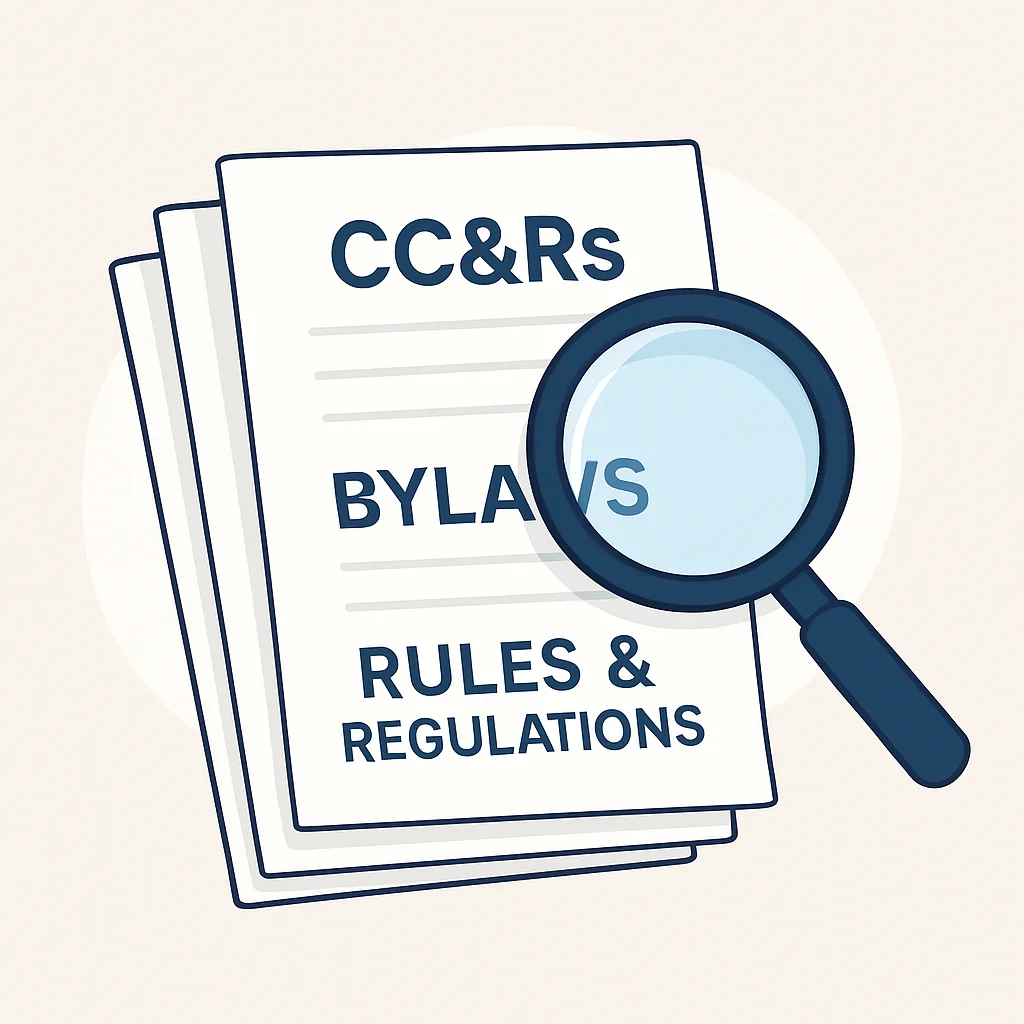
The powers and limitations of any HOA or Condo Association are enshrined in a set of legal documents. As a developer or prospective homeowner, thoroughly reviewing these documents is essential. They serve as the constitution of your community. While specific names may differ by state or country, the core documents generally include:
Covenants, Conditions, and Restrictions (CC&Rs)
The CC&Rs are the foundational legal document for any common-interest community. They are recorded with the county recorder’s office and run with the land, meaning they are binding on all current and future property owners in the community. Consider them as the “supreme law” of the community. Key elements typically found in CC&Rs include:
- Property Use Restrictions: These define how you can utilize your property. Examples include restrictions on business operations from home, the number of occupants, or even the color you can paint your front door.
- Architectural Guidelines: Rules regarding exterior modifications, landscaping, fences, additions, and even satellite dishes. Most require prior approval from an Architectural Review Committee (ARC).
- Maintenance Responsibilities: Clearly delineating what the association maintains (e.g., common landscaping) versus what the homeowner maintains (e.g., their private yard, interior of a condo unit).
- Assessment Obligations: Outlining the method for calculating and collecting regular assessments (dues) and special assessments.
- Enforcement Mechanisms: Detailing the procedures for addressing violations, including fines, liens, and legal action.
Bylaws
While CC&Rs dictate what you can and cannot do with your property, the Bylaws govern how the HOA or Condo Association itself operates. They essentially serve as the operational manual for the organization. Important information found in the Bylaws includes:
- Board Member Elections: Procedures for nominating, electing, and removing board members, including term limits and eligibility.
- Meeting Protocols: Rules for annual meetings, special meetings, board meetings, quorum requirements, and voting procedures.
- Officer Duties: Descriptions of the responsibilities of the President, Vice President, Secretary, and Treasurer.
- Financial Management: Guidelines for budgeting, financial reporting, and auditing.
Rules & Regulations
These are typically more detailed and easily amendable than CC&Rs or Bylaws. They often cover day-to-day operational aspects and specific policies that enhance or clarify the broader rules in the CC&Rs. Examples include:
- Pool Hours and Usage: Specific times the pool is open, guest policies, and safety rules.
- Pet Policies: Detailed rules on leash requirements, waste disposal, and restricted breeds or sizes.
- Parking Rules: Designating visitor parking, towing policies, and restrictions on commercial vehicles.
- Noise Restrictions: Quiet hours and rules regarding excessive noise.
Always remember to read these documents carefully, ideally with legal counsel, before committing to any property within an association. They dictate your rights, obligations, and potential liabilities.
KEY POINT
The CC&Rs are the supreme legal document for property use, Bylaws govern the association’s operations, and Rules & Regulations cover day-to-day policies. All three must be reviewed thoroughly.
4. Common Rules & Restrictions You’ll Encounter
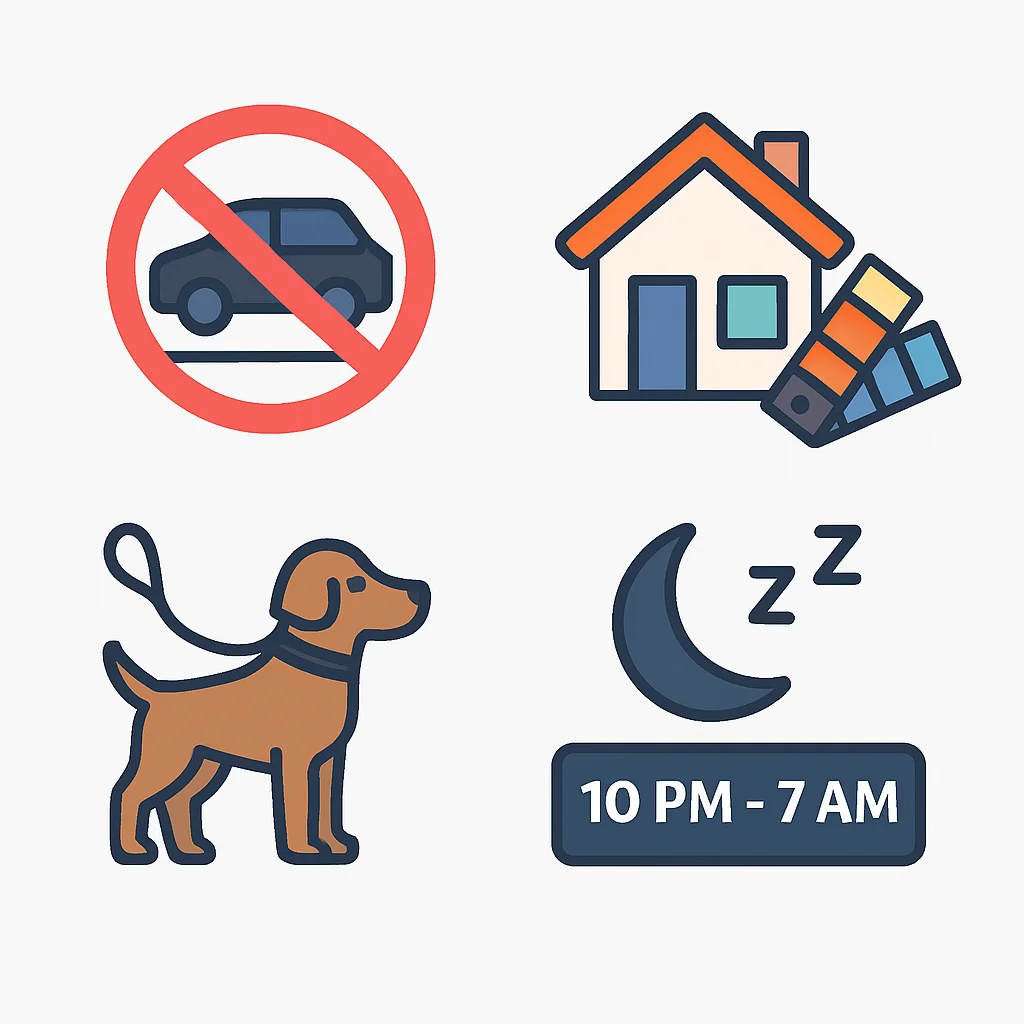
HOA and Condo Association rules are designed to uphold a certain aesthetic, lifestyle, and property value within the community. While they may sometimes seem restrictive, they are generally established to benefit all residents. Here are some of the most common types of rules you will encounter:
Architectural and Exterior Guidelines
These are arguably the most frequent source of homeowner disputes. Associations aim to ensure a consistent appearance and prevent modifications that could detract from community aesthetics or property values. Common restrictions include:
- Paint Colors: Specific approved color palettes for exterior walls, doors, and trim.
- Landscaping: Requirements for lawn maintenance, approved plant species, and restrictions on artificial turf or certain types of fencing.
- Exterior Modifications: Any additions like decks, patios, sheds, solar panels, or even security cameras often require prior written approval from the Architectural Review Committee (ARC).
- Holiday Decorations: Limitations on the type, size, and duration of holiday displays.
Pet Policies
Pet rules can vary widely, from very lenient to extremely strict. It is crucial to check these if you have pets or plan to acquire one. Common pet policies include:
- Number and Type of Pets: Limits on how many pets you can have, and restrictions on certain breeds (e.g., “aggressive breeds”) or exotic animals.
- Weight Limits: Some communities impose weight restrictions, particularly in condos or high-density areas.
- Leash and Waste Rules: Mandatory leash use in common areas and strict enforcement of pet waste removal.
Rental Restrictions
For investors and developers, rental restrictions are critical. Many associations implement these to maintain a certain owner-occupancy rate, which can affect property values and financing options for future buyers. Common restrictions include:
- Rental Caps: A limit on the percentage of units that can be rented out at any given time (e.g., only 20% of units can be non-owner occupied).
- Lease Term Minimums: Requiring leases to be for a minimum duration (e.g., no short-term rentals, minimum 6-month lease).
- Tenant Approval: Some associations require potential tenants to undergo an application and approval process, including background checks.
Parking and Vehicle Rules
Parking is often a contentious issue in communities, leading to strict rules:
- Assigned vs. Visitor Parking: Clear demarcation of spaces and enforcement of visitor parking areas.
- Vehicle Restrictions: Prohibitions on commercial vehicles, RVs, boats, or inoperable vehicles being parked on the street or in driveways.
- Overnight Parking: Rules regarding street parking during specific hours.
Noise and Nuisance Ordinances
These rules aim to ensure peaceful enjoyment of the community for all residents. They often include:
- Quiet Hours: Designated times when noise levels must be kept to a minimum.
- Excessive Noise: Prohibitions against loud parties, construction noise outside of approved hours, or continuous barking dogs.
Understanding these common rules upfront can save you a lot of headaches down the line. Always request the complete set of governing documents and review them thoroughly before making any decisions.
KEY POINT
Key rule categories include architectural standards, pet policies, rental restrictions, parking, and noise. Developers must pay close attention to rental caps and architectural guidelines for future property value and marketability.
5. Financial Obligations: Dues, Assessments, and Fees
Beyond the rules governing property use, financial commitments are a cornerstone of community living. Every homeowner in an HOA or condo association is required to contribute financially to the upkeep and management of the common elements and services. These obligations are legally binding and come with significant consequences if not met.
Regular Assessments (Dues)
These are the monthly, quarterly, or annual fees paid by all members to cover the association’s operating expenses. This includes a wide range of costs such as:
- Maintenance: Landscaping, pool cleaning, common area repairs, exterior building maintenance (for condos).
- Utilities: Water for common areas, electricity for streetlights, shared internet/cable services.
- Insurance: Master insurance policies covering common property (homeowners still need individual policies for their unit/interior).
- Management Fees: Costs for professional property management companies, if applicable.
- Reserve Funds: A portion of dues is typically allocated to a reserve fund for future major repairs and replacements (e.g., roof replacement, repaving roads, elevator upgrades). This is crucial for long-term financial health.
Average HOA fees can vary dramatically. In 2026, you might see fees ranging from $100 to $300 per month for basic HOAs in suburban areas, while luxury condo associations in major cities could command $500 to over $1,000 per month due to extensive amenities and higher maintenance costs.
Special Assessments
These are additional, one-time fees levied on homeowners to cover unexpected expenses or major projects for which the reserve fund is insufficient. Examples include:
- Major Repairs: Emergency roof replacement after storm damage, unexpected structural repairs.
- Large Capital Improvements: Installation of new community features like a playground, or significant upgrades to existing amenities.
- Legal Fees: Costs incurred from significant litigation against the association.
Special assessments can be substantial, sometimes ranging from hundreds to tens of thousands of dollars per unit, depending on the scope of the project and the number of units. A well-managed association with robust reserve funds is less likely to levy frequent or large special assessments.
Late Fees and Penalties
Failure to pay dues or special assessments on time will result in late fees and potentially interest charges, as outlined in the governing documents. These can quickly accumulate. More severely, associations have powerful legal tools to enforce payment:
- Liens: The association can place a lien on your property, which is a legal claim against the asset. This lien must typically be satisfied before the property can be sold or refinanced.
- Foreclosure: In many states, if a homeowner consistently fails to pay assessments, the association can initiate foreclosure proceedings, even if the mortgage is current. This is a drastic measure but a real threat.
- Suspension of Privileges: Homeowners may lose access to common amenities like pools, gyms, or clubhouses.
WARNING
Unpaid HOA/Condo assessments can lead to liens on your property and even foreclosure, regardless of whether your mortgage payments are current. Always prioritize these payments.
For developers, understanding the financial health of an existing association (if buying into one) or establishing a sustainable budget for a new one is crucial. Under-budgeting or underfunding reserves can lead to disgruntled homeowners and significant special assessments down the line, impacting the community’s desirability and property values.

6. Developer-Specific Considerations in Community Living
Developers play a vital role in establishing the foundation of common-interest communities. The decisions made during the planning and development phases have long-lasting impacts on future homeowners and the association itself. Here are key considerations for developers in 2026:
Initial Setup and Governing Documents
As a developer, you are responsible for drafting and recording the initial CC&Rs, Bylaws, and Rules & Regulations. This is a complex legal process that requires expertise. Key elements to focus on:
- Clarity and Enforceability: Documents must be clear, concise, and legally enforceable to prevent future disputes. Ambiguities can be exploited.
- Future-Proofing: Consider future trends like EV charging stations, smart home technology, and evolving short-term rental regulations.
- Phased Development: If the community is built in phases, the documents must clearly outline how new phases will integrate into the existing association structure and financial model.
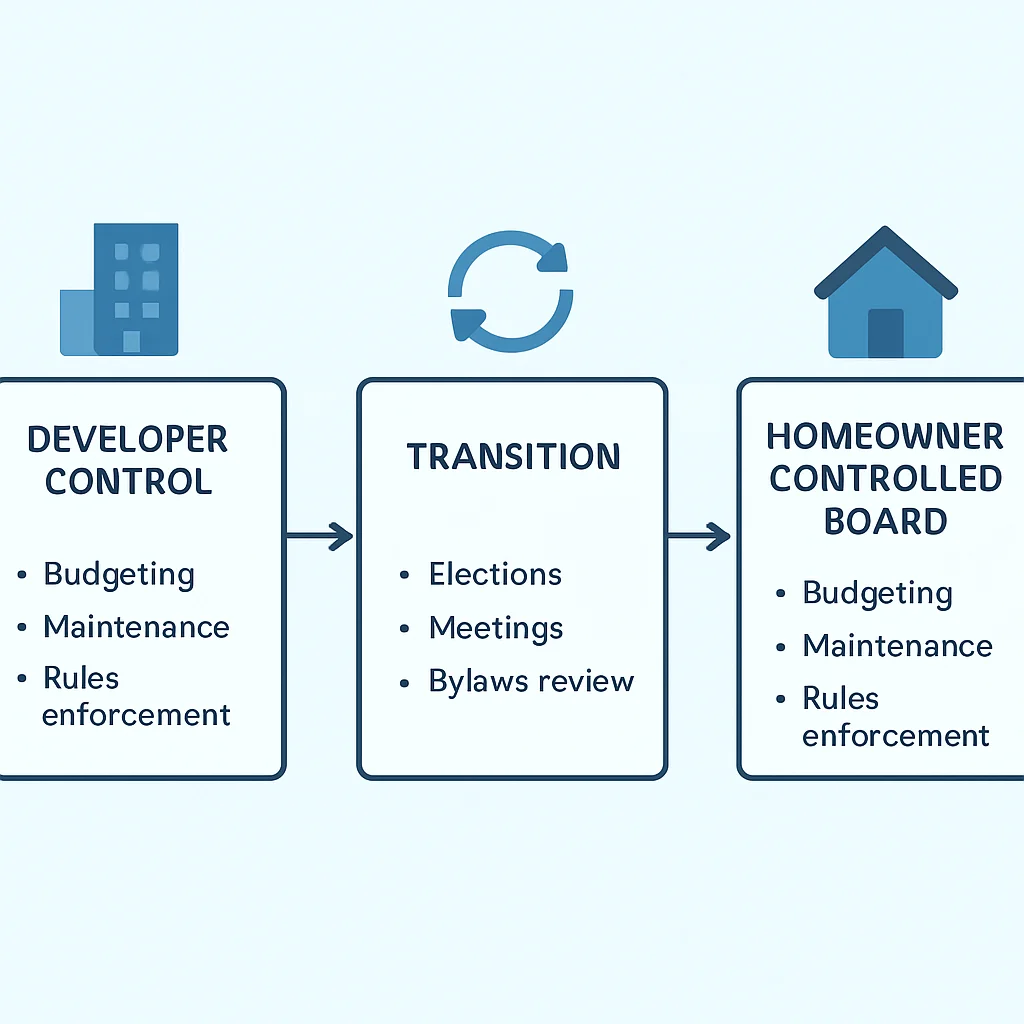
Developer Control Period
Initially, the developer controls the HOA board. This “developer control period” allows the developer to complete construction, market properties, and ensure the community’s initial operations align with their vision. State laws dictate the duration and conditions for this period, often tied to a percentage of units sold (e.g., 75% of units sold, or a specific number of years, whichever comes first). During this time, developers must:
- Act Fiduciarily: Despite control, the developer has a fiduciary duty to act in the best interest of the association and its members.
- Maintain Transparency: Keep accurate financial records and provide them to homeowners upon request.
- Fund Reserves Appropriately: Ensure sufficient funds are collected for reserves, even during the control period, to avoid large special assessments immediately after transition.
Transition to Homeowner Control
The transition from developer to homeowner control is a critical phase. A smooth transition involves:
- Handover of Documents: Providing all legal, financial, and architectural documents to the new homeowner-controlled board.
- Common Area Inspection: Conducting a thorough inspection of common areas and amenities, often with an independent engineer, to identify any construction defects or warranty issues.
- Financial Reconciliation: A clear accounting of all funds, including operating and reserve accounts.
Poor transitions are a common source of developer-HOA disputes. Homeowners often discover underfunded reserves or construction defects after the developer has relinquished control, leading to costly litigation. For instance, in 2026, many states have specific statutory requirements for transition, including deadlines and required disclosures. For example, Florida’s Condominium Act (Chapter 718, Florida Statutes) has detailed provisions for developer turnover.
Avoiding Common Pitfalls
Developers should proactively address potential issues:
- Underfunding Reserves: This is a major issue. While it might make initial assessments lower and properties more attractive, it inevitably leads to large special assessments later, harming the community’s reputation.
- Construction Defects: Ensure quality construction and address any defects promptly during the warranty period.
- Lack of Communication: Maintain open and honest communication with early homeowners, even during the control period.
KEY POINT
Developers are critical in establishing HOA frameworks, managing the control period, and executing a smooth transition. Proactive planning, clear documentation, and adequate reserve funding are essential to prevent future disputes.
7. Real-World Scenarios: Navigating Common Disputes
Even with the best intentions and clear documents, disputes can arise. Understanding how these common scenarios typically unfold and how to approach resolution is key to harmonious community living.
Case 1: Unapproved Architectural Modification
A homeowner installs a new fence that doesn’t match the community’s approved style or height, without seeking prior ARC approval.
Resolution: The HOA would typically send a formal violation notice, detailing the specific rule violated and providing a deadline for correction (e.g., 30 days). If the homeowner fails to comply, fines may be levied, and ultimately, the association could pursue legal action to compel removal or modification. The homeowner’s best course of action is to respond promptly, attempt to rectify the situation, or appeal the decision if they believe they have grounds.
Case 2: Rental Cap Violation
An investor purchases a condo unit with the intention to rent it out, but the condo association has reached its 20% rental cap, and there’s a waiting list.
Resolution: The investor would be unable to rent their unit until a spot opens on the waiting list. This highlights the importance of due diligence. The investor should have obtained an estoppel certificate or reviewed the association’s rental policies and current rental occupancy rates prior to purchase. If the investor proceeds to rent the unit, the association could impose fines, suspend voting rights, or even pursue legal injunctions. Some states, like California (Civil Code §4740), have specific rules regarding rental restrictions and their enforceability against existing owners.
Case 3: Disputed Special Assessment
The HOA board votes for a $5,000 special assessment per household to cover unexpected repairs to the community’s private road, but some homeowners believe the board mismanaged funds or that the repair isn’t urgent.
Resolution: Homeowners can request to review the association’s financial records, meeting minutes, and bids for the repair project to verify the necessity and cost. They can attend board meetings to voice concerns. If a significant number of homeowners are dissatisfied, they might petition for a special meeting to discuss the assessment or even recall board members. Ultimately, if a resolution cannot be reached internally, homeowners may seek mediation or legal counsel. The board, in turn, must demonstrate it acted within its fiduciary duty and followed proper procedures as outlined in the Bylaws for approving such assessments.
Case 4: Developer Transition Disputes
After the developer hands over control to the homeowner board, the new board discovers significant structural defects in the clubhouse roof and an underfunded reserve account, requiring a substantial special assessment.
Resolution: This is a complex legal issue. The homeowner board would typically engage an attorney specializing in construction defect litigation and HOA law. They would conduct a forensic audit of the association’s finances and an independent engineering inspection of the common elements. Legal action against the developer for breach of warranty, breach of fiduciary duty, or statutory violations (e.g., failure to adequately fund reserves as required by state law) is common. Developers must be prepared for this possibility by ensuring quality construction, proper reserve funding, and thorough documentation during the control and transition phases. States like Nevada (NRS 116.3108) have specific timelines for construction defect claims.
KEY POINT
Common disputes include architectural violations, rental restrictions, and special assessments. For developers, post-transition issues like construction defects or underfunded reserves are high-risk. Proactive communication and robust legal counsel are vital for all parties.
8. Caveats and Important Considerations
Navigating HOA and condo rules requires diligence and an understanding of several critical caveats:
State and Local Laws Vary Significantly
The legal framework governing HOAs and condo associations is primarily state-specific. What is permissible in California (e.g., Davis-Stirling Act for HOAs) might differ in New York (e.g., Condominium Act). Always consult with legal professionals familiar with the laws in your specific jurisdiction. These laws dictate everything from meeting requirements to lien processes and construction defect statutes of limitations.
The Importance of Legal Counsel
Whether you are drafting governing documents as a developer, interpreting complex rules as a homeowner, or involved in a dispute, competent legal counsel is invaluable. An experienced attorney specializing in community association law can help you understand your rights, obligations, and the best course of action. This is not an area for DIY legal work.
Due Diligence is Non-Negotiable
Before purchasing any property in a community association, obtain and thoroughly review all governing documents, financial statements (especially reserve studies), and recent meeting minutes. This provides a comprehensive picture of the association’s health, potential future costs, and any ongoing issues. For developers, this means meticulously drafting these documents and ensuring they comply with all relevant statutes.
Rules Can Change
Governing documents are not static. While CC&Rs are harder to amend, Bylaws and Rules & Regulations can be updated by the board or through homeowner votes. Stay informed by attending meetings and reviewing communications from your association. What was allowed last year might not be in 2026.
WARNING
Always seek legal advice from an attorney specializing in community association law in your specific jurisdiction. General advice cannot substitute for tailored legal counsel due to varying state laws.
Frequently Asked Questions (FAQ)
Q. What is the difference between an HOA and a Condo Association?
A. HOAs typically govern planned communities with individually owned homes and shared common amenities, while Condo Associations manage condominium buildings where individual units are owned and all structural and exterior elements are common property shared by all owners.
Q. Can an HOA really foreclose on my home if I don’t pay dues?
A. Yes, in most U.S. states, HOAs and Condo Associations have the legal power to place a lien on your property for unpaid assessments and can proceed with foreclosure, even if your mortgage is current. The specific process and timelines vary by state law.
Q. What documents should I review before buying into an HOA or condo?
A. You should meticulously review the Covenants, Conditions, and Restrictions (CC&Rs), Bylaws, Rules & Regulations, recent financial statements (including reserve studies), and meeting minutes. It’s advisable to do this with legal counsel.
Q. As a developer, what is my biggest risk when establishing a new HOA?
A. One of the biggest risks for developers is underfunding the association’s reserve accounts or failing to disclose construction defects. This can lead to significant financial liability and costly litigation from homeowners after the transition to homeowner control.
Thanks for reading
Navigating the world of HOAs and Condo Associations can seem daunting, but with the right knowledge and proactive approach, it becomes a manageable aspect of property ownership and development. By understanding the governing documents, financial obligations, and potential pitfalls, you can ensure a smoother experience and protect your investments in 2026 and beyond.
Got questions? Drop a comment below or connect with us at Kwonglish.com for more insights into real estate and legal matters.