
SUMMARY
Stock Options & RSUs for Developers: Maximizing Your Equity Compensation in 2026
This guide provides developers with a comprehensive understanding of stock options and Restricted Stock Units (RSUs) and how to maximize their equity compensation to build significant wealth.
Keywords: Stock Options, RSUs, Equity Compensation
TABLE OF CONTENTS
1 Overview: Why Equity Compensation Matters
2 Understanding Equity Compensation: Stock Options vs. RSUs
3 Key Terms and Concepts
4 Tax Implications of Stock Options and RSUs in 2026
5 Strategies for Maximizing Your Equity
6 Real-World Scenarios and Examples
7 Common Pitfalls and How to Avoid Them
8 Frequently Asked Questions (FAQ)
OVERVIEW
Why Equity Compensation Matters for Developers
Hello, Kwonglish readers! As a developer in 2026, your compensation package likely includes more than just a base salary. In the competitive tech industry, companies often provide equity compensation in the form of stock options or Restricted Stock Units (RSUs) to attract and retain top talent. For many, this equity can represent a significant portion of their total compensation and, if managed correctly, can be a powerful tool for building substantial long-term wealth.
However, understanding the nuances of stock options and RSUs, especially their tax implications and strategic management, can feel like learning a new programming language. It’s complex, often filled with jargon, and the rules can change. That’s why I’ve created this comprehensive guide: to demystify equity compensation for developers like you, providing practical, trustworthy information to help you maximize your financial potential in 2026 and beyond.
“Understanding your equity compensation isn’t just about reading a document; it’s about actively strategizing to convert potential wealth into real financial security.”
— Kwonglish
Many developers, especially those early in their careers or joining fast-growing startups, might underestimate the value of their equity or mishandle it due to a lack of clear information. This guide aims to change that. We’ll break down the types of equity, explain the critical terminology, walk through the tax consequences you need to be aware of in 2026, and share actionable strategies to help you make informed decisions. Remember, while this guide provides general financial information, it’s always wise to consult with a qualified financial advisor or tax professional for personalized advice.
KEY POINT
Equity compensation can represent 20% to 50% (or even more) of a developer’s total compensation package, especially at high-growth tech companies. Ignoring it is leaving money on the table.
CORE GUIDE
Understanding Equity Compensation: Stock Options vs. RSUs
Let’s dive into the two most common forms of equity compensation you’ll encounter as a developer: Stock Options and Restricted Stock Units (RSUs). While both aim to align your interests with the company’s success, they function very differently, especially concerning their value and tax treatment.
Stock Options: The “Option” to Buy
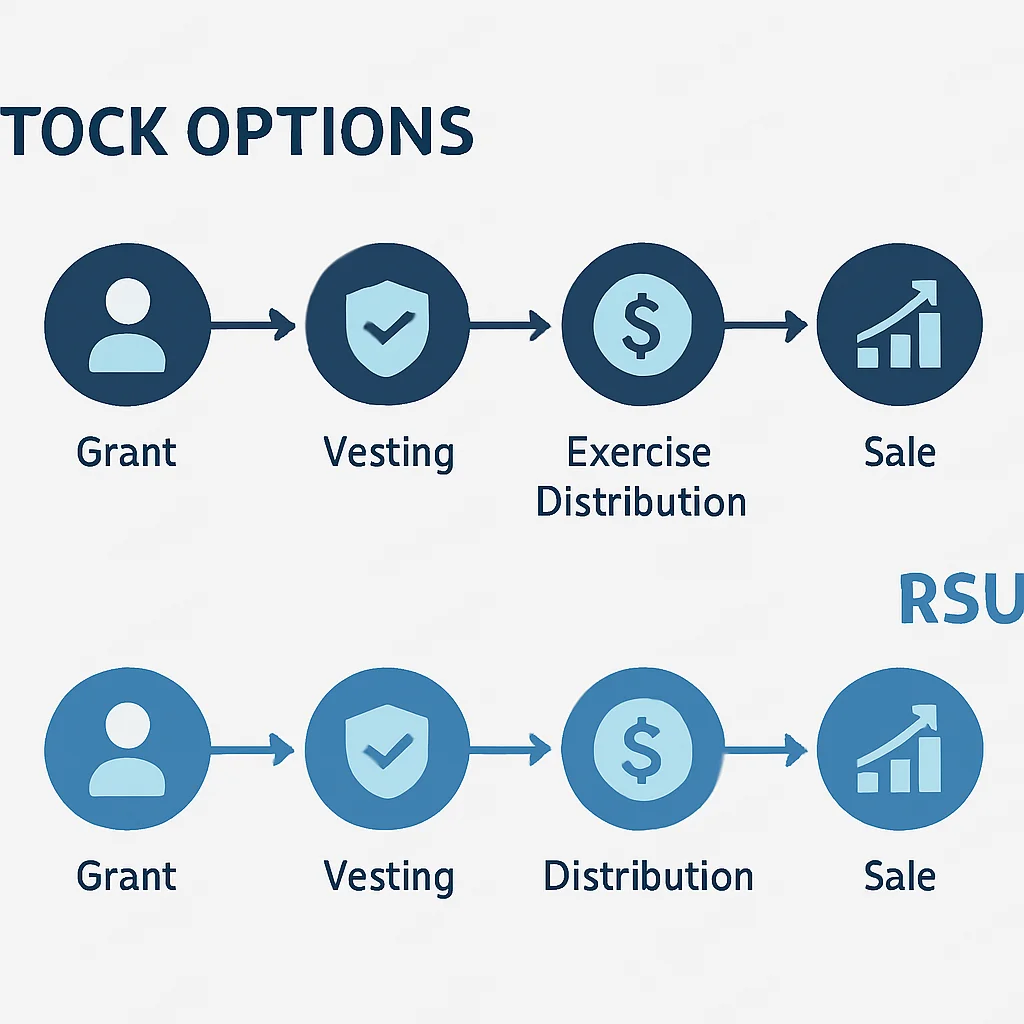
Stock options give you the right, but not the obligation, to purchase a certain number of company shares at a predetermined price (called the strike price or exercise price) within a specific timeframe. You don’t own the stock until you “exercise” your options, meaning you pay the strike price to buy the shares.
There are two main types of stock options:
Types of Stock Options
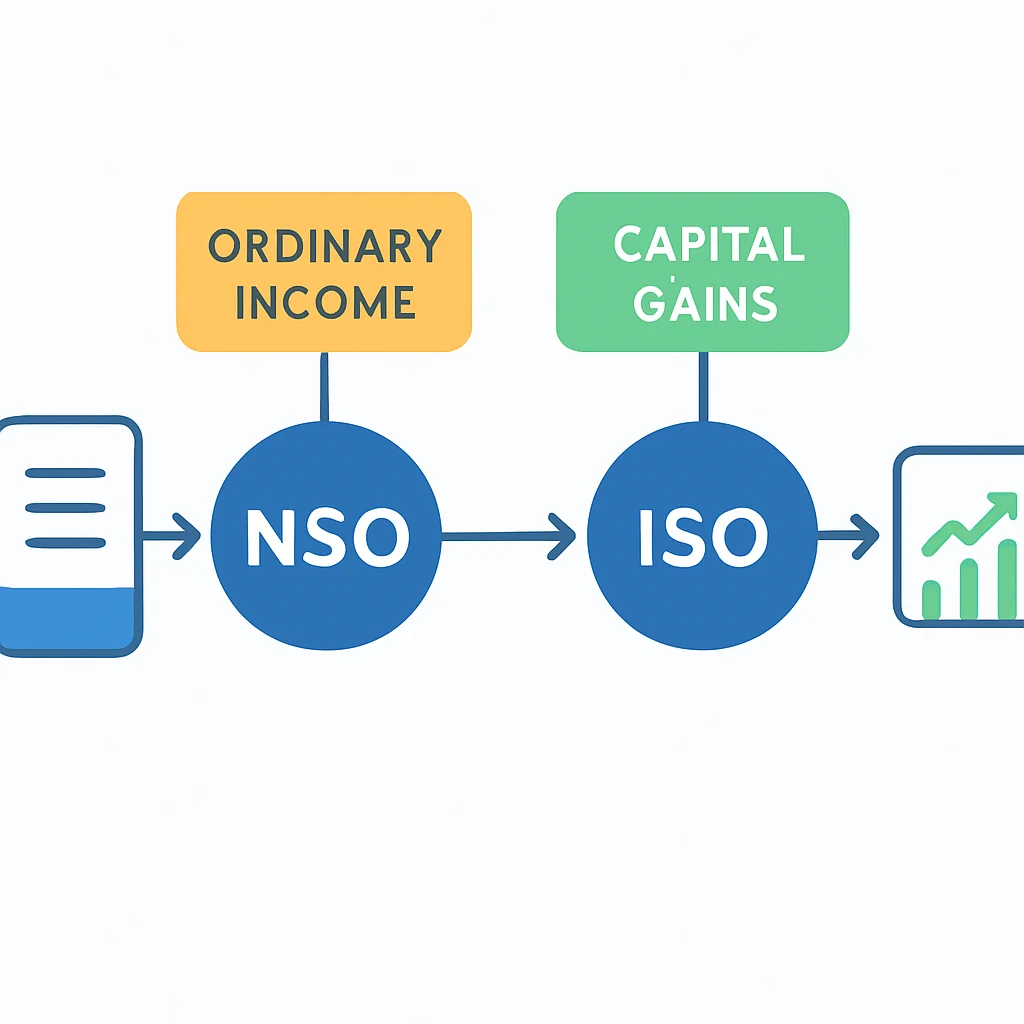
1. Incentive Stock Options (ISOs) — Primarily offered by private companies or early-stage public companies. They can offer significant tax advantages if specific IRS rules are met, primarily by allowing the gain to be taxed at capital gains rates rather than ordinary income rates. However, they can trigger the Alternative Minimum Tax (AMT) upon exercise.
2. Non-Qualified Stock Options (NSOs) — More common, especially at public companies. They are simpler from a tax perspective but generally less tax-advantaged. The difference between the strike price and the Fair Market Value (FMV) at exercise is taxed as ordinary income.
KEY POINT
With stock options, you only profit if the company’s stock price rises above your strike price. If the stock falls below the strike price, your options are “underwater” or “out-of-the-money” and have no intrinsic value.
Restricted Stock Units (RSUs): Actual Shares, Later
RSUs are promises from your company to give you shares of the company’s stock (or the cash equivalent) once certain conditions are met, typically a vesting schedule. Unlike stock options, you don’t have to pay a strike price to acquire the shares; they are simply given to you once they vest.
RSUs are generally considered less risky than stock options because they always have value as long as the company’s stock has value. Even if the stock price drops, the shares you receive upon vesting still hold their current market value, whereas stock options could become worthless if the market price falls below your strike price.
“RSUs are like deferred compensation in company stock; once they vest, they become your property, subject to ordinary income tax.”
— Financial Planning Insights
Many larger, publicly traded tech companies prefer RSUs because they are simpler for employees to understand and generally have more predictable tax outcomes. They also reduce the risk of employees holding “underwater” options, which can be demotivating.
ESSENTIALS
Key Terms and Concepts
Before we delve deeper into tax strategies, it’s crucial to have a solid grasp of the terminology. These terms are fundamental to understanding your equity compensation statement and making informed decisions.
The ABCs of Equity Compensation
Critical Terminology
Grant Date — The date your company officially grants you stock options or RSUs. This is often the date you start employment or receive a promotion.
Vesting Schedule — The timeline over which your equity compensation becomes truly yours. A common schedule is “4-year vesting with a 1-year cliff,” meaning you receive no equity if you leave before 1 year, and then a percentage vests each month/quarter for the remaining 3 years. For example, 25% vests after year 1, and then 1/48th of the total grant vests each month for the next 36 months.
Cliff — The initial period (e.g., 1 year) before any portion of your equity vests. If you leave before the cliff, you forfeit all granted equity.
Strike Price (Exercise Price) — For stock options, this is the fixed price per share at which you can buy the company’s stock, regardless of its current market value. This is typically set at the Fair Market Value (FMV) on the grant date.
Fair Market Value (FMV) — The current market price of one share of your company’s stock. For public companies, this is the trading price. For private companies, it’s determined by a 409A valuation, usually conducted annually.
Exercise — The act of purchasing shares by paying the strike price for your vested stock options. You then become the legal owner of those shares.
Expiration Date — The final date by which you must exercise your stock options. This is typically 7-10 years from the grant date, or often 90 days after leaving the company (though this can vary, so check your plan document).
Spread — The difference between the Fair Market Value (FMV) of the stock and your strike price at the time of exercise. This is the intrinsic value of your options.
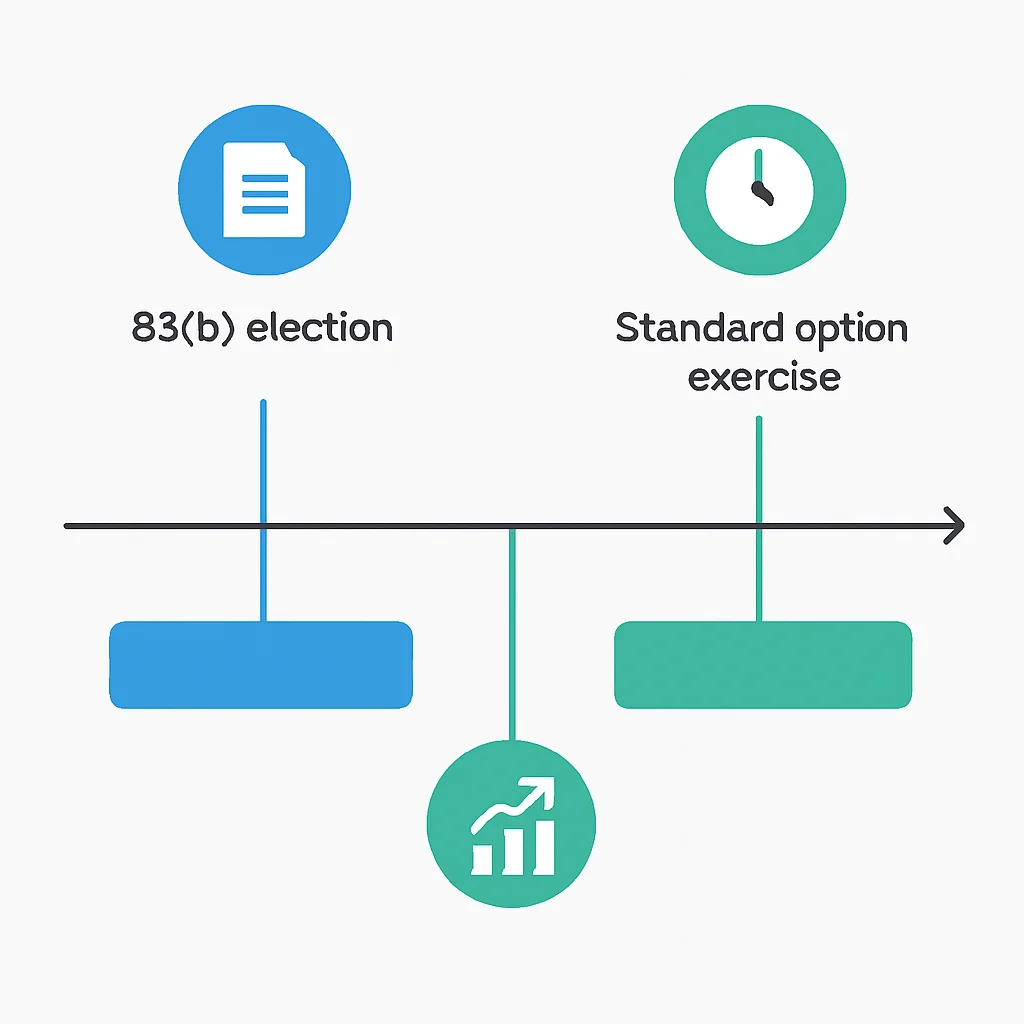
83(b) Election — An IRS election that allows you to pay taxes on the fair market value of your restricted stock (or early-exercised stock options) at the time of grant, rather than at vesting. This can be highly advantageous if the stock is expected to appreciate significantly.
Alternative Minimum Tax (AMT) — A supplementary income tax imposed by the United States federal government on certain high-income earners. It can be triggered by the “paper gain” from exercising ISOs.
KEY POINT
Always read your company’s stock plan document. It contains the definitive rules, vesting schedules, exercise windows, and post-termination policies that govern your specific equity grants.
TAXATION
Tax Implications of Stock Options and RSUs in 2026
This is where things get tricky, but also where smart planning pays off. The tax treatment of equity compensation is complex and varies significantly between NSOs, ISOs, and RSUs. Understanding these differences is crucial for effective financial planning in 2026.
Non-Qualified Stock Options (NSOs) Tax Treatment
NSOs are generally the most straightforward from a tax perspective:
- Grant Date: No taxable event.
- Exercise Date: The “spread” (FMV at exercise minus strike price) is taxed as ordinary income. This amount is added to your W-2 wages, subject to federal, state, Social Security, and Medicare taxes. Your company will typically withhold taxes at this point.
- Sale Date: When you sell the shares, any gain or loss from the FMV at exercise to the sale price is taxed as a capital gain or loss. This gain is short-term if you hold the shares for one year or less after exercise, and long-term if held for more than one year.
CODE EXPLANATION
This example calculates the ordinary income tax event upon exercising NSOs based on a hypothetical scenario.
# NSO Tax Calculation Example (simplified for illustration)
strike_price = 10.00  # Price per share at grant
fmv_at_exercise = 50.00  # Fair Market Value per share at exercise
num_shares = 1000

ordinary_income_per_share = fmv_at_exercise - strike_price
total_ordinary_income = ordinary_income_per_share * num_shares

print(f"Strike Price: ${strike_price:.2f}")
print(f"FMV at Exercise: ${fmv_at_exercise:.2f}")
print(f"Number of Shares: {num_shares}")
print(f"Ordinary Income per Share: ${ordinary_income_per_share:.2f}")
print(f"Total Ordinary Income (Taxable Event): ${total_ordinary_income:.2f}")

# Assuming a 30% combined federal/state ordinary income tax rate
estimated_tax_on_exercise = total_ordinary_income * 0.30
print(f"Estimated Tax on Exercise (30% rate): ${estimated_tax_on_exercise:.2f}")

# If you sell shares later at $60.00
sale_price = 60.00
cost_basis = fmv_at_exercise # Your new cost basis is the FMV at exercise
capital_gain_per_share = sale_price - cost_basis
total_capital_gain = capital_gain_per_share * num_shares
print(f"Sale Price: ${sale_price:.2f}")
print(f"Total Capital Gain: ${total_capital_gain:.2f}")
# This capital gain would be taxed at short-term or long-term rates
Incentive Stock Options (ISOs) Tax Treatment
ISOs offer potential long-term capital gains rates, but come with a significant catch: the Alternative Minimum Tax (AMT).
- Grant Date: No taxable event.
- Exercise Date: No ordinary income tax. However, the “spread” (FMV at exercise minus strike price) is considered an AMT preference item. This means it’s added back to your income solely for AMT calculation purposes. If your income is high enough, or your spread is large enough, you might owe AMT. This is a “phantom income” tax – you pay tax on a gain you haven’t realized in cash.
- Sale Date: To qualify for preferential long-term capital gains rates, you must meet two conditions:
- You sell the shares at least two years from the grant date.
- You sell the shares at least one year from the exercise date.
If both conditions are met, the entire gain (sale price minus strike price) is taxed at long-term capital gains rates. If not, a portion of the gain is “disqualifying disposition” and taxed as ordinary income.
WARNING
The Alternative Minimum Tax (AMT) for ISOs can be a huge trap. It can result in a substantial tax bill without any cash to pay for it, potentially forcing you to sell shares prematurely. Always consult a tax professional before exercising ISOs, especially if the spread is large.
Restricted Stock Units (RSUs) Tax Treatment
RSUs are generally simpler and more predictable:
- Grant Date: No taxable event.
- Vesting Date: This is the primary taxable event. The full Fair Market Value (FMV) of the shares on the vesting date is taxed as ordinary income. This amount is added to your W-2 wages and is subject to federal, state, Social Security, and Medicare taxes. Your company will typically withhold taxes by selling a portion of your vested shares (a “sell-to-cover” transaction).
- Sale Date: When you sell the shares, any gain or loss from the FMV at vesting to the sale price is taxed as a capital gain or loss. Your cost basis for these shares is the FMV on the vesting date. This gain is short-term if you hold the shares for one year or less after vesting, and long-term if held for more than one year.
KEY POINT
For RSUs, the vesting date is your key tax trigger. The value of the shares at vesting is treated just like cash income, and taxes are typically withheld automatically, reducing the number of shares you actually receive.
STRATEGIES
Strategies for Maximizing Your Equity
Now that you understand the basics and tax implications, let’s explore actionable strategies to maximize the value of your equity compensation.
1. Early Exercise with 83(b) Election (for Stock Options, especially private companies)
If you have stock options, particularly with a private company where the current FMV is low or equal to your strike price, an 83(b) election can be incredibly powerful. It allows you to pay taxes on the FMV of your shares at the time of exercise (even if they’re unvested) rather than at vesting. Why is this good?
- Lower Taxable Income: If the FMV is low (e.g., $0.01 per share), your initial tax bill will be minimal.
- Start Capital Gains Clock Early: The long-term capital gains holding period (over one year) starts from your exercise date, not your vesting date. This means future appreciation could be taxed at lower long-term capital gains rates.
- Avoid Ordinary Income on Appreciation: All future appreciation above the FMV at election is treated as capital gains, avoiding ordinary income tax on that growth.
WARNING
An 83(b) election is irrevocable and must be filed with the IRS within 30 days of your grant/exercise date. If your company fails or the stock value drops, you’ve paid taxes on shares that might become worthless. This is a high-risk, high-reward strategy for early-stage companies.
2. Diversification and Selling Strategies
Once your equity vests (RSUs) or you exercise (options), you own company stock. A common mistake is holding onto too much of it, leading to a highly concentrated portfolio. Financial advisors often recommend that no more than 10-20% of your net worth should be tied to a single company’s stock, especially your employer’s.
Consider these strategies:
- Sell-to-Cover (Automatic for RSUs): Your company often automatically sells enough shares to cover the tax withholding upon RSU vesting. This is the simplest option, but it means you immediately diversify by only receiving the net shares.
- Sell-All and Diversify: For many, especially with RSUs, the best strategy is often to sell all vested shares immediately and reinvest the proceeds into a diversified portfolio (e.g., index funds, ETFs). This minimizes company-specific risk and allows you to control your asset allocation.
- Hold for Long-Term Capital Gains (for Options): If you believe in the long-term prospects of your company and have met the holding period for ISOs, you might hold shares for over a year after exercise to qualify for lower long-term capital gains rates. This strategy carries more risk.
- Dollar-Cost Averaging Out: Instead of selling all at once, you could sell a fixed dollar amount or percentage of shares at regular intervals (e.g., monthly or quarterly) to smooth out market fluctuations and reduce emotional decision-making.
KEY POINT
Your company’s stock is not a diversified investment. While it’s great to be an owner, actively diversifying your wealth is crucial for long-term financial security.

3. Tax Loss Harvesting
If you’ve held shares from your equity compensation (after vesting/exercise) and their value has dropped, you might be able to use tax loss harvesting. This involves selling investments at a loss to offset capital gains and, potentially, a limited amount of ordinary income (up to $3,000 per year). This can be particularly useful if you have other capital gains from other investments.
4. Integrate with Your Overall Financial Plan
Don’t view equity compensation in isolation. It should be a part of your broader financial strategy:
- Emergency Fund: Ensure you have 3-6 months of living expenses saved in cash before making aggressive equity decisions.
- Retirement Accounts: Maximize contributions to your 401(k), IRA, or Roth IRA. The tax advantages here are often more predictable and powerful than trying to optimize every equity move.
- Debt Management: Use equity proceeds to pay down high-interest debt.
- Future Goals: Align your equity strategy with short-term goals (e.g., down payment on a house) and long-term goals (e.g., early retirement).
REAL-WORLD
Real-World Scenarios and Examples
Let’s look at some hypothetical examples to illustrate how these concepts play out in practice. Assume all examples are for a developer in 2026, subject to a combined federal and state ordinary income tax rate of 35% and a long-term capital gains rate of 15%.
Scenario 1: RSU Vesting and Immediate Sale
Case: Alex’s RSU Vesting
Alex, a senior developer, has 1,000 RSUs vesting. The FMV on the vesting date is $100 per share.
Breakdown:
- Taxable Income: 1,000 shares * $100/share = $100,000. This is added to Alex’s ordinary income.
- Tax Withholding: At a 35% ordinary income tax rate, approximately $35,000 in taxes ($100,000 * 0.35) will be withheld. This usually means 350 shares are sold to cover taxes, and Alex receives 650 shares.
- Net Shares Received: 650 shares.
- Immediate Sale: Alex decides to immediately sell all 650 shares. Since there’s no price change between vesting and immediate sale, there is no additional capital gain or loss. Alex receives $65,000 cash (650 shares * $100/share) after taxes, which can then be diversified.
Scenario 2: NSO Exercise and Long-Term Hold
Case: Ben’s NSO Strategy
Ben has 2,000 NSOs with a strike price of $10. The FMV at exercise is $60 per share. Ben exercises and holds the shares for 18 months before selling.
Breakdown:
- Exercise Cost: 2,000 shares * $10/share = $20,000.
- Ordinary Income at Exercise: (FMV $60 – Strike $10) * 2,000 shares = $100,000. This is added to Ben’s W-2 income.
- Tax on Ordinary Income: $100,000 * 0.35 = $35,000. Ben needs to have funds available for this tax bill.
- Cost Basis: Ben’s cost basis for the shares becomes the FMV at exercise, $60 per share.
- Sale after 18 Months: Assume Ben sells the shares at $80 per share after 18 months.
- Capital Gain: ($80 Sale Price – $60 Cost Basis) * 2,000 shares = $40,000. Since Ben held the shares for 18 months (more than 1 year after exercise), this is a long-term capital gain.
- Tax on Capital Gain: $40,000 * 0.15 = $6,000.
KEY POINT
For NSOs, remember to account for the ordinary income tax at exercise. If you don’t have the cash to pay the taxes, you might need to do a “cashless exercise” where some shares are immediately sold to cover the exercise cost and taxes.
Scenario 3: ISO Exercise and AMT Consideration
Case: Carla’s ISO Dilemma
Carla has 5,000 ISOs with a strike price of $5. The FMV at exercise is $40 per share. Carla exercises all 5,000 shares.
Breakdown:
- Exercise Cost: 5,000 shares * $5/share = $25,000.
- AMT Adjustment: (FMV $40 – Strike $5) * 5,000 shares = $175,000. This $175,000 is an AMT preference item.
- Potential AMT: If Carla’s other income and deductions are such that this $175,000 pushes her into AMT territory, she could owe significant taxes (e.g., 26-28% AMT rates) even though she hasn’t sold the shares. For instance, if her AMT liability increases by $40,000, she’d need to pay that from other funds.
- Holding Period: To get long-term capital gains, Carla must hold the shares for at least two years from the grant date AND one year from the exercise date. If she sells before these periods, it’s a “disqualifying disposition,” and a portion of the gain is taxed as ordinary income.
- Sale after Qualifying Period: If Carla sells the shares at $60 after meeting the holding periods, the entire gain ($60 Sale Price – $5 Strike Price) * 5,000 shares = $275,000 would be taxed at the long-term capital gains rate (15%), resulting in $41,250 in taxes. The AMT paid earlier might be partially recovered as an AMT credit.
WARNING
The AMT is notoriously complex. Do not exercise a large number of ISOs without consulting a tax advisor who can run a detailed AMT calculation for your specific situation. The tax bill can be substantial and unexpected.
CAVEATS
Common Pitfalls and How to Avoid Them
Even with a solid understanding, it’s easy to make mistakes. Here are some common pitfalls developers fall into and how to steer clear of them:
1. Ignoring the “Expiration Date”
Stock options have a finite life. Forfeiting valuable options because you missed the exercise window (especially after leaving a company, where the window can shrink to 90 days) is a costly error. Set reminders, understand your plan document, and plan your exercise well in advance.
2. Over-Concentration in Company Stock
It feels good to be loyal to your company, but putting too many eggs in one basket is risky. If your company faces a downturn, your job, your future equity, and your existing shares could all be negatively impacted. Diversify your holdings as soon as financially prudent.
3. Neglecting Tax Planning
The biggest pitfall is often the unexpected tax bill. Whether it’s the ordinary income from NSO exercise/RSU vesting or the dreaded AMT from ISOs, failing to set aside funds for taxes can lead to forced sales or financial strain. Always understand the tax implications before the taxable event occurs.
WARNING
Never assume your company’s payroll department will automatically handle all your equity tax obligations perfectly. While they do withhold, you are ultimately responsible for accurate reporting and payment to the IRS.
4. Emotional Decision Making
The stock market is volatile, and it’s easy to get caught up in the hype or panic. Stick to a predetermined plan for exercising and selling. Don’t let fear of missing out (FOMO) or fear of loss dictate your financial decisions.
5. Not Consulting Professionals
While this guide provides a strong foundation, it cannot replace personalized advice. A qualified financial advisor can help integrate your equity into your overall financial plan, and a tax professional can ensure compliance and identify potential tax-saving strategies specific to your situation. This is especially true for complex ISO situations or large equity grants.
KEY POINT
The cost of professional financial and tax advice is often a small fraction of the potential gains or avoided losses from properly managing your equity compensation.

FAQ
Frequently Asked Questions (FAQ)
Q. What happens to my stock options or RSUs if I leave my company?
A. This depends entirely on your company’s specific plan document. For stock options, you typically have a limited window (often 90 days) to exercise your vested options after termination; otherwise, they are forfeited. Unvested options are usually always forfeited. For RSUs, any unvested units are typically forfeited, and vested units already distributed are yours to keep, subject to any post-employment trading restrictions.
Q. Can I sell my RSUs immediately after they vest?
A. Yes, in most cases, you can sell your RSUs as soon as they vest and are distributed, provided you are not in a company-imposed blackout period. Many employees opt for an immediate sale to diversify their portfolio and avoid further company-specific stock risk.
Q. Is an 83(b) election always a good idea for stock options?
A. No, an 83(b) election carries significant risk. It is generally only considered a good idea if the company’s stock has a very low fair market value at the time of exercise (often in early-stage private companies) and you are confident in the company’s future growth. If the company fails or the stock value drops, you’ve paid taxes on unvested shares that might become worthless, and you cannot revoke the election.
Q. What is the difference between my cost basis for NSOs and ISOs?
A. For NSOs, your cost basis for capital gains calculations is the Fair Market Value (FMV) of the shares on the exercise date, as you’ve already paid ordinary income tax on the spread. For ISOs, if you meet the qualifying disposition rules, your cost basis for capital gains is your original strike price, as the entire gain is taxed at capital gains rates.
WRAP-UP
Key Takeaways for Developers in 2026
Navigating the world of stock options and RSUs can seem daunting, but it’s an essential skill for any developer looking to maximize their total compensation and build significant wealth. By now, you should have a clearer understanding of the differences between these equity types, their tax implications in 2026, and strategic approaches to manage them effectively.
Your Equity Compensation Checklist
☑ Understand if you have Stock Options (NSOs/ISOs) or RSUs.
☑ Know your vesting schedule, strike price, and expiration dates.
☑ Anticipate the tax implications for each type of equity.
☑ Consider diversification to reduce single-company risk.
☑ Plan for tax liabilities (especially AMT for ISOs).
☑ Integrate equity decisions into your broader financial plan.
☑ Consult with a financial advisor or tax professional for personalized advice.
Remember, equity compensation is a dynamic asset. Its value fluctuates, and its tax treatment requires ongoing attention. By staying informed and proactive, you can turn your company’s shares into a powerful engine for your personal financial growth. Happy coding, and even happier wealth building!
Ready to Level Up Your Finances?
We hope this guide empowers you to make smarter decisions about your equity compensation. Your financial future is in your hands – start planning today!
Got more questions about stock options, RSUs, or financial planning for developers? Drop a comment below or share your experiences on Kwonglish.com!
Related Posts
- [Finance & Investing] Cryptocurrency Investing for Developers: A Beginner’s Guide to Digital Assets in 2026
- [Finance & Investing] Smart Debt Management for Developers: Strategies to Pay Off Loans & Credit Cards in 2026
- [Finance & Investing] Smart Tax Strategies for Developers in 2026: Maximize Deductions & Save More