
SUMMARY
Python Backend Frameworks Compared: Django vs. Flask vs. FastAPI in 2026
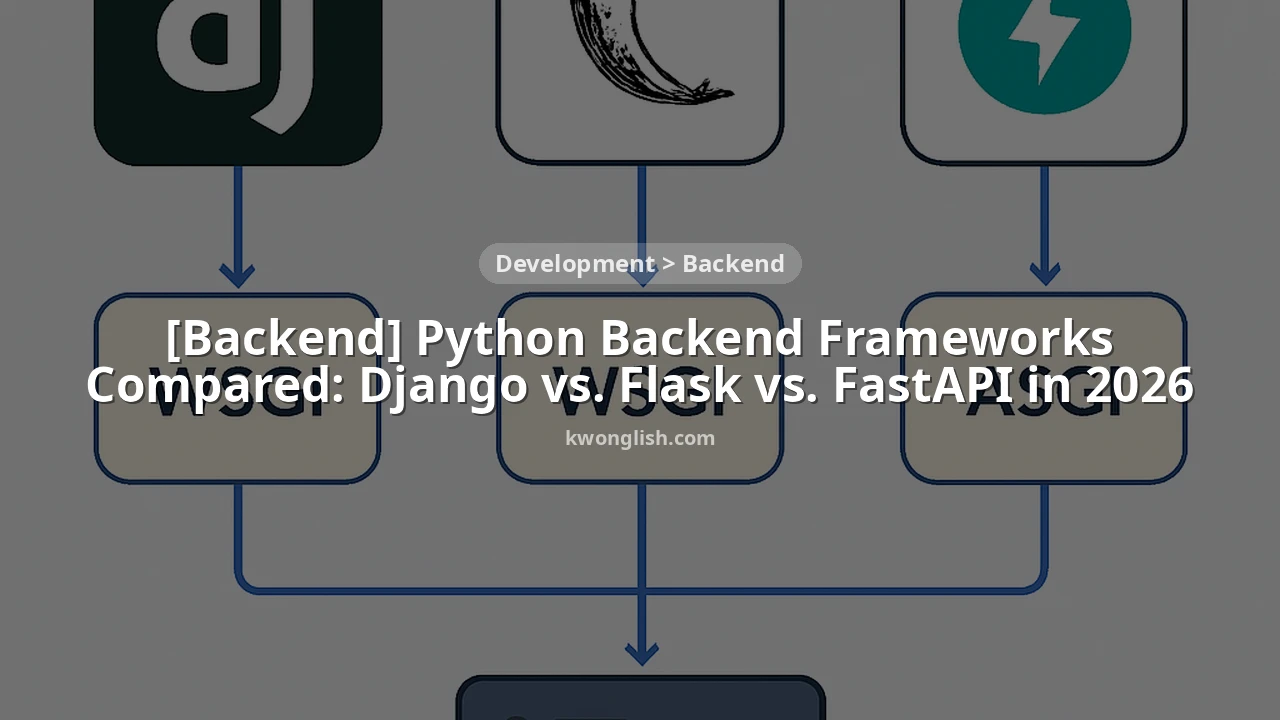
A detailed comparison of Python’s leading backend frameworks — Django, Flask, and FastAPI — covering features, performance, and best use cases for developers in 2026.
Keywords: Django, Flask, FastAPI, Python web frameworks
TABLE OF CONTENTS
1. Introduction: Python’s Backend Landscape in 2026
2. Deep Dive: Framework Philosophies and Core Features
3. Performance and Scalability Analysis
4. Common Challenges and Solutions
5. Practical Application: Choosing the Right Tool for Your Project
6. Frequently Asked Questions (FAQ)
7. Conclusion: The Evolving Python Backend Ecosystem
INTRODUCTION
Python’s Backend Landscape in 2026
As we navigate the dynamic world of web development in 2026, Python continues to hold its ground as a dominant force in backend programming. Its versatility, extensive libraries, and strong community support make it a go-to choice for everything from simple scripts to complex enterprise applications. However, with a plethora of frameworks available, choosing the right one can be a critical decision that impacts a project’s development speed, performance, and long-term maintainability.
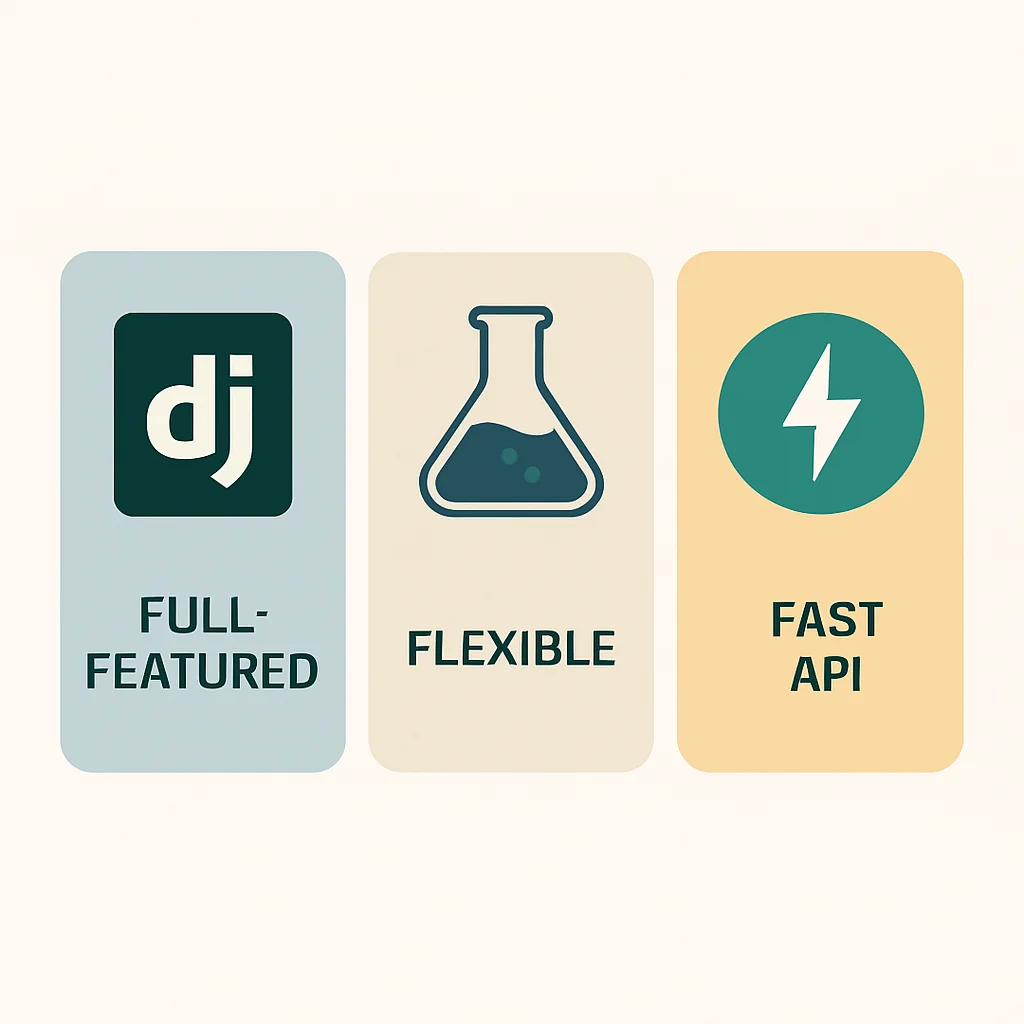
Among the many contenders, three Python web frameworks consistently stand out: Django, Flask, and FastAPI. Each brings a distinct philosophy and set of features to the table, catering to different project requirements and developer preferences. Django, the seasoned veteran, offers a “batteries-included” approach for rapid full-stack development. Flask, the minimalist microframework, provides flexibility and fine-grained control. FastAPI, the modern challenger, excels in building high-performance APIs with native asynchronous support and automatic documentation.
This report aims to provide a comprehensive, in-depth comparison of these three leading frameworks in 2026. We will dissect their core features, analyze their performance characteristics, discuss their scalability potential, and explore their ideal use cases. By the end, you should have a clear understanding of which framework is best suited for your next backend project, whether you’re building a content management system, a microservice, or a data-intensive API.
KEY POINT
The choice between Django, Flask, and FastAPI in 2026 hinges on project scale, performance requirements, and preferred development style. Django offers a full ecosystem, Flask provides maximal flexibility, and FastAPI delivers modern, high-speed API development.
CORE CONTENT
Deep Dive: Framework Philosophies and Core Features
To truly understand these frameworks, we must first grasp their underlying philosophies and the core features they offer out-of-the-box or through well-established extensions. This section provides an overview of each framework’s design principles and a detailed comparison of their key functionalities.
Django: The “Batteries Included” Web Framework
Django, first released in 2005, embodies the “batteries included” philosophy, providing almost everything a developer needs to build complex web applications right out of the box. It follows the Model-View-Template (MVT) architectural pattern, which is a variation of MVC. Its core strengths lie in its robust ORM (Object-Relational Mapper), powerful admin interface, and comprehensive security features.
Django’s design principle emphasizes rapid development and clean, pragmatic design. It encourages the “Don’t Repeat Yourself” (DRY) principle, aiming to minimize redundant code. This makes it highly productive for large-scale, data-driven applications where consistency and maintainability are paramount. For API development, Django REST Framework (DRF) is the de facto standard, extending Django’s capabilities to build powerful, flexible APIs with minimal effort.
Flask: The Lightweight Microframework
In stark contrast to Django, Flask is a microframework, meaning it provides only the bare essentials for web development. It doesn’t include an ORM, database abstraction layer, or form validation out of the box. This minimalist approach gives developers immense flexibility and choice, allowing them to pick and integrate libraries and tools that best fit their specific needs. Flask’s philosophy can be summarized as “explicit is better than implicit,” giving the developer full control.
Flask is built on Werkzeug (a WSGI utility library) and Jinja2 (a templating engine). Its simplicity makes it incredibly easy to learn and get started with, often used for smaller applications, microservices, or custom APIs where overhead needs to be minimal. For more complex features, Flask relies on a rich ecosystem of extensions like Flask-SQLAlchemy for ORM, Flask-WTF for forms, and Flask-RESTful/Flask-RESTx for API building.
FastAPI: The Modern, High-Performance API Framework
FastAPI, a relatively newer player, has rapidly gained popularity since its inception, especially in the context of API development. It leverages modern Python features like type hints (async/await) and builds upon Starlette (for the web parts) and Pydantic (for data validation and serialization). Its primary goal is to provide a framework for building APIs that are both extremely performant and easy to develop, with automatic data validation, serialization, and interactive API documentation (Swagger UI/ReDoc) built-in.
FastAPI’s key advantage is its native support for asynchronous programming, making it highly efficient for I/O-bound tasks typical of web APIs. The use of Pydantic for data models not only ensures data integrity but also generates OpenAPI schema automatically, reducing boilerplate code significantly. This combination makes FastAPI a compelling choice for microservices, data science APIs, and any project where high throughput and clear API contracts are essential.
Feature Comparison Table
Here’s a detailed comparison of key features across Django, Flask, and FastAPI:
| Feature | Django | Flask | FastAPI |
|---|---|---|---|
| Type | Full-stack web framework | Microframework | High-performance API framework |
| ORM / Database | Built-in powerful ORM | SQLAlchemy (via Flask-SQLAlchemy) | SQLModel or SQLAlchemy (async support) |
| Templating Engine | Django Template Language | Jinja2 (built-in) | Jinja2 (via Starlette’s Jinja2Templates) |
| Admin Panel | Built-in, highly customizable | Flask-Admin (extension) | Custom implementation needed |
| Routing | URL patterns in urls.py | Decorator-based (@app.route) | Decorator-based (@app.get, @app.post) |
| Data Validation/Serialization | Django Forms, DRF Serializers | Marshmallow (via extensions) | Pydantic (built-in, automatic) |
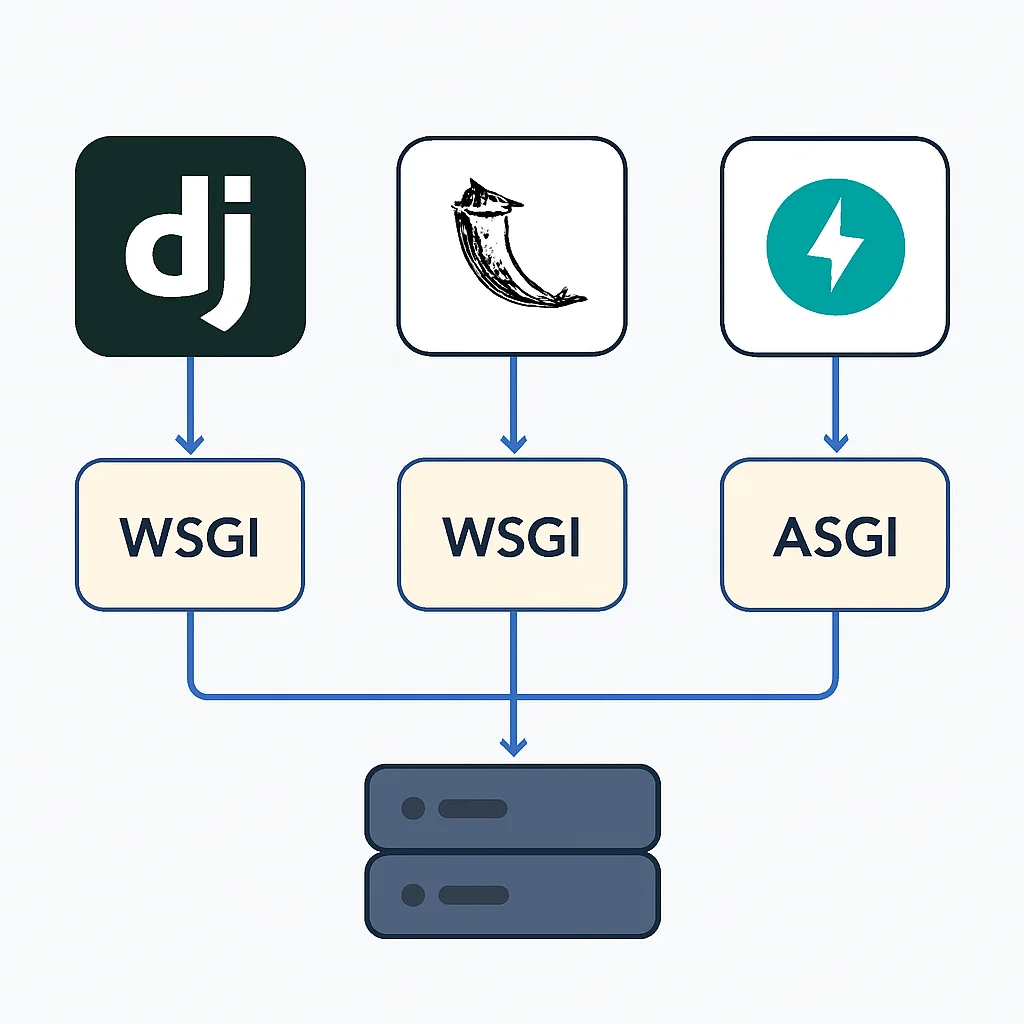
| Asynchronous Support | Limited (async views/ORM in 4.x+), ASGI compatible | WSGI-based, async via ASGI wrappers (e.g., Quart) | Native ASGI, full async/await support |
| API Documentation | DRF Spectacular (extension) | Flask-RESTx (extension) | Built-in OpenAPI (Swagger UI, ReDoc) |
| Learning Curve | Moderate to high (due to opinionated structure) | Low (minimalist core) | Moderate (requires understanding type hints) |
| Community & Ecosystem | Very large, mature, extensive libraries | Large, flexible, many extensions | Rapidly growing, active, modern |
PERFORMANCE & SCALABILITY
Performance and Scalability Analysis
Performance and scalability are often critical factors when selecting a backend framework. While Python itself is not known for raw CPU-bound performance compared to languages like Go or Rust, its frameworks are highly optimized for I/O-bound web tasks. The choice of framework, server, and architecture significantly impacts how many requests per second (RPS) an application can handle and how effectively it can scale.
Understanding Performance Characteristics
Web application performance is typically measured in terms of throughput (RPS), latency, and resource utilization. For Python web frameworks, the underlying server (WSGI for Django/Flask, ASGI for FastAPI) plays a crucial role. Gunicorn and uWSGI are common WSGI servers, while Uvicorn is the leading ASGI server. The nature of the workload (CPU-bound computations vs. I/O-bound database queries/API calls) also dictates performance.
Here’s a general overview of their performance characteristics for a typical I/O-bound API endpoint (e.g., fetching data from a database and returning JSON):
PERFORMANCE INSIGHTS
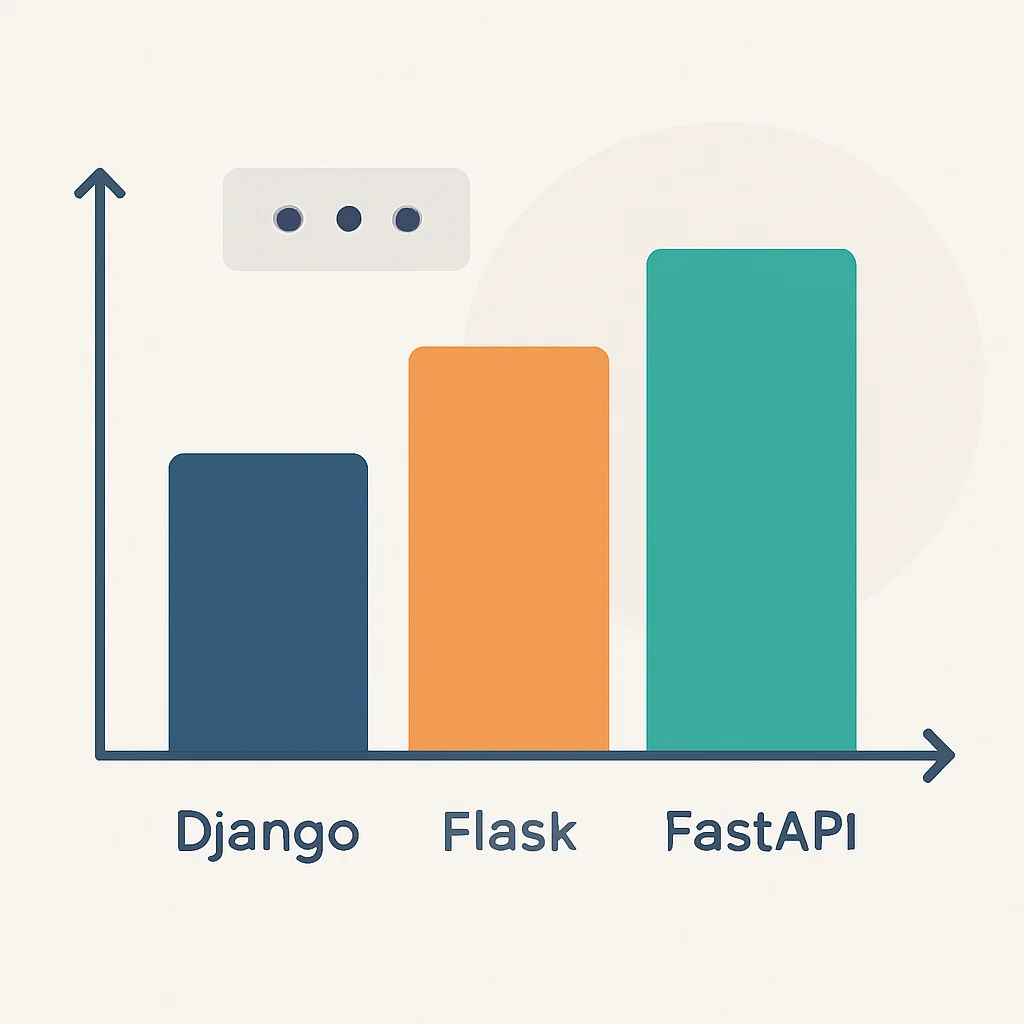
Hypothetical RPS for a Simple JSON API Endpoint (2026 data)
Based on common benchmarks and optimizations, these figures represent typical performance for a simple endpoint without heavy computation, served by their recommended application servers (Uvicorn for FastAPI, Gunicorn for Flask/Django).
FASTAPI — 8,000 – 12,000+ RPS
Leveraging Starlette and Uvicorn with native async/await, FastAPI consistently delivers top-tier performance for I/O-bound tasks. Pydantic’s optimized validation further contributes to its speed.
FLASK — 2,000 – 5,000 RPS
While lightweight, Flask’s synchronous WSGI nature means it’s generally slower than ASGI frameworks for concurrent I/O. Performance can be good with Gunicorn and proper optimization, but it requires more manual effort.
DJANGO (with DRF) — 1,000 – 3,000 RPS
Django’s extensive features and ORM introduce some overhead. While Django 4.x+ has introduced async views and ASGI compatibility, its synchronous core and ORM can still be a bottleneck for raw API throughput compared to FastAPI. Caching and database optimization are key.
Scalability and Concurrency
Scalability refers to an application’s ability to handle increasing loads. All three frameworks can be scaled horizontally by running multiple instances behind a load balancer. However, their approaches to concurrency differ:
Django: Traditionally synchronous (WSGI), meaning each request ties up a worker process/thread until completion. While Django 4.x and 5.x have introduced asynchronous views and ORM methods, the core remains largely synchronous. This means that for highly concurrent I/O-bound tasks, it might require more worker processes than an ASGI framework to achieve similar throughput, consuming more memory. Scaling involves optimizing database queries, utilizing caching (Redis/Memcached), and deploying multiple Gunicorn workers.
Flask: Similar to Django, Flask is WSGI-based and synchronous. It excels at horizontal scaling, often paired with Gunicorn and Nginx. Its minimalist nature can sometimes lead to better resource efficiency than a full-stack framework if developers are careful about what extensions they include. For asynchronous capabilities, developers often turn to libraries like Celery for background tasks or adopt ASGI-compatible frameworks like Quart (a Flask-like ASGI framework).
FastAPI: Built from the ground up on ASGI (Asynchronous Server Gateway Interface), FastAPI is inherently asynchronous. This means a single worker process can efficiently handle many concurrent I/O-bound requests by switching between tasks while waiting for I/O operations to complete. This leads to significantly lower resource consumption (CPU and memory) per request and higher throughput for I/O-heavy workloads. Scaling FastAPI involves running multiple Uvicorn worker processes, often managed by Gunicorn, behind a load balancer.
KEY POINT
For raw API performance and efficient handling of concurrent I/O-bound requests in 2026, FastAPI with its native ASGI support generally outperforms Django and Flask, which traditionally rely on synchronous WSGI architectures (though Django is increasingly supporting async).
PROBLEM SOLVING
Common Challenges and Solutions
No framework is without its quirks or challenges. Understanding these potential roadblocks and knowing how to navigate them is crucial for efficient development. Here, we address common issues faced when working with Django, Flask, and FastAPI.
PROBLEM 01
Django’s Steep Learning Curve and Perceived Monolith
For newcomers, Django’s opinionated structure, extensive ORM, and “magic” behind its components (like the Admin interface) can feel overwhelming. Its full-stack nature can also be perceived as heavy or “monolithic” for projects that only need a simple API.
SOLUTION — Embrace the ecosystem, focus on DRF for APIs
The best way to tackle Django’s learning curve is to embrace its ecosystem. Follow official tutorials, understand the MVT pattern, and leverage its powerful features rather than fighting them. For API-only projects, focus on Django REST Framework (DRF). DRF provides a clear path to building robust APIs, separating concerns effectively and making Django feel less monolithic. It also has excellent documentation and a vast community.
CODE EXPLANATION
A simple Django REST Framework serializer and viewset to quickly expose a model as an API endpoint, demonstrating how DRF simplifies API creation within Django.
# myapp/serializers.py
from rest_framework import serializers
from .models import MyModel

class MyModelSerializer(serializers.ModelSerializer):
    class Meta:
        model = MyModel
        fields = ['id', 'name', 'description']

# myapp/views.py
from rest_framework import viewsets
from .models import MyModel
from .serializers import MyModelSerializer

class MyModelViewSet(viewsets.ModelViewSet):
    queryset = MyModel.objects.all()
    serializer_class = MyModelSerializer

# myproject/urls.py
from django.contrib import admin
from django.urls import path, include
from rest_framework.routers import DefaultRouter
from myapp.views import MyModelViewSet

router = DefaultRouter()
router.register(r'mymodels', MyModelViewSet)

urlpatterns = [
    path('admin/', admin.site.urls),
    path('api/', include(router.urls)),
]
PROBLEM 02
Flask’s Boilerplate for Larger Applications and “Extension Hell”
While Flask’s minimalism is a strength for small projects, it can become a burden for larger applications. Developers often find themselves writing significant boilerplate code for features like authentication, database integration, or form handling. Managing numerous extensions, ensuring compatibility, and maintaining a consistent project structure can also become challenging, sometimes referred to as “extension hell.”
SOLUTION — Use blueprints, well-maintained extensions, and project templates
For larger Flask applications, leverage Blueprints to modularize your application into smaller, manageable components. Stick to well-documented and actively maintained extensions (e.g., Flask-SQLAlchemy, Flask-Login, Flask-Migrate). Consider using established Flask project templates or cookiecutters (like Cookiecutter-Flask) that provide a solid starting structure and pre-configured extensions, reducing initial setup and boilerplate.
CODE EXPLANATION
An example of how Flask Blueprints organize an application into logical modules, making it more scalable and maintainable than a single-file application.
# app.py
from flask import Flask
from .auth import auth_bp
from .api import api_bp

def create_app():
    app = Flask(__name__)
    app.config.from_object('config.Config') # Load configuration

    # Register Blueprints
    app.register_blueprint(auth_bp, url_prefix='/auth')
    app.register_blueprint(api_bp, url_prefix='/api')

    @app.route('/')
    def index():
        return "Welcome to the Flask App!"

    return app

# auth.py (inside app/auth/ folder)
from flask import Blueprint, render_template

auth_bp = Blueprint('auth', __name__, template_folder='templates')

@auth_bp.route('/login')
def login():
    return render_template('login.html')

# api.py (inside app/api/ folder)
from flask import Blueprint, jsonify

api_bp = Blueprint('api', __name__)

@api_bp.route('/data')
def get_data():
    return jsonify({"message": "Data from API"})
PROBLEM 03
FastAPI’s Newer Ecosystem and Reliance on Type Hints
As a relatively newer framework, FastAPI’s ecosystem, while growing rapidly, is not as mature or extensive as Django’s or Flask’s. Finding niche extensions or solutions might sometimes be harder. Additionally, its heavy reliance on Python type hints and Pydantic for data validation can be a new paradigm for developers not accustomed to modern Python practices, requiring an initial mental shift.
SOLUTION — Embrace type hints, leverage Starlette/Pydantic features
The best approach for FastAPI is to fully embrace Python type hints; they are not just for static analysis but are fundamental to how FastAPI works for request parsing, validation, and documentation. Leverage the power of Pydantic for defining complex data models and dependencies for managing common logic. For missing “batteries,” remember FastAPI is built on Starlette, allowing direct use of Starlette’s extensive capabilities (e.g., middlewares, static files, templating) and its growing ecosystem of compatible libraries.
CODE EXPLANATION
This FastAPI example demonstrates defining a Pydantic model for request body validation and using type hints in the path operation function. FastAPI automatically validates the incoming JSON against the Item model.
from fastapi import FastAPI
from pydantic import BaseModel
from typing import Optional

app = FastAPI()

class Item(BaseModel):
    name: str
    description: Optional[str] = None
    price: float
    tax: Optional[float] = None

@app.post("/items/")
async def create_item(item: Item):
    """
    Create a new item with automatic validation using Pydantic.
    """
    item_dict = item.dict()
    if item.tax:
        price_with_tax = item.price + item.tax
        item_dict.update({"price_with_tax": price_with_tax})
    return item_dict

@app.get("/items/{item_id}")
async def read_item(item_id: int, q: Optional[str] = None):
    """
    Retrieve an item by ID.
    """
    return {"item_id": item_id, "q": q}
PRACTICAL APPLICATION
Practical Application: Choosing the Right Tool for Your Project
The “best” framework is always subjective and depends entirely on the specific needs of your project, your team’s expertise, and your desired development speed. Below, we outline ideal use cases for each framework in 2026, along with a simple “Hello World” example to illustrate their basic structure.
Ideal Use Cases
Django: For Complex, Data-Driven Web Applications
Enterprise-grade web applications — Django’s comprehensive nature makes it ideal for large, complex systems like CRMs, ERPs, and internal tools that require robust security, authentication, and database management.
Content Management Systems (CMS) & E-commerce — Its powerful ORM, admin panel, and template engine are perfect for building custom CMS platforms (beyond standard solutions like WordPress) and scalable e-commerce sites.
Rapid development with a full stack — When you need to get a feature-rich application up and running quickly, Django’s “batteries included” approach significantly reduces development time for common functionalities.
Flask: For Microservices, Small APIs, and Custom Web Apps
Microservices architecture — Its lightweight nature and flexibility make Flask an excellent choice for building individual microservices that need to be nimble and independent.
Small to medium-sized APIs — When you need to expose data or functionality via a simple API without the overhead of a full-stack framework, Flask offers the perfect balance of simplicity and extensibility.
Custom web applications with specific requirements — Developers who prefer to choose every component (ORM, templating, authentication) and have fine-grained control over their application’s architecture will find Flask ideal.
FastAPI: For High-Performance APIs and Data-Intensive Services
High-performance APIs — Any project demanding maximum throughput and low latency for API endpoints, such as real-time analytics, financial services, or IoT backends, will benefit from FastAPI’s asynchronous capabilities.
Data science and machine learning APIs — FastAPI is a favorite for serving machine learning models, as its Pydantic models simplify input validation and output serialization for data scientists.
Modern web applications with strong API contracts — Projects that prioritize automatic API documentation (OpenAPI/Swagger UI) and strict data validation for clear client-server communication are a perfect fit.
“Hello World” Examples
Let’s quickly look at how a basic “Hello, Kwonglish!” endpoint is implemented in each framework, highlighting their fundamental structure.
1
Django “Hello World”
Django requires a project and an app setup. The view function handles the request, and a URL pattern maps to it.
CODE EXPLANATION
A Django view function that returns an HTTP response, mapped to a URL pattern. This demonstrates Django’s structured approach.
# myproject/myproject/urls.py
from django.contrib import admin
from django.urls import path, include

urlpatterns = [
    path('admin/', admin.site.urls),
    path('hello/', include('myapp.urls')), # Link to myapp's urls
]

# myproject/myapp/urls.py
from django.urls import path
from . import views

urlpatterns = [
    path('', views.hello_kwonglish, name='hello_kwonglish'),
]

# myproject/myapp/views.py
from django.http import HttpResponse

def hello_kwonglish(request):
    return HttpResponse("Hello, Kwonglish! from Django")
2
Flask “Hello World”
Flask’s minimal setup allows for a single-file application, perfect for quick demonstrations or microservices.
CODE EXPLANATION
A simple Flask application with a single route decorated to respond with “Hello, Kwonglish!”.
# app.py
from flask import Flask

app = Flask(__name__)

@app.route("/hello")
def hello_kwonglish():
    return "Hello, Kwonglish! from Flask"

if __name__ == "__main__":
    app.run(debug=True)
3
FastAPI “Hello World”
FastAPI’s example also shows a concise, single-file setup, but with the added benefit of native async and automatic documentation.
CODE EXPLANATION
A FastAPI application with an asynchronous route. Run with uvicorn main:app --reload to see it in action and access auto-generated docs at /docs.
# main.py
from fastapi import FastAPI

app = FastAPI()

@app.get("/hello")
async def hello_kwonglish():
    return {"message": "Hello, Kwonglish! from FastAPI"}
KEY POINT
When making your choice, consider Django for full-stack, complex applications, Flask for lightweight microservices and flexibility, and FastAPI for high-performance, modern APIs, especially those requiring strong data validation and auto-documentation.
Frequently Asked Questions (FAQ)
Q. Which Python framework is best for beginners in 2026?
Flask is generally considered the easiest for beginners due to its minimalist design and fewer “magic” components, allowing for a clear understanding of web development fundamentals. FastAPI is also approachable if you’re comfortable with Python type hints, while Django has a steeper initial learning curve due to its comprehensive nature.
Q. Can Django be used for building high-performance APIs?
Yes, Django can build high-performance APIs, especially when paired with Django REST Framework (DRF) and optimized for performance (caching, efficient database queries). With Django 4.x+ introducing async views and ASGI compatibility, its performance for I/O-bound tasks has improved, though it might still require more resources than a native ASGI framework like FastAPI for extreme concurrency.
Q. What are the main advantages of FastAPI over Flask for API development?
FastAPI’s main advantages include native asynchronous support for high concurrency, automatic data validation and serialization via Pydantic, and built-in interactive API documentation (Swagger UI/ReDoc). These features significantly reduce boilerplate and improve developer experience for API-first projects compared to Flask, where these functionalities often require integrating multiple extensions manually.
Q. Is it difficult to migrate from Flask to FastAPI?
Migrating from Flask to FastAPI can involve some refactoring, primarily due to FastAPI’s reliance on type hints and Pydantic models for request/response handling. However, the core routing concepts are similar, and both frameworks are lightweight. The biggest change is adapting to the asynchronous paradigm and defining data models explicitly, which ultimately leads to more robust and self-documenting APIs.
CONCLUSION
The Evolving Python Backend Ecosystem
The Python backend ecosystem in 2026 is vibrant and diverse, offering powerful tools for virtually any project. Django, Flask, and FastAPI each carve out their niche, demonstrating that there’s no single “best” framework, but rather the most appropriate one for a given context.
Django remains the undisputed champion for large, complex, and data-driven web applications where rapid development of a full-stack solution is paramount. Its comprehensive feature set and mature ecosystem provide stability and a clear path for growth. For teams familiar with its conventions, Django delivers unparalleled productivity.
Flask continues to be the go-to choice for developers seeking maximum flexibility, minimal overhead, and fine-grained control. It’s ideal for microservices, small APIs, and bespoke web applications where developers prefer to handpick every component. Its simplicity makes it excellent for rapid prototyping and learning the fundamentals.
FastAPI is the rising star, dominating the landscape for high-performance API development. Its native asynchronous capabilities, automatic data validation, and integrated documentation make it exceptionally efficient and developer-friendly for microservices, data science APIs, and any project demanding speed and clear API contracts. Its growth trajectory in 2026 suggests it will only become more influential.
Ultimately, the decision rests on your project’s specific requirements, performance expectations, and your team’s familiarity with each framework’s paradigms. Each of these frameworks will continue to evolve, integrating new Python features and adapting to the ever-changing demands of web development. By understanding their strengths and weaknesses, you can make an informed choice that sets your project up for success in 2026 and beyond.
Thanks for reading!
We hope this in-depth comparison helps you navigate the exciting world of Python backend development. Your feedback and insights are invaluable to us.
Got feedback or questions? Drop a comment below!