
SUMMARY
TensorFlow vs PyTorch: Choosing Your Machine Learning Framework in 2026
A comprehensive comparison of the leading machine learning frameworks for AI development.
Keywords: TensorFlow, PyTorch, ML Frameworks
TABLE OF CONTENTS
1. Introduction: The Evolving Landscape of ML Frameworks
2. TensorFlow Deep Dive: Enterprise Powerhouse
3. PyTorch Deep Dive: Research & Flexibility Champion
4. Head-to-Head Comparison: Key Differentiators in 2026
5. Ideal Use Cases: When to Choose Which Framework
6. Practical Application: Building a Simple Neural Network
7. Frequently Asked Questions (FAQ)
8. Wrap-Up: The Future of ML Frameworks
INTRODUCTION
The Evolving Landscape of ML Frameworks
In the rapidly accelerating world of Artificial Intelligence and Machine Learning, the choice of the underlying framework is a foundational decision that impacts everything from development velocity to deployment efficiency. As we navigate through 2026, the two titans, TensorFlow and PyTorch, continue to dominate the landscape, each having carved out significant niches and evolved considerably since their inception. This isn’t merely a debate of preference; it’s a strategic decision rooted in project requirements, team expertise, and long-term vision.
The year 2026 sees both frameworks reaching new levels of maturity, with enhanced features, broader ecosystems, and more streamlined workflows. TensorFlow, backed by Google, has solidified its position as an enterprise-grade solution, emphasizing robust production deployment, scalability, and integration into various platforms. PyTorch, championed by Meta AI, maintains its reputation for flexibility, Pythonic design, and a strong foothold in academic research and rapid prototyping. Understanding their current state, strengths, and weaknesses is crucial for any developer or organization aiming to build cutting-edge AI applications.
“Choosing the right ML framework in 2026 isn’t about picking the ‘best’ one universally, but rather the ‘best fit’ for your specific project goals, whether it’s bleeding-edge research or robust production deployment.”
KEY POINT
The decision between TensorFlow and PyTorch in 2026 hinges on a careful evaluation of project needs, particularly concerning development agility, deployment scalability, and ecosystem integration.
CORE CONTENT
TensorFlow Deep Dive: Enterprise Powerhouse
TensorFlow, initially released by Google in 2015, has undergone significant transformations, most notably with the release of TensorFlow 2.x which deeply integrated Keras and introduced eager execution as the default. This move addressed many of the criticisms leveled against its earlier versions, primarily around complexity and a steeper learning curve. In 2026, TensorFlow stands as a mature, comprehensive ecosystem designed for large-scale, production-ready machine learning applications across various platforms.
Key Features and Evolution in 2026
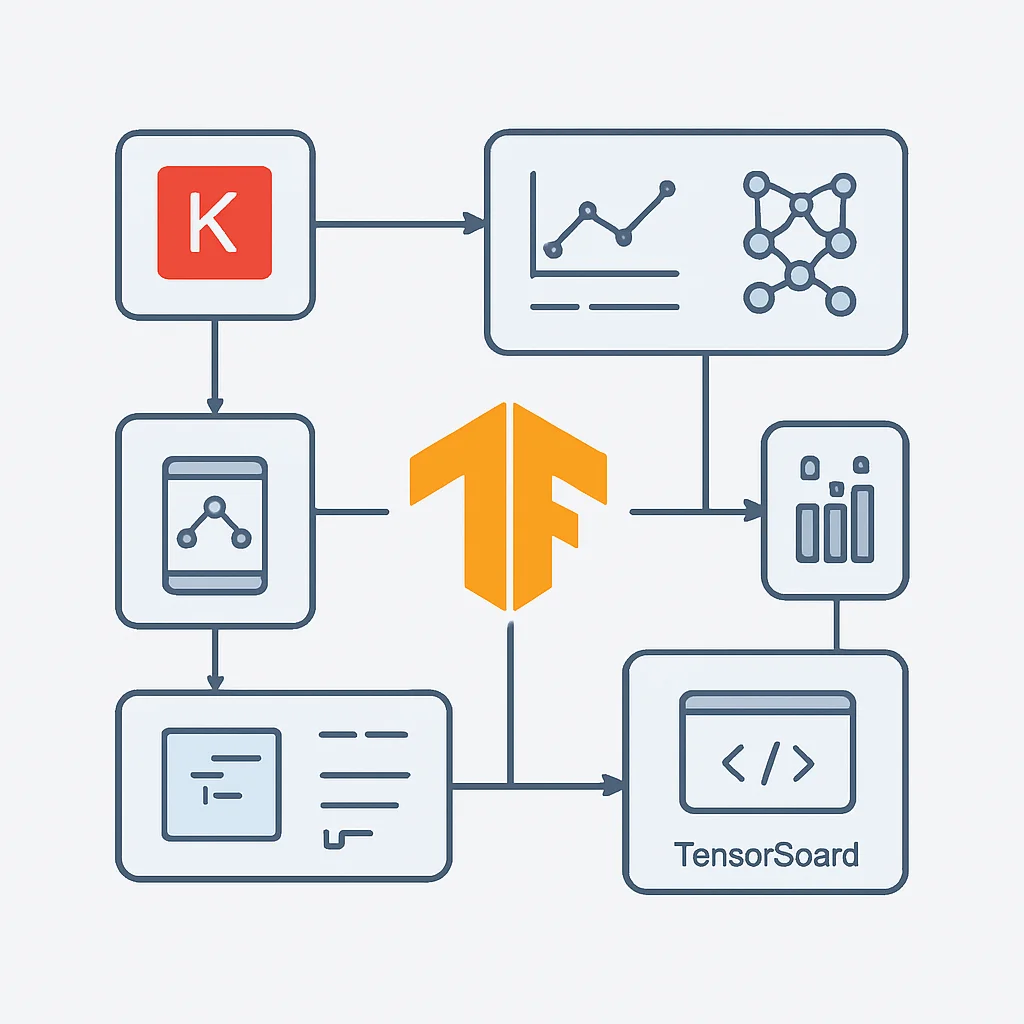
TensorFlow’s strength lies in its expansive ecosystem and focus on end-to-end ML workflows. Key features include:
TensorFlow’s Core Strengths
Eager Execution & Keras API — TensorFlow 2.x embraced eager execution by default, making debugging and development more intuitive. Keras, now the high-level API, simplifies model building significantly, reducing boilerplate code by up to 50% compared to TF 1.x.
Distributed Training — Robust support for distributed training across multiple GPUs, TPUs, and machines, critical for handling massive datasets and complex models. TensorFlow’s tf.distribute.Strategy API abstracts away much of the complexity, offering strategies like MirroredStrategy for single-host, multiple-device training.
TensorFlow Extended (TFX) — A comprehensive platform for production ML, covering data validation (TFDV), transformation (TFT), model serving (TFServing), and model analysis (TFMA). This suite is invaluable for MLOps.
Deployment Versatility — TensorFlow Lite for mobile and edge devices, TensorFlow.js for in-browser ML, and TensorFlow Serving for high-performance model deployment on servers. This extensive reach makes it a go-to for deploying models across a diverse range of environments.
Rich Tooling & Visualization — TensorBoard offers powerful visualization for training metrics, model graphs, and data distributions, aiding in debugging and performance analysis. Other tools like What-If Tool enhance model interpretability.
The focus on a complete ML lifecycle, from data ingestion to deployment and monitoring, makes TensorFlow particularly attractive for enterprises looking to operationalize AI at scale. Its deep integration with Google Cloud AI services (e.g., Vertex AI) further solidifies its enterprise appeal, offering managed solutions for training, tuning, and serving models.
Strengths and Weaknesses in 2026
Pros
✔ Production Readiness: Unparalleled tools for MLOps, deployment, and scalability, making it ideal for large-scale enterprise applications.
✔ Cross-Platform Deployment: Extensive support for mobile, web, and edge devices via TF Lite and TF.js.
✔ Comprehensive Ecosystem: A vast collection of tools, libraries, and pre-trained models (e.g., TensorFlow Hub).
✔ Strong Community & Corporate Support: Backed by Google, ensuring continuous development, robust documentation, and extensive resources.
Cons
✖ Steeper Learning Curve (historically): While TF 2.x with Keras is much better, some of its lower-level APIs can still be more verbose than PyTorch.
✖ Less “Pythonic” Feel: Despite improvements, some developers find PyTorch’s native Python integration more fluid for rapid experimentation.
KEY POINT
TensorFlow’s strength in 2026 lies in its comprehensive MLOps ecosystem and unparalleled deployment capabilities, making it a top choice for organizations focused on putting AI models into production at scale.
CORE CONTENT
PyTorch Deep Dive: Research & Flexibility Champion
PyTorch, open-sourced by Facebook’s AI Research lab (now Meta AI) in 2016, quickly gained traction, particularly within the academic and research communities. Its design philosophy emphasizes simplicity, flexibility, and a deep integration with Python’s native ecosystem. By 2026, PyTorch has matured significantly, bridging the gap between research and production with tools like TorchScript and TorchServe, while steadfastly retaining its core strengths.
Key Features and Evolution in 2026
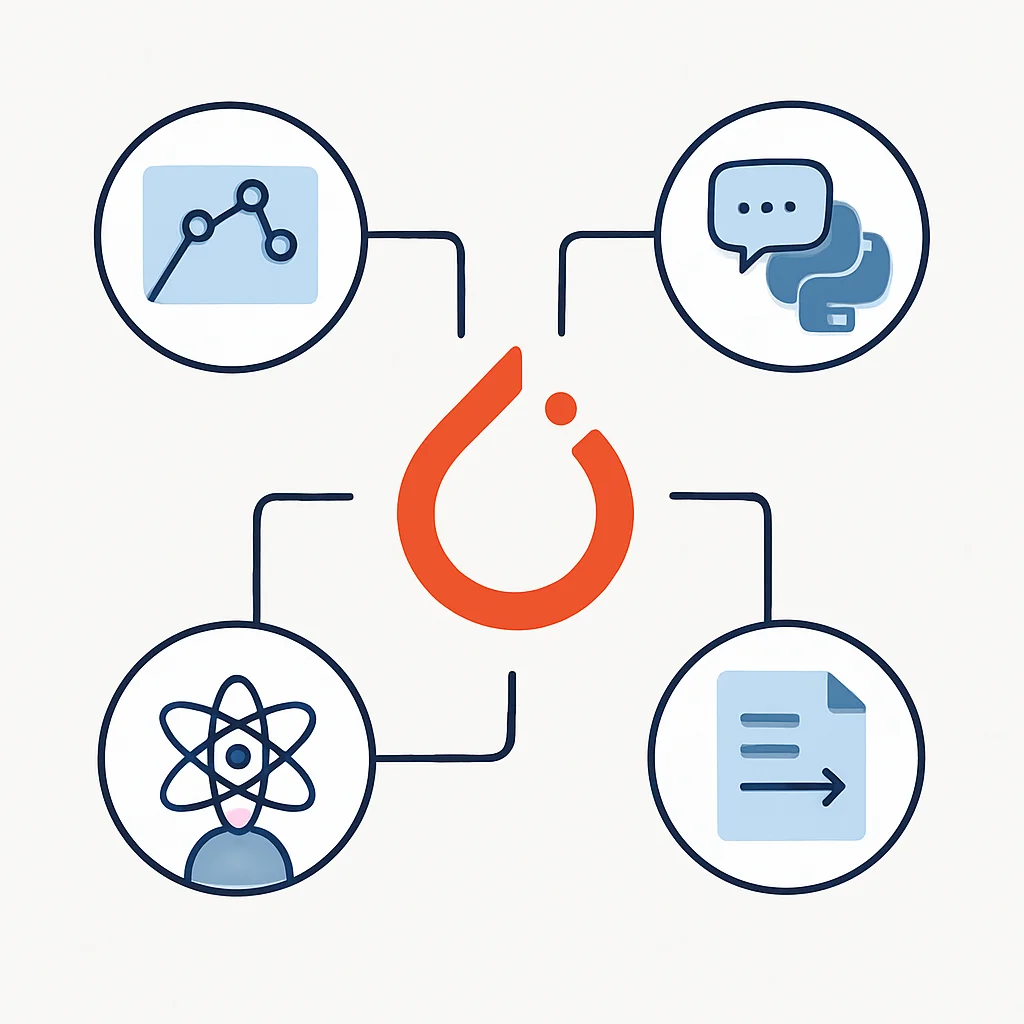
PyTorch’s appeal stems from its dynamic computation graph and intuitive Pythonic interface. Key features include:
PyTorch’s Core Strengths
Dynamic Computation Graph — Unlike TensorFlow’s earlier static graphs, PyTorch uses a dynamic graph (define-by-run). This allows for easier debugging using standard Python tools, and greater flexibility for models with dynamic architectures (e.g., RNNs where input length varies).
Pythonic & Intuitive API — PyTorch feels more like native Python, making it highly approachable for developers familiar with Python’s data science stack (NumPy, SciPy). Its API design is often praised for its clarity and consistency, reducing the cognitive load for new users.
TorchScript for Production — To address the need for deployment, TorchScript allows models to be serialized and run in production environments without a Python dependency. It provides a path to static graph compilation and optimization, offering the best of both worlds: dynamic for development, static for deployment.
Distributed Training — PyTorch also offers robust support for distributed training, particularly with its torch.distributed package. It’s highly flexible, allowing developers to implement various parallelism strategies, and has seen significant performance improvements in 2026.
Vibrant Research Community — PyTorch enjoys immense popularity in academia and research labs. This leads to a rapid influx of new models, techniques, and papers often released with PyTorch implementations, making it a fertile ground for cutting-edge AI development.
PyTorch’s growth has been fueled by its ease of use and the ability to quickly iterate on experimental models. While its production ecosystem was initially less mature than TensorFlow’s, tools like TorchServe (for model serving) and PyTorch Mobile (for edge deployment) have significantly closed this gap by 2026, making it a viable option for both research and production.
Strengths and Weaknesses in 2026
Pros
✔ Ease of Use & Flexibility: Highly intuitive, Pythonic API and dynamic graphs make it excellent for rapid prototyping and complex model architectures.
✔ Debugging: Standard Python debugging tools can be used directly with PyTorch models, simplifying the development process.
✔ Strong Research Community: A go-to for cutting-edge research, leading to a vibrant ecosystem of new models and techniques.
✔ Growing Production Ecosystem: TorchScript, TorchServe, and PyTorch Mobile have significantly improved its production deployment story.
Cons
✖ Less Mature MLOps Ecosystem (compared to TFX): While improving, its full-stack MLOps tooling is still catching up to TensorFlow’s comprehensive offerings.
✖ Fewer Direct Mobile/Edge Integrations: PyTorch Mobile is robust, but TensorFlow Lite still often has a broader range of direct hardware optimizations and pre-built solutions for specific embedded systems.
KEY POINT
PyTorch in 2026 excels in research, rapid prototyping, and scenarios demanding high flexibility due to its dynamic graph and Pythonic nature, with its production capabilities steadily expanding.
COMPARATIVE ANALYSIS
Head-to-Head Comparison: Key Differentiators in 2026
While both TensorFlow and PyTorch are powerful, general-purpose deep learning frameworks, their design philosophies lead to distinct advantages in different scenarios. Let’s break down the key areas of comparison as of 2026.
Ease of Use & Learning Curve
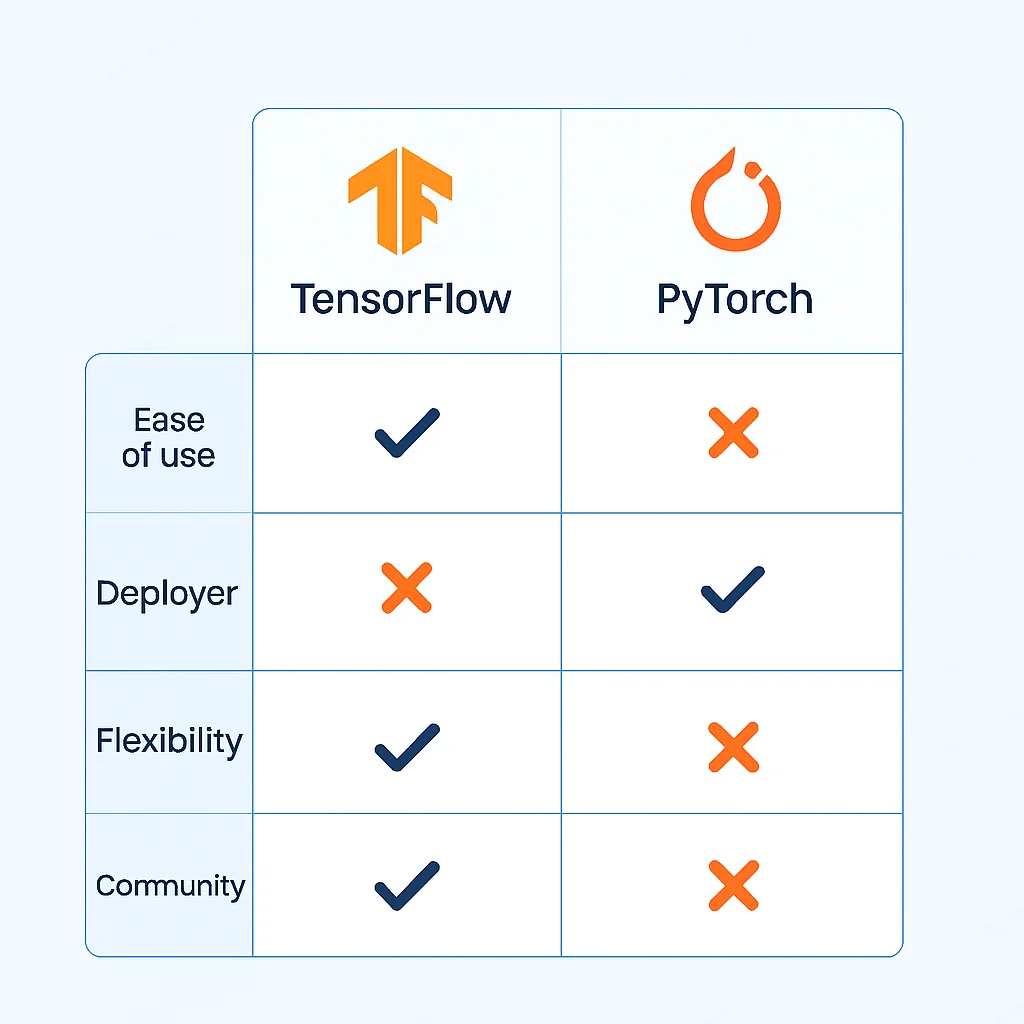
PyTorch generally boasts a gentler learning curve for those familiar with Python, thanks to its imperative, “define-by-run” approach and NumPy-like API. Debugging is straightforward using standard Python tools. TensorFlow 2.x, with its Keras integration and eager execution, has significantly improved its user-friendliness, making it competitive. However, for low-level control or diving into the full TFX ecosystem, TensorFlow can still feel more complex.
Flexibility & Prototyping
PyTorch’s dynamic computational graph offers unparalleled flexibility for research and prototyping, especially for models with varying input sizes or complex control flows (e.g., in natural language processing or reinforcement learning). This allows researchers to experiment rapidly. TensorFlow’s AutoGraph feature in TF 2.x can convert eager execution code into static graphs for performance benefits, but PyTorch’s native dynamic approach often feels more natural for exploratory work.
Production Deployment
This has historically been TensorFlow’s strong suit, and it remains a leader in 2026. TFX provides a robust, end-to-end platform for MLOps, including data validation, transformation, model serving (TensorFlow Serving), and monitoring. PyTorch has made massive strides with TorchScript (for model serialization and optimization) and TorchServe (for model serving), closing much of the gap. However, TensorFlow’s ecosystem for enterprise-grade deployment, particularly with integrated cloud services like Google Cloud’s Vertex AI, often offers a more mature and comprehensive solution out-of-the-box.
Ecosystem & Community Support
Both frameworks boast massive, active communities. TensorFlow’s community is vast and global, with extensive documentation, tutorials, and pre-trained models (TensorFlow Hub). PyTorch’s community is particularly vibrant in the research domain, leading to faster adoption of new architectures and frequently updated model implementations. Libraries like Hugging Face Transformers are framework-agnostic, supporting both, indicating a trend towards interoperability.
Distributed Training
Both frameworks offer excellent capabilities for distributed training, essential for scaling models on large datasets or complex architectures. TensorFlow’s tf.distribute.Strategy API provides a high-level, unified way to handle various distribution strategies (e.g., multi-GPU, multi-worker, TPU). PyTorch’s torch.distributed package is highly flexible, allowing fine-grained control over communication primitives and collective operations, often preferred by advanced users for custom distributed setups.
Mobile & Edge Deployment
TensorFlow Lite has been a pioneer in this space, offering highly optimized runtime for various mobile and embedded platforms, with tools for quantization and hardware acceleration. PyTorch Mobile provides similar capabilities, allowing models to be deployed on iOS and Android. While PyTorch Mobile has matured, TensorFlow Lite often has a slight edge in terms of direct hardware integration, a broader range of pre-optimized operations, and a larger existing deployment base on constrained devices.
KEY POINT
In 2026, TensorFlow leads in robust, end-to-end MLOps and cross-platform deployment, while PyTorch excels in flexibility, research-driven development, and a highly Pythonic user experience.
IDEAL USE CASES
Ideal Use Cases: When to Choose Which Framework
Given their distinct strengths, the choice between TensorFlow and PyTorch often boils down to the specific context of your project.
Choose TensorFlow if:
Enterprise-Scale Deployment
Your project requires a robust, end-to-end MLOps pipeline for production, including data validation, model serving, and monitoring, often integrated with cloud infrastructure like Google Cloud. Think large-scale recommendation systems, fraud detection, or autonomous driving systems.
Mobile and Edge AI
You need to deploy models on resource-constrained devices such as smartphones (Android/iOS), IoT devices, or embedded systems. TensorFlow Lite offers unparalleled optimization and a broad range of pre-trained, quantized models.
Web-based Machine Learning
Building interactive ML applications directly in the browser with JavaScript. TensorFlow.js enables client-side inference and even training, enhancing user experience and privacy.
Large-scale Research with Managed Infrastructure
While PyTorch often leads in raw research, if your research lab has significant investment in Google Cloud or needs highly managed infrastructure for large-scale experiments, TensorFlow’s integration with TPUs and Vertex AI can be a strong advantage.
Choose PyTorch if:
Academic Research & Rapid Prototyping
You are at the forefront of AI research, developing novel architectures, or need maximum flexibility for experimentation. PyTorch’s dynamic graph and Pythonic nature accelerate the research cycle.
Complex & Dynamic Models
Your model architectures involve conditional computations, variable-length inputs, or complex control flow that benefits from the “define-by-run” paradigm, such as advanced NLP models or generative adversarial networks (GANs).
Python-First Development
Your team heavily relies on Python’s data science ecosystem and values a framework that integrates seamlessly with tools like NumPy and standard Python debugging.
Startups & Smaller Teams
For teams prioritizing fast iteration, ease of learning, and a fluid development experience, PyTorch often proves to be more agile, allowing for quicker proof-of-concept development.

KEY POINT
The “best” framework is contextual: TensorFlow for robust MLOps and extensive deployment, PyTorch for agile research and flexible model development.
PRACTICAL APPLICATION
Practical Application: Building a Simple Neural Network
To illustrate the practical differences, let’s look at how to build a very simple feedforward neural network for binary classification using both TensorFlow/Keras and PyTorch.
TensorFlow/Keras Example
Using the Keras API, TensorFlow allows for extremely concise model definitions.
CODE EXPLANATION
This code snippet demonstrates building a simple sequential neural network using TensorFlow’s Keras API. It defines a model with two dense layers, compiles it with an optimizer and loss function, and then trains it on some dummy data. The Keras API significantly simplifies model creation and training workflows.
import tensorflow as tf
import numpy as np

# 1. Prepare dummy data
X_train = np.random.rand(100, 10).astype(np.float32) # 100 samples, 10 features
y_train = np.random.randint(0, 2, 100).astype(np.float32) # Binary labels

# 2. Define the model using Keras Sequential API
model = tf.keras.Sequential([
    tf.keras.layers.Dense(32, activation='relu', input_shape=(10,)), # Input layer with 10 features
    tf.keras.layers.Dense(1, activation='sigmoid') # Output layer for binary classification
])

# 3. Compile the model
model.compile(optimizer='adam',
              loss='binary_crossentropy',
              metrics=['accuracy'])

# 4. Train the model
print("Training TensorFlow model...")
history = model.fit(X_train, y_train, epochs=10, batch_size=32, verbose=0)
print(f"TensorFlow Training Accuracy: {history.history['accuracy'][-1]:.4f}")

# 5. Make predictions
X_new = np.random.rand(5, 10).astype(np.float32)
predictions = model.predict(X_new)
print("\nTensorFlow Predictions:")
print(predictions)
As you can see, the Keras API makes the process very high-level and intuitive, requiring minimal lines of code for standard tasks.
PyTorch Example
PyTorch allows for more explicit control, often preferred by researchers, while still being quite readable.
CODE EXPLANATION
This PyTorch example defines a neural network as a Python class inheriting from nn.Module, which is standard practice. It explicitly defines the forward pass. The training loop is also explicitly written, giving more control over each step. This approach, while slightly more verbose for simple models, offers immense flexibility for complex, custom architectures.
import torch
import torch.nn as nn
import torch.optim as optim
import numpy as np

# 1. Prepare dummy data
X_train_pt = torch.tensor(np.random.rand(100, 10), dtype=torch.float32)
y_train_pt = torch.tensor(np.random.randint(0, 2, 100), dtype=torch.float32).unsqueeze(1) # Needs to be (N, 1) for BCELogitsLoss

# 2. Define the model
class SimpleNN(nn.Module):
    def __init__(self):
        super(SimpleNN, self).__init__()
        self.fc1 = nn.Linear(10, 32) # Input layer (10 features) to hidden layer (32 neurons)
        self.relu = nn.ReLU()
        self.fc2 = nn.Linear(32, 1) # Hidden layer to output layer (1 neuron for binary)
        self.sigmoid = nn.Sigmoid() # Sigmoid for binary classification

    def forward(self, x):
        x = self.fc1(x)
        x = self.relu(x)
        x = self.fc2(x)
        x = self.sigmoid(x)
        return x

model_pt = SimpleNN()

# 3. Define Loss Function and Optimizer
criterion = nn.BCELoss() # Binary Cross-Entropy Loss
optimizer = optim.Adam(model_pt.parameters(), lr=0.001)

# 4. Train the model
print("Training PyTorch model...")
for epoch in range(10):
    optimizer.zero_grad() # Zero the gradients
    outputs = model_pt(X_train_pt) # Forward pass
    loss = criterion(outputs, y_train_pt) # Calculate loss
    loss.backward() # Backward pass (compute gradients)
    optimizer.step() # Update weights

    # Calculate accuracy
    predicted = (outputs > 0.5).float()
    accuracy = (predicted == y_train_pt).float().mean()
    # print(f"Epoch {epoch+1}, Loss: {loss.item():.4f}, Accuracy: {accuracy.item():.4f}")

print(f"PyTorch Training Accuracy (last epoch): {accuracy.item():.4f}")

# 5. Make predictions
X_new_pt = torch.tensor(np.random.rand(5, 10), dtype=torch.float32)
with torch.no_grad(): # Disable gradient calculation for inference
    predictions_pt = model_pt(X_new_pt)
print("\nPyTorch Predictions:")
print(predictions_pt)
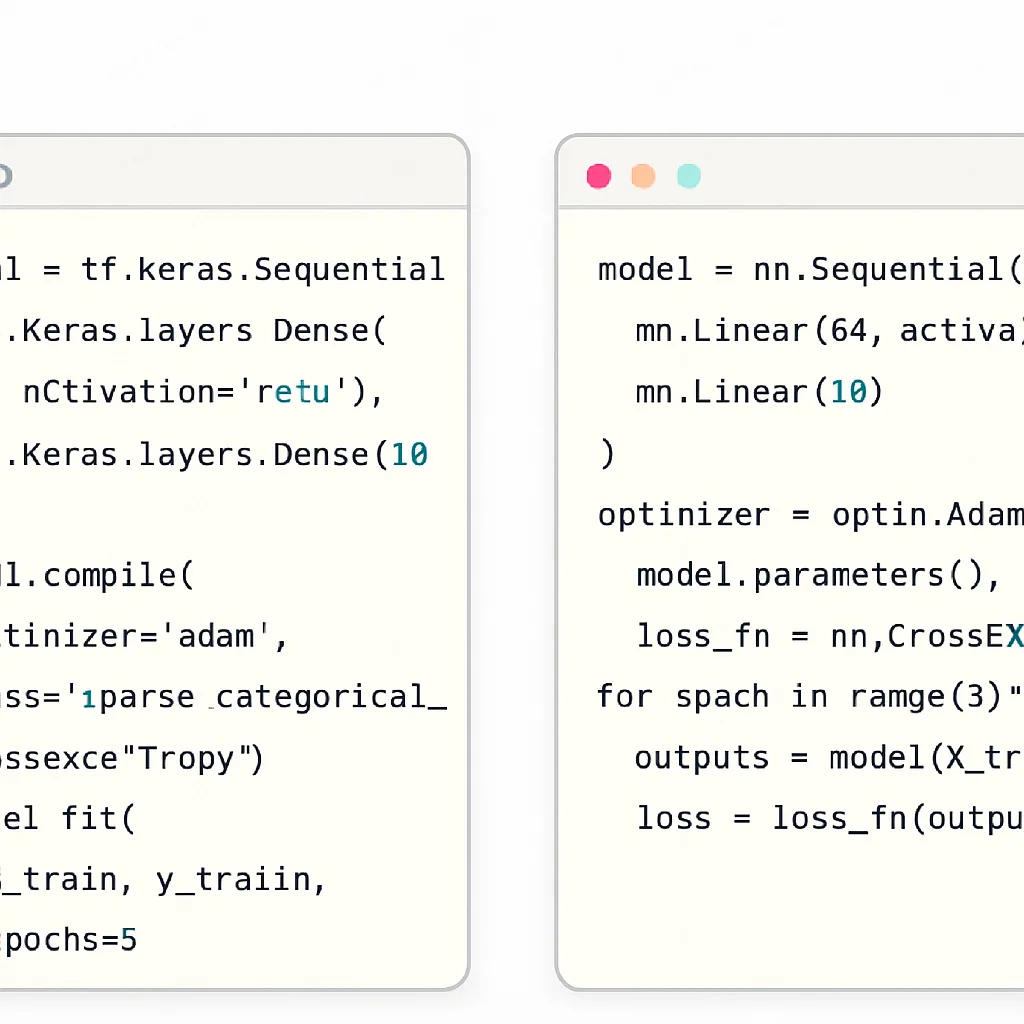
This comparison highlights the “batteries included” high-level abstraction of Keras in TensorFlow versus the more explicit, Python-native approach of PyTorch. Both achieve the same goal, but the development experience differs.
KEY POINT
TensorFlow/Keras offers a high-level, concise API for common tasks, while PyTorch provides more granular control and a “Pythonic” feel, particularly evident in custom model definitions and training loops.
Frequently Asked Questions (FAQ)
Q. Is TensorFlow still relevant in 2026 given PyTorch’s popularity in research?
Absolutely. TensorFlow remains highly relevant, especially for enterprise-grade applications, production deployment, and large-scale MLOps. Its comprehensive ecosystem, including TFX and TensorFlow Lite, positions it strongly for industrial applications, even as PyTorch dominates much of the academic research.
Q. Can I convert models between TensorFlow and PyTorch?
Yes, model conversion is possible, often using intermediate formats like ONNX (Open Neural Network Exchange). Tools exist to convert models from one framework to ONNX, and then from ONNX to the other framework. However, complex or highly customized layers might require manual adjustments.
Q. Which framework is better for beginners in 2026?
For beginners, PyTorch often has a slightly gentler learning curve due to its Pythonic nature and dynamic graph, making debugging more intuitive. TensorFlow 2.x with Keras is also very beginner-friendly for standard tasks. The choice often comes down to personal preference and prior Python experience.
Q. What are the trends for these frameworks beyond 2026?
Beyond 2026, we expect continued convergence, with both frameworks enhancing their strengths while adopting features from each other. Focus areas will likely include deeper integration with hardware accelerators, improved MLOps automation, enhanced security features for production, and further simplification of distributed training for even larger models.
WRAP-UP
The Future of ML Frameworks
In 2026, both TensorFlow and PyTorch stand as formidable tools for machine learning development, each with a distinct personality and ideal use cases. There isn’t a single “winner”; rather, the optimal choice is a strategic alignment with your project’s lifecycle stage, team expertise, and deployment targets.
TensorFlow continues to be the bedrock for large-scale, enterprise-grade AI deployments, offering an unparalleled ecosystem for MLOps, scalability, and cross-platform deployment. Its comprehensive tooling, from data pipelines to mobile inference, makes it a robust choice for production environments. PyTorch, on the other hand, excels in the fast-paced world of AI research and rapid prototyping, valuing flexibility, a Pythonic interface, and dynamic model architectures. Its growing production capabilities mean it’s no longer just for the lab, but for agile deployments too.
The trend moving forward, even beyond 2026, is likely to be one of increasing convergence and interoperability. We’re already seeing features from one framework inspire the other, and the rise of framework-agnostic tools like Hugging Face and ONNX further blurs the lines. Developers are increasingly leveraging the strengths of both, sometimes using PyTorch for initial research and then porting to TensorFlow for optimized production, or vice-versa with TorchScript. The future of ML development will likely involve a more fluid movement between these powerful tools, allowing practitioners to pick the right instrument for each specific task in their AI orchestra.
The choice in 2026 is less about exclusive loyalty and more about strategic selection, with a growing trend towards leveraging both frameworks or their interoperable components for different stages of the ML lifecycle.
Thanks for reading!
We hope this comprehensive analysis helps you make informed decisions for your machine learning projects in 2026 and beyond.
Got questions or insights to share? Drop a comment below or connect with Kwonglish!