
SUMMARY
Building Robust MLOps Pipelines: A Developer’s Guide to Production ML in 2026
An essential guide for developers on building, deploying, and monitoring machine learning models in production using robust MLOps pipelines and best practices.
Keywords: MLOps, ML pipelines, production ML
TABLE OF CONTENTS
What We’ll Cover
1. The Imperative of MLOps in 2026: Beyond Experimentation
2. Deconstructing the MLOps Pipeline: Core Components
3. Essential MLOps Building Blocks: Tools and Technologies
4. Implementing Robust CI/CD for Machine Learning Models
5. The Watchtower: Monitoring, Observability, and Governance
6. Practical Application: Crafting a Production-Ready MLOps Workflow
7. Frequently Asked Questions (FAQ)
INTRODUCTION
1. The Imperative of MLOps in 2026: Beyond Experimentation
The landscape of Artificial Intelligence and Machine Learning has evolved dramatically. What started as experimental projects in research labs has now permeated every industry, driving critical business decisions and powering innovative products. In 2026, the focus has shifted from merely building models to reliably deploying, managing, and scaling them in production environments. This is where MLOps – Machine Learning Operations – becomes not just a best practice, but an absolute necessity.
Traditional software development has long benefited from DevOps principles, enabling rapid iteration, automated deployments, and robust monitoring. However, ML systems introduce unique complexities that DevOps alone cannot fully address. These include managing data versions, handling model drift, monitoring data quality, orchestrating retraining, and ensuring reproducibility across diverse environments. Without a structured MLOps approach, organizations face significant challenges: long deployment cycles, inconsistent model performance, difficulty debugging, and a high risk of models failing silently in production.
Consider a scenario where a financial institution deploys a fraud detection model. If this model isn’t continuously monitored for performance degradation or data drift, it could quickly become obsolete as fraud patterns evolve. A decline in accuracy from 95% to 80% could cost the institution millions in undetected fraud within weeks. Similarly, an e-commerce recommendation engine that isn’t regularly updated with fresh user interaction data will provide stale recommendations, leading to decreased user engagement and lost sales. The stakes are simply too high in 2026 to treat ML models as static artifacts.
KEY POINT
MLOps bridges the gap between ML development and operations, ensuring that models are not only built effectively but also deployed, managed, and monitored reliably and scalably in production, a critical requirement for AI success in 2026.
This guide is designed for developers – data scientists, machine learning engineers, and software engineers – who are tasked with bringing ML models from experimentation to a robust, production-grade reality. We’ll explore the core components of MLOps pipelines, delve into the essential tools and technologies, discuss the intricacies of CI/CD for ML, and highlight the critical aspects of monitoring and governance. By the end, you’ll have a clear roadmap to building MLOps pipelines that stand the test of time and complexity in the dynamic AI landscape of 2026.
CORE CONTENT
2. Deconstructing the MLOps Pipeline: Core Components
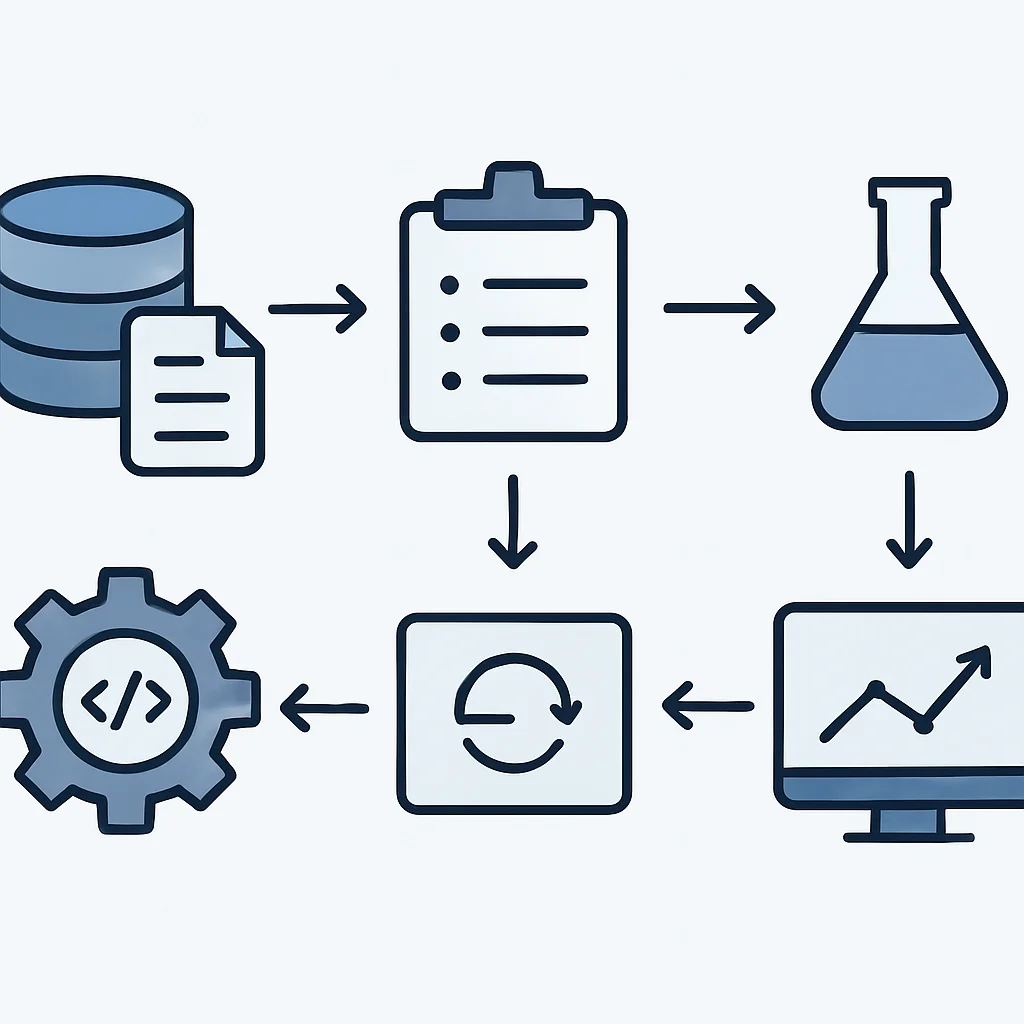
An MLOps pipeline is a structured, automated workflow that manages the entire lifecycle of a machine learning model, from data preparation to deployment and continuous monitoring. Unlike a linear DevOps pipeline, MLOps often involves cyclical processes due to the inherent iterative nature of ML development and the need for continuous model retraining. Let’s break down the essential stages:
2.1. Data Ingestion, Validation, and Versioning
This initial stage is foundational. It involves collecting raw data from various sources (databases, APIs, streaming services), cleaning and transforming it, and crucially, validating its quality. Data validation checks for schema adherence, missing values, outliers, and statistical properties that could impact model performance. Most importantly, data versioning ensures that every dataset used for training or evaluation is immutable and traceable. This allows for reproducibility and debugging, answering questions like “Which data version was model X trained on?”
Tools like Data Version Control (DVC) or cloud-native solutions like S3 versioning or Google Cloud Storage’s object versioning, combined with metadata management, are critical here. For instance, a dataset used in January 2026 for a model might have different characteristics than the one used in April 2026. Without versioning, comparing model performance across these periods becomes a guessing game.
2.2. Model Training and Experiment Tracking
Once data is prepared, the model training process begins. This includes feature engineering, model selection, hyperparameter tuning, and actual model training on distributed infrastructure if needed. A key MLOps aspect here is experiment tracking. Every training run – including the code version, hyperparameters, metrics (accuracy, precision, recall, F1-score), and the resulting model artifact – must be logged and made searchable. This allows data scientists to compare experiments, reproduce results, and select the best performing model for deployment.
Consider an image classification model where a data scientist tries 10 different architectures (ResNet, EfficientNet, Vision Transformer) with varying learning rates and batch sizes. An experiment tracking system like MLflow or Weights & Biases would log all 100+ runs, their associated metrics, and the trained model files, making it easy to identify the optimal configuration.
CODE EXPLANATION
This Python snippet demonstrates how to use MLflow to track a simple model training experiment, logging parameters, metrics, and the model artifact. This ensures reproducibility and traceability of each training run.
import mlflow
import mlflow.sklearn
from sklearn.linear_model import LogisticRegression
from sklearn.model_selection import train_test_split
from sklearn.metrics import accuracy_score
import numpy as np

# Simulate data
X = np.random.rand(100, 10)
y = np.random.randint(0, 2, 100)
X_train, X_test, y_train, y_test = train_test_split(X, y, test_size=0.2, random_state=42)

# Start an MLflow run
with mlflow.start_run():
    # Define hyperparameters
    solver = "liblinear"
    C = 0.1

    # Log parameters
    mlflow.log_param("solver", solver)
    mlflow.log_param("C", C)

    # Train a model
    model = LogisticRegression(solver=solver, C=C)
    model.fit(X_train, y_train)

    # Make predictions and evaluate
    y_pred = model.predict(X_test)
    accuracy = accuracy_score(y_test, y_pred)

    # Log metrics
    mlflow.log_metric("accuracy", accuracy)

    # Log the model
    mlflow.sklearn.log_model(model, "logistic_regression_model")

    print(f"MLflow Run ID: {mlflow.active_run().info.run_id}")
    print(f"Accuracy: {accuracy}")
2.3. Model Versioning and Registry
Once a model is trained and validated, it needs to be stored and managed in a central model registry. This registry acts as a single source of truth for all models, allowing for versioning, metadata tagging, stage transitions (e.g., Staging, Production, Archived), and approval workflows. This ensures that only validated and approved models make it to production.
For example, a fraud detection model might go from “Staging” after initial testing to “Production” after A/B testing shows a 2% improvement in fraud detection rate with no increase in false positives. The registry would track all these transitions, ensuring proper governance.
2.4. CI/CD for ML (Continuous Integration/Continuous Delivery)
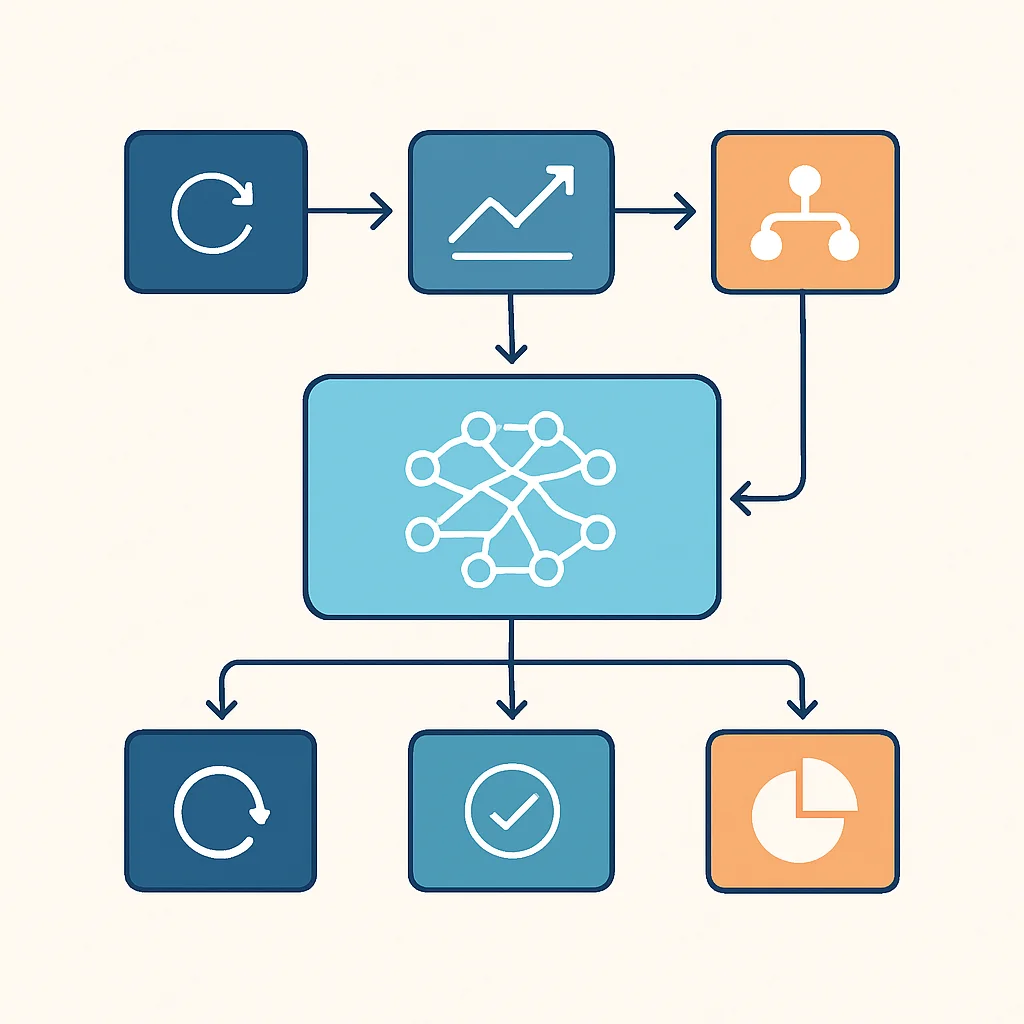
This is where MLOps truly differentiates itself. CI/CD for ML involves automating the testing, retraining, and deployment of models. It’s not just about deploying code changes, but also about detecting data drift, model decay, or new feature requirements that trigger an automated retraining and redeployment cycle. This includes:
- Continuous Integration (CI): Automating code testing (unit tests, integration tests), data validation, and model sanity checks (e.g., does the model load? does it make predictions?).
- Continuous Delivery (CD): Automating the deployment of new model versions to staging or production environments. This often involves containerization (Docker) and orchestration (Kubernetes).
- Continuous Training (CT): A unique ML aspect where pipelines are triggered by new data arrivals, performance degradation, or scheduled intervals to retrain and update models.
2.5. Model Deployment and Serving
Deploying a model means making it available for inference. This can range from batch predictions to real-time API endpoints. Key considerations include scalability, latency, throughput, and resilience. Deployment strategies often involve containerization (Docker) and orchestration platforms (Kubernetes), or serverless functions for cost-efficiency. Advanced strategies like A/B testing, canary deployments, and blue/green deployments allow for safe rollout of new model versions.
A real-time recommendation engine needs to serve predictions within milliseconds. This typically requires deploying the model as a microservice on a highly available, scalable infrastructure, possibly leveraging GPU acceleration for deep learning models.
2.6. Model Monitoring and Observability
Once deployed, models must be continuously monitored for performance, data quality, and operational health. This involves tracking various metrics:
- Model Performance: Accuracy, precision, recall, F1-score, RMSE – measured against ground truth if available, or proxy metrics.
- Data Drift: Changes in the distribution of input features over time, potentially leading to performance degradation.
- Concept Drift: Changes in the relationship between input features and the target variable.
- Operational Metrics: Latency, throughput, error rates of the model serving infrastructure.
- Explainability: Monitoring why a model makes certain predictions, especially critical in regulated industries.
Alerts are configured to notify teams when metrics cross predefined thresholds, triggering investigation or automated retraining. For instance, if a model’s F1-score drops by 5% over a week, or if the distribution of a key input feature (e.g., customer age) shifts significantly, an alert should be triggered.
KEY POINT
A robust MLOps pipeline encompasses data management, experiment tracking, model versioning, automated CI/CD for continuous training and deployment, and comprehensive monitoring to ensure model reliability and performance in production.
TOOLS & TECHNOLOGIES
3. Essential MLOps Building Blocks: Tools and Technologies
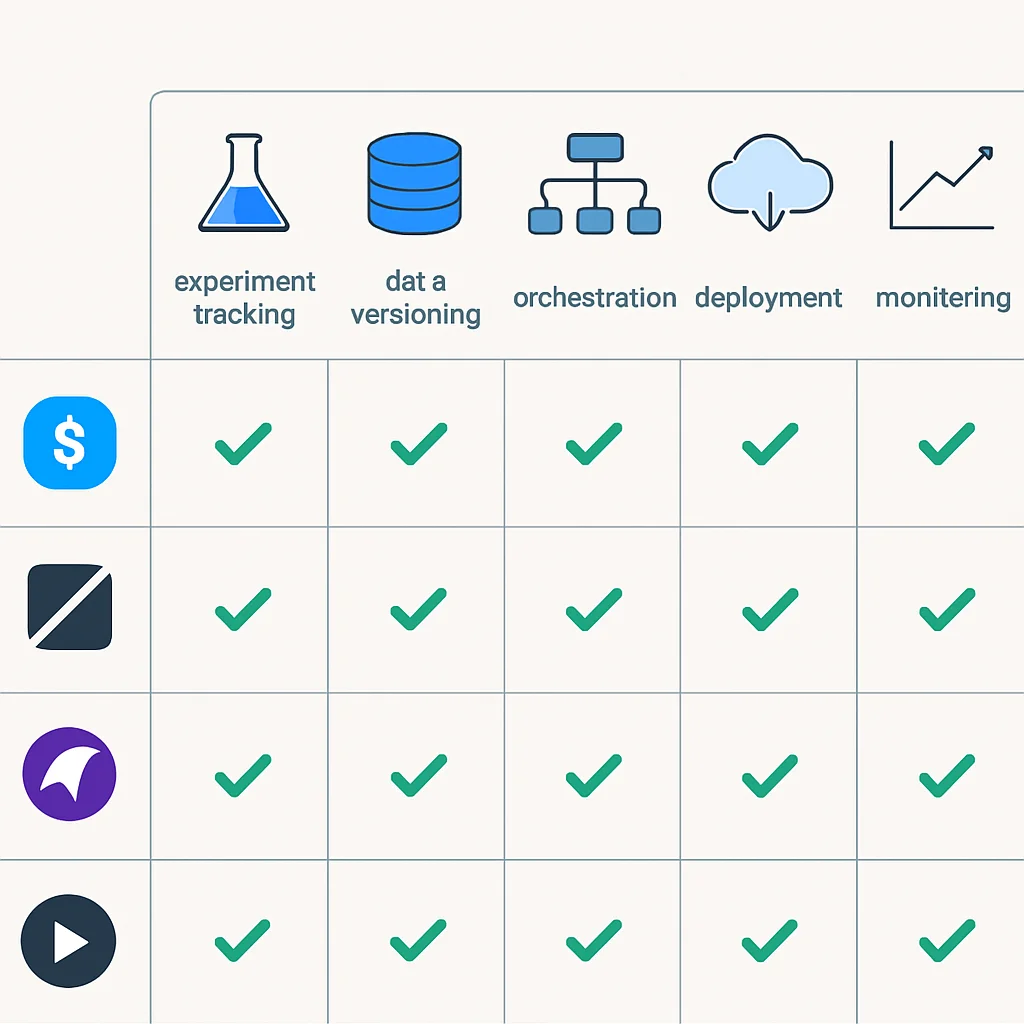
The MLOps ecosystem is rich and diverse, offering a multitude of tools for each stage of the pipeline. Choosing the right set of tools often depends on your existing infrastructure, team expertise, and specific project requirements. Here’s a breakdown of some prominent categories and examples in 2026:
3.1. Experiment Tracking & Model Registry
- MLflow: An open-source platform for managing the ML lifecycle, offering components for tracking experiments (
MLflow Tracking), packaging ML code (MLflow Projects), and managing models (MLflow Model Registry). Widely adopted for its flexibility and integration capabilities. - Weights & Biases (W&B): A popular commercial platform providing robust experiment tracking, visualization, and hyperparameter optimization. Excellent for deep learning research.
- Neptune.ai: Another strong contender for experiment tracking, model registry, and dataset versioning, offering a user-friendly UI and API.
3.2. Data Versioning & Management
- DVC (Data Version Control): An open-source system that works alongside Git to manage large datasets and models, providing versioning, reproducibility, and pipeline execution.
- LakeFS: An open-source tool that brings Git-like branching and versioning to data lakes, allowing atomic operations and isolation of changes.
- Cloud Object Storage (S3, GCS, Azure Blob Storage): While not strictly versioning tools themselves, they provide underlying storage with native versioning capabilities that can be integrated with DVC or custom solutions.
3.3. Orchestration & Pipelines
- Kubeflow Pipelines: A component of the Kubeflow platform, it allows for building and deploying portable, scalable ML workflows on Kubernetes. Ideal for complex, multi-step ML pipelines.
- Apache Airflow: A widely used open-source platform to programmatically author, schedule, and monitor workflows. Excellent for data orchestration but requires custom operators for ML tasks.
- Argo Workflows: A Kubernetes-native workflow engine, often used for CI/CD and general workflow orchestration, including ML pipelines.
3.4. Model Serving & Deployment
- BentoML: An open-source framework for building, shipping, and scaling AI applications. It allows packaging models into production-ready API endpoints.
- Seldon Core: An open-source platform for deploying ML models on Kubernetes, providing advanced features like A/B testing, canary rollouts, and explainability.
- TensorFlow Serving / TorchServe: High-performance serving systems specifically optimized for TensorFlow and PyTorch models, respectively.
3.5. Cloud-Native MLOps Platforms
Major cloud providers offer integrated MLOps platforms that simplify many of these tasks, often providing managed services for data, training, model registry, and serving.
- Amazon SageMaker: A comprehensive suite of tools covering the entire ML lifecycle, from data labeling and feature store to training, deployment, and monitoring.
- Google Cloud Vertex AI: Google’s unified ML platform offering tools for building, deploying, and scaling ML models, integrating services like AI Platform, AutoML, and explainability.
- Azure Machine Learning: Microsoft’s cloud-based platform for end-to-end ML, providing services for data preparation, model training, deployment, and MLOps.
3.6. Monitoring & Observability
- Prometheus & Grafana: Open-source tools for monitoring and visualization, widely used for infrastructure metrics and adaptable for ML model metrics.
- Evidently AI: An open-source tool for data drift and model performance monitoring, providing interactive reports and dashboards.
- Fiddler AI: A commercial platform for ML monitoring, explainability, and fairness, offering deep insights into model behavior.
KEY POINT
The MLOps toolchain is modular, allowing teams to pick and choose components that best fit their needs. Open-source solutions like MLflow and DVC offer flexibility, while cloud-native platforms provide integrated, managed services for faster setup.
CI/CD FOR ML
4. Implementing Robust CI/CD for Machine Learning Models
CI/CD is the backbone of modern software development, and its principles are equally vital for MLOps. However, applying CI/CD to ML models introduces unique challenges due to the data-dependent nature of ML and the need to manage not just code, but also data and models as first-class citizens. The goal is to automate the entire process from code changes to model deployment and continuous retraining.
4.1. Continuous Integration (CI) for ML
In ML CI, beyond traditional unit and integration tests for code, we also need to incorporate tests specific to the ML workflow:
- Data Validation Tests: Ensure new data adheres to expected schema, ranges, and distributions. Catching data quality issues early prevents model failures.
- Model Sanity Tests: Verify that the trained model loads correctly, can make predictions, and that predictions are within reasonable bounds (e.g., probability scores sum to 1).
- Training Script Tests: Ensure the training script runs without errors and produces a model artifact.
- Performance Regression Tests: Run a quick evaluation on a small, fixed test set to ensure new code changes haven’t drastically degraded model performance compared to a baseline.
These tests are typically triggered by code commits to a version control system (e.g., Git) and run on CI platforms like GitHub Actions, GitLab CI, or Jenkins. If any test fails, the pipeline stops, and developers are alerted.
4.2. Continuous Delivery (CD) and Continuous Training (CT)
CD in MLOps focuses on automating the deployment of new model versions. However, ML models require an additional layer: Continuous Training (CT).
- Triggering Mechanisms: CT pipelines can be triggered by various events:
- New data arrival (e.g., daily batch of transactions).
- Scheduled intervals (e.g., weekly retraining).
- Monitoring alerts (e.g., detection of data drift or model performance decay).
- Code changes to the training pipeline.
- Automated Retraining and Evaluation: The CT pipeline automatically fetches the latest data, retrains the model, and evaluates its performance against a robust test set (which should also be versioned!). Only if the new model meets predefined performance thresholds (e.g., at least 90% accuracy and no more than 5% drop in F1-score compared to the previous production model) is it considered for deployment.
- Model Promotion: Successful models are registered in the model registry, often transitioning through stages like “Staging” (for integration tests and manual review) to “Production.”
- Deployment Strategies: For CD, safe deployment strategies are crucial.
- Blue/Green Deployment: Deploy the new model version (green) alongside the existing one (blue), then switch traffic. If issues arise, switch back to blue.
- Canary Deployment: Route a small percentage of traffic to the new model (canary), monitor its performance, and gradually increase traffic if stable.
- A/B Testing: Route traffic to different model versions and measure business metrics (e.g., conversion rates) to determine which model performs better in a real-world scenario.
CODE EXPLANATION
This YAML snippet outlines a simplified GitHub Actions workflow for a CI/CD pipeline in MLOps. It demonstrates steps for code checkout, environment setup, data validation, model training, and logging to MLflow, triggered on pushes to the main branch.
name: MLOps CI/CD Pipeline

on:
  push:
    branches:
      - main
  schedule:
    - cron: '0 0 * * 0' # Weekly retraining every Sunday at midnight

jobs:
  build-and-train:
    runs-on: ubuntu-latest
    steps:
    - name: Checkout code
      uses: actions/checkout@v4

    - name: Set up Python
      uses: actions/setup-python@v5
      with:
        python-version: '3.9'

    - name: Install dependencies
      run: |
        pip install -r requirements.txt
        pip install mlflow scikit-learn numpy pandas

    - name: Run data validation
      run: python scripts/validate_data.py

    - name: Train model and log to MLflow
      env:
        MLFLOW_TRACKING_URI: ${{ secrets.MLFLOW_TRACKING_URI }}
        MLFLOW_TRACKING_USERNAME: ${{ secrets.MLFLOW_TRACKING_USERNAME }}
        MLFLOW_TRACKING_PASSWORD: ${{ secrets.MLFLOW_TRACKING_PASSWORD }}
      run: python scripts/train_model.py

    - name: Evaluate model performance
      run: python scripts/evaluate_model.py

    # Example for CD: Deploy if performance meets threshold
    - name: Deploy model to Staging
      if: success() # Only if previous steps pass
      run: |
        # Logic to fetch best model from MLflow and deploy to staging
        # e.g., using a custom deployment script or cloud provider SDK
        echo "Deploying model to staging environment..."
        python scripts/deploy_model.py --stage staging --model-name "FraudDetection"

    # Further steps could include:
    # - A/B testing setup
    # - Production deployment after manual approval or A/B test results
KEY POINT
CI/CD for ML extends traditional software practices by incorporating data validation, model testing, and continuous training (CT) triggered by data or performance shifts, ensuring models remain relevant and effective post-deployment.
MONITORING & GOVERNANCE
5. The Watchtower: Monitoring, Observability, and Governance
Deploying a model is only half the battle; ensuring its continued performance, reliability, and ethical operation in production is the ongoing war. This is where robust monitoring, observability, and governance mechanisms come into play. In 2026, with increasing regulatory scrutiny (e.g., the EU AI Act) and a greater emphasis on responsible AI, these aspects are more critical than ever.
5.1. Model Performance Monitoring
We need to track how well our model is performing on live data. Key metrics include:
- Accuracy, Precision, Recall, F1-score: If ground truth labels are available (e.g., confirmed fraud cases, actual user clicks), these are the gold standard. They can be calculated in batches or near real-time.
- Regression Metrics: RMSE, MAE, R-squared for regression models.
- Business Metrics: The ultimate goal. How does the model impact conversion rates, customer churn, revenue, or operational efficiency? A 1% increase in a recommendation model’s F1-score might translate to a 0.5% increase in daily revenue, which should be tracked.
- Latency and Throughput: Operational metrics for the serving infrastructure. A model might be accurate but too slow to be useful in a real-time application.
5.2. Data Drift and Concept Drift Detection
These are unique challenges to ML systems:
- Data Drift: Occurs when the distribution of the input data changes over time. For example, if a model was trained on customer demographics from 2024, and by 2026 the customer base has significantly shifted (e.g., younger average age, different geographic spread), the model might perform poorly. Tools like Kolmogorov-Smirnov (K-S) test or Jensen-Shannon divergence can quantify distribution shifts.
- Concept Drift: Occurs when the relationship between the input features and the target variable changes. For instance, in a spam detection model, spammers constantly evolve their tactics, making previously effective features less relevant. This is harder to detect directly but often manifests as a drop in model performance.
Monitoring these drifts is crucial to trigger retraining pipelines before significant performance degradation occurs. Setting up alerts for changes in feature distributions (e.g., if the mean of a key numerical feature shifts by more than 2 standard deviations) can provide early warnings.
5.3. Explainability and Fairness Monitoring
With the rise of responsible AI, understanding why a model makes a particular decision (explainability) and ensuring it doesn’t exhibit unfair biases (fairness) are paramount, especially in high-stakes domains like finance, healthcare, or hiring.
- Explainability: Tools like LIME, SHAP, and integrated gradients help interpret model predictions locally (for individual instances) and globally (for overall feature importance). Monitoring these explanations over time can detect shifts in feature importance or unexpected decision rationale.
- Fairness: Assessing models for biases across sensitive attributes (gender, race, age) using metrics like demographic parity, equalized odds, or disparate impact. Continuous monitoring ensures that the model remains fair as data and context evolve. For example, a loan approval model might initially show fair outcomes, but if new data introduces a bias against a certain demographic, this needs to be detected and mitigated.
5.4. Regulatory Compliance and Governance in 2026
The regulatory landscape for AI is rapidly maturing. The EU AI Act, expected to be fully implemented by 2026, introduces stringent requirements for high-risk AI systems, including transparency, robustness, human oversight, and data governance. MLOps pipelines must be designed with these regulations in mind:
- Audit Trails: Comprehensive logging of all pipeline steps, data versions, model versions, training parameters, and evaluation metrics is essential for auditability.
- Reproducibility: The ability to reproduce any model’s training and deployment from a specific point in time is critical for demonstrating compliance.
- Documentation: Clear documentation of model cards, data sheets, and impact assessments.
- Responsible AI Principles: Integrating fairness, transparency, and accountability into the entire ML lifecycle, not just as an afterthought.
WARNING
Neglecting comprehensive monitoring can lead to silent model failures, significant financial losses, reputational damage, and potential non-compliance with evolving AI regulations. Proactive monitoring is non-negotiable for production ML.
KEY POINT
Effective monitoring goes beyond basic operational metrics to include model performance, data/concept drift, explainability, and fairness, forming the bedrock of responsible and compliant AI systems in 2026.

PRACTICAL APPLICATION
6. Practical Application: Crafting a Production-Ready MLOps Workflow
Let’s put theory into practice by outlining a typical MLOps workflow for a machine learning project, such as building a customer churn prediction model. This example will integrate several concepts and tools we’ve discussed.
Scenario: Customer Churn Prediction for a SaaS Company
Our goal is to predict which customers are likely to churn in the next 30 days, allowing the customer success team to intervene proactively. The model needs to be updated regularly as customer behavior changes.
CODE EXPLANATION
This Python script demonstrates a simple model serving API using FastAPI, loading a model from MLflow. This API would be containerized and deployed to a production environment.
# app.py - FastAPI serving application
from fastapi import FastAPI
from pydantic import BaseModel
import mlflow.pyfunc
import pandas as pd

app = FastAPI(title="Churn Prediction API")

# Load the latest production model from MLflow Model Registry
# Replace 'ChurnPredictor' with your actual model name in MLflow
# And 'Production' with the desired stage
model_name = "ChurnPredictor"
model_version = "Production" # Or a specific version number if preferred
model = mlflow.pyfunc.load_model(model_uri=f"models:/{model_name}/{model_version}")

class ChurnFeatures(BaseModel):
    feature1: float
    feature2: int
    feature3: str
    # ... define all expected features

@app.post("/predict")
async def predict_churn(features: ChurnFeatures):
    try:
        # Convert input features to DataFrame for model
        input_df = pd.DataFrame([features.dict()])
        prediction = model.predict(input_df).tolist()
        return {"model_name": model_name, "model_version": model_version, "prediction": prediction[0]}
    except Exception as e:
        return {"error": str(e)}

# To run this with uvicorn: uvicorn app:app --host 0.0.0.0 --port 8000
KEY POINT
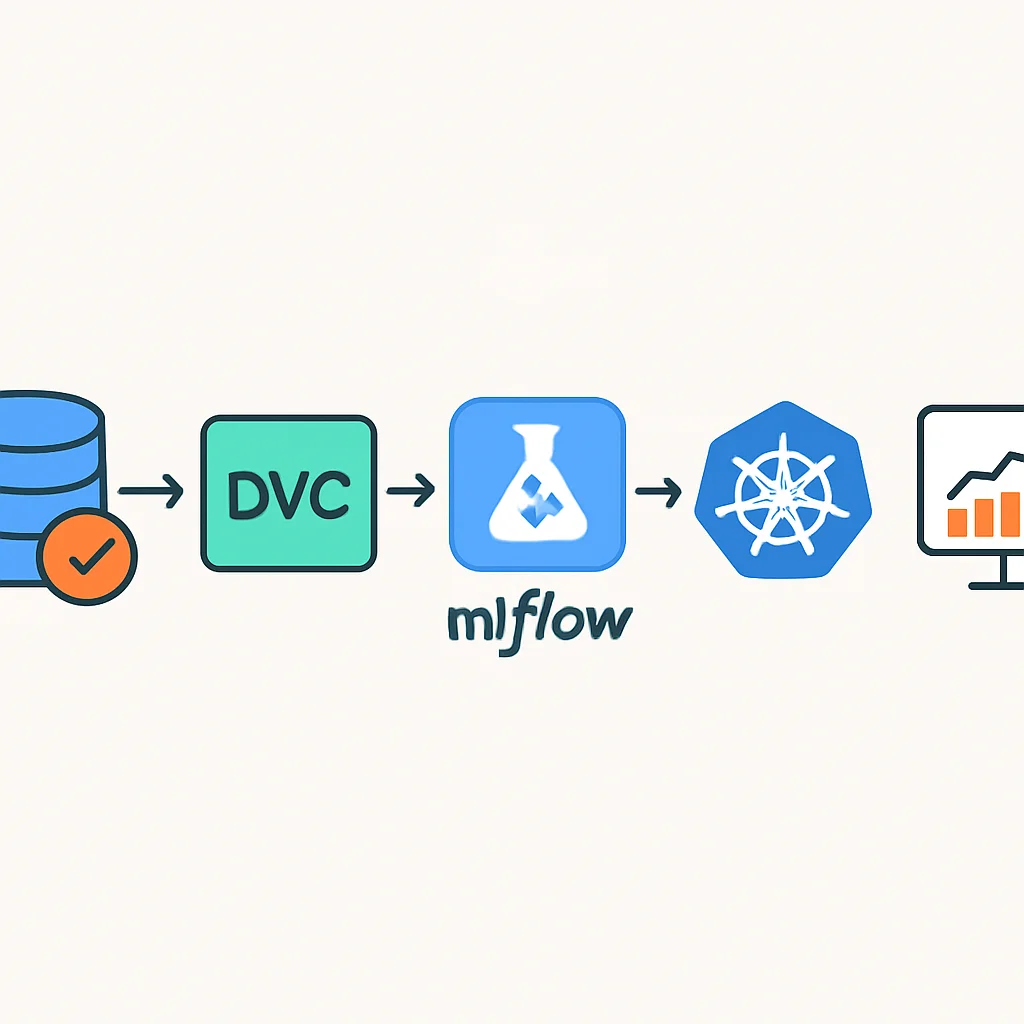
A practical MLOps workflow integrates data versioning, automated training with experiment tracking, a structured model registry, robust CI/CD for safe deployment, and continuous monitoring to create a self-healing, adaptive ML system.
Frequently Asked Questions (FAQ)
Q. What is the primary difference between MLOps and traditional DevOps?
MLOps extends DevOps principles to machine learning, specifically addressing complexities like data versioning, experiment tracking, model retraining (Continuous Training), and monitoring for data/concept drift, which are not typically found in traditional software deployments.
Q. Why is data versioning so important in MLOps?
Data versioning is crucial for reproducibility and debugging. It ensures that you can always trace which specific dataset was used to train a particular model version, allowing you to re-create past results or investigate performance changes due to data shifts.
Q. What is model drift and why should I monitor for it?
Model drift refers to the degradation of a model’s performance over time due to changes in the underlying data (data drift) or the relationship between features and target (concept drift). Monitoring for drift is essential to ensure models remain accurate and relevant in dynamic real-world environments, triggering timely retraining.
Q. How do MLOps tools like MLflow or Kubeflow help streamline the ML lifecycle?
MLflow provides components for experiment tracking, project packaging, and model management, simplifying reproducibility and collaboration. Kubeflow, on the other hand, offers an end-to-end platform for deploying and managing ML workloads on Kubernetes, ideal for complex, scalable pipelines.
Q. What are the key considerations for deploying ML models safely?
Safe deployment involves strategies like blue/green deployments, canary releases, and A/B testing. These methods allow new model versions to be introduced gradually and monitored in production, minimizing risks and enabling quick rollbacks if performance issues arise.
WRAP-UP
Wrapping Up: The Future of Production ML
The journey from an experimental machine learning model to a robust, production-grade AI application is complex, but with MLOps, it’s an achievable and essential endeavor. As we’ve explored, MLOps is not just a collection of tools but a culture and a set of practices that ensure the continuous delivery, deployment, and monitoring of ML systems.
In 2026, the demand for reliable, scalable, and explainable AI is higher than ever. By embracing MLOps principles – from meticulous data versioning and experiment tracking to automated CI/CD and comprehensive monitoring for drift and fairness – developers can build systems that are not only performant but also resilient, auditable, and compliant with emerging regulations. This structured approach significantly reduces time-to-market for new models, minimizes operational risks, and fosters a collaborative environment between data scientists, ML engineers, and operations teams.
The MLOps landscape will continue to evolve, with increasing integration of AI safety, ethical AI frameworks, and perhaps even more sophisticated autonomous systems that can self-heal and adapt. For now, mastering the fundamentals outlined in this guide will equip you with the knowledge and tools to confidently navigate the challenges of production ML and build the intelligent systems of tomorrow.
KEY POINT
MLOps is the bridge to sustainable AI, transforming experimental models into reliable, scalable, and compliant production systems, which is paramount for innovation and success in the current and future AI landscape.
Thanks for reading!
We hope this guide empowers you to build more robust and efficient MLOps pipelines for your machine learning projects.
Got questions or insights to share about your MLOps journey? Drop a comment below!