
SUMMARY
Developer Salary Negotiation Guide: Maximize Your Tech Job Offer in 2026
A comprehensive guide for developers on how to confidently negotiate their salary, ensuring you get the compensation you deserve in 2026.
Keywords: developer salary, salary negotiation, tech job offer
TABLE OF CONTENTS
1 Why It Matters: The Power of Negotiation in 2026
2 Core Methods: Your Step-by-Step Negotiation Blueprint
3 Practical Application: Crafting Your Negotiation Strategy
4 Common Pitfalls & Mistakes to Avoid
5 Frequently Asked Questions
6 Wrap-Up: Your Future, Negotiated.
MOTIVATION
Why It Matters: The Power of Negotiation in 2026
Hey there, Kwonglish fam! Let’s talk about something crucial that many developers shy away from: salary negotiation. You’ve poured countless hours into mastering algorithms, building impressive projects, and debugging complex systems. You’re a problem-solver, an innovator, and a highly sought-after talent in the tech world. So why is it that when an offer comes in, so many of us just… accept it?
In 2026, the tech landscape is as dynamic as ever. While some sectors are experiencing shifts, the demand for skilled developers remains robust. However, simply getting an offer isn’t enough; securing the best offer is where your true value is recognized. Think about it: a small percentage increase in your starting salary compounds over your entire career. It affects your bonuses, your stock options, your retirement savings, and even your future negotiating power.
Many developers, particularly those early in their careers, often feel uncomfortable discussing money. We’re taught to be humble, to focus on the work, and to be grateful for opportunities. While these are admirable traits, they can actively work against you when it comes to compensation. Companies expect you to negotiate; it’s part of the game. Not negotiating is often seen as a sign of under-valuing yourself, or simply not understanding market rates.
“The single biggest raise you’ll ever get is often the one you negotiate at the start of a new job.”
— Kwonglish
Let’s consider the long-term impact. Imagine two developers, both starting at the same company with similar skills. Developer A accepts an offer of $120,000. Developer B, using smart negotiation tactics, secures $130,000. Assuming a modest 5% annual raise, after just five years, Developer B would have earned significantly more, and their base for future raises would be higher. This gap only widens over a 10- or 20-year career. It’s not just about the initial number; it’s about setting a higher trajectory for your financial future.
In 2026, with inflation rates still a consideration and the cost of living continuing to rise in major tech hubs, maximizing your compensation isn’t a luxury; it’s a necessity. This guide is designed to empower you with the knowledge and confidence to approach salary negotiation like a pro. We’ll cover everything from meticulous research to crafting compelling counter-offers, ensuring you walk away with the best possible deal.
KEY POINT
Negotiating your initial job offer can have a cumulative impact of hundreds of thousands of dollars over your career. It’s not just about the immediate gain, but about establishing a higher financial baseline for your entire professional journey.

STRATEGY
Core Methods: Your Step-by-Step Negotiation Blueprint
Negotiation isn’t a mystical art; it’s a skill built on preparation, confidence, and strategic communication. Here’s a step-by-step blueprint to guide you.
Step 1: Research and Understand Your Value
1
Know Your Market Value
Before you even think about an offer, you need to know what you’re worth. This isn’t just a number; it’s a range based on multiple factors.
Your market value is determined by a combination of your experience level, specific tech stack (e.g., Python, React, AWS, Machine Learning), geographic location (cost of living varies wildly), company size and type (startup vs. FAANG), and current market demand for your skills. Don’t rely on anecdotal evidence; use reliable data sources.
Key Resources for 2026:
- Levels.fyi: Excellent for detailed compensation data, especially for larger tech companies, breaking down base, stock, and bonus. Filter by company, role, level, and location.
- Glassdoor & Indeed: Provide salary ranges based on user submissions and job postings. Be mindful that data quality can vary.
- LinkedIn Salary: Offers insights based on LinkedIn member data, often providing more personalized estimates.
- Hired.com & Triplebyte: These platforms often share salary benchmarks for candidates on their networks.
- Local Tech Meetups & Communities: Networking with peers can provide invaluable qualitative data and insights into local compensation trends.
When researching, look for data points that closely match your profile. Are you a Senior Software Engineer with 7 years of experience in San Francisco, specializing in Go and Kubernetes? Find data for that specific combination. Don’t just look at a generic “Software Engineer” average.
CODE EXPLANATION
This Python snippet demonstrates how you might organize and analyze hypothetical salary data. While you’d typically pull data from APIs or scraped sources, this shows a basic structure for understanding compensation components and calculating averages for comparison.
import pandas as pd

# Hypothetical salary data for different roles/locations in 2026
data = {
    'Role': ['Software Engineer', 'Senior Software Engineer', 'Staff Engineer', 'Software Engineer', 'Senior Software Engineer'],
    'Location': ['NYC', 'NYC', 'SF', 'Austin', 'Austin'],
    'Experience_Years': [3, 7, 10, 2, 6],
    'Base_Salary': [120000, 180000, 250000, 100000, 160000],
    'Stock_Equity_USD': [20000, 80000, 150000, 10000, 60000],
    'Bonus_USD': [5000, 15000, 25000, 3000, 10000],
    'Total_Comp_USD': [145000, 275000, 425000, 113000, 230000]
}

df = pd.DataFrame(data)

print("--- Initial Salary Data ---")
print(df)
print("\n")

# Calculate average total compensation for a specific role/location
nyc_senior_se = df[(df['Role'] == 'Senior Software Engineer') & (df['Location'] == 'NYC')]
if not nyc_senior_se.empty:
    avg_tc_nyc_senior = nyc_senior_se['Total_Comp_USD'].mean()
    print(f"Average Total Comp for Senior SE in NYC: ${avg_tc_nyc_senior:,.2f}")
else:
    print("No data for Senior SE in NYC.")

# Function to estimate your target range
def estimate_target_range(role, location, experience, df_data):
    relevant_data = df_data[(df_data['Role'] == role) &
                            (df_data['Location'] == location) &
                            (df_data['Experience_Years'] >= experience - 2) &
                            (df_data['Experience_Years'] <= experience + 2)]

    if not relevant_data.empty:
        min_tc = relevant_data['Total_Comp_USD'].min()
        max_tc = relevant_data['Total_Comp_USD'].max()
        avg_tc = relevant_data['Total_Comp_USD'].mean()
        return f"Estimated TC Range for {role} in {location} with {experience} yrs exp: ${min_tc:,.2f} - ${max_tc:,.2f} (Avg: ${avg_tc:,.2f})"
    else:
        return f"No relevant data found for {role} in {location} with {experience} yrs exp."

print("\n--- Your Estimated Target Range ---")
print(estimate_target_range('Software Engineer', 'Austin', 2, df))
print(estimate_target_range('Staff Engineer', 'SF', 10, df))
Step 2: Build Your Negotiation Levers
2
Identify Your Strengths
What makes you stand out? Your unique skills, experience, and accomplishments are your strongest negotiation assets.
Once you know your market value, you need to articulate why you deserve to be at the higher end of that range. This involves highlighting your specific achievements and how they align with the company’s needs. Did you lead a project that saved the company thousands? Did you implement a new technology that improved performance by 30%? Quantify your impact whenever possible.
Another powerful lever is having multiple offers. This is why the advice “Always Be Interviewing” (ABI) is so prevalent in tech. Even if you’re happy in your current role, staying active in the interview market keeps your skills sharp and gives you a realistic sense of your market demand. When you receive an offer, having a competing one immediately strengthens your position. It tells the hiring company that other reputable organizations also recognize your value.
KEY POINT
Your strongest negotiation leverage comes from a combination of clearly articulated past achievements (quantified impact) and, ideally, competing offers that validate your market value.
Step 3: Master the Art of the Counter-Offer
3
Strategize Your Response
Once you receive an offer, take a deep breath. Don’t accept on the spot. Express enthusiasm, but ask for time to review the offer thoroughly.
When you get an offer, your immediate response should be positive but non-committal. Something like, “Thank you so much for this exciting offer! I’m really thrilled about the opportunity to join [Company Name]. I’d love to take a couple of days to review the details.” This buys you time to analyze the offer against your research and prepare your counter.
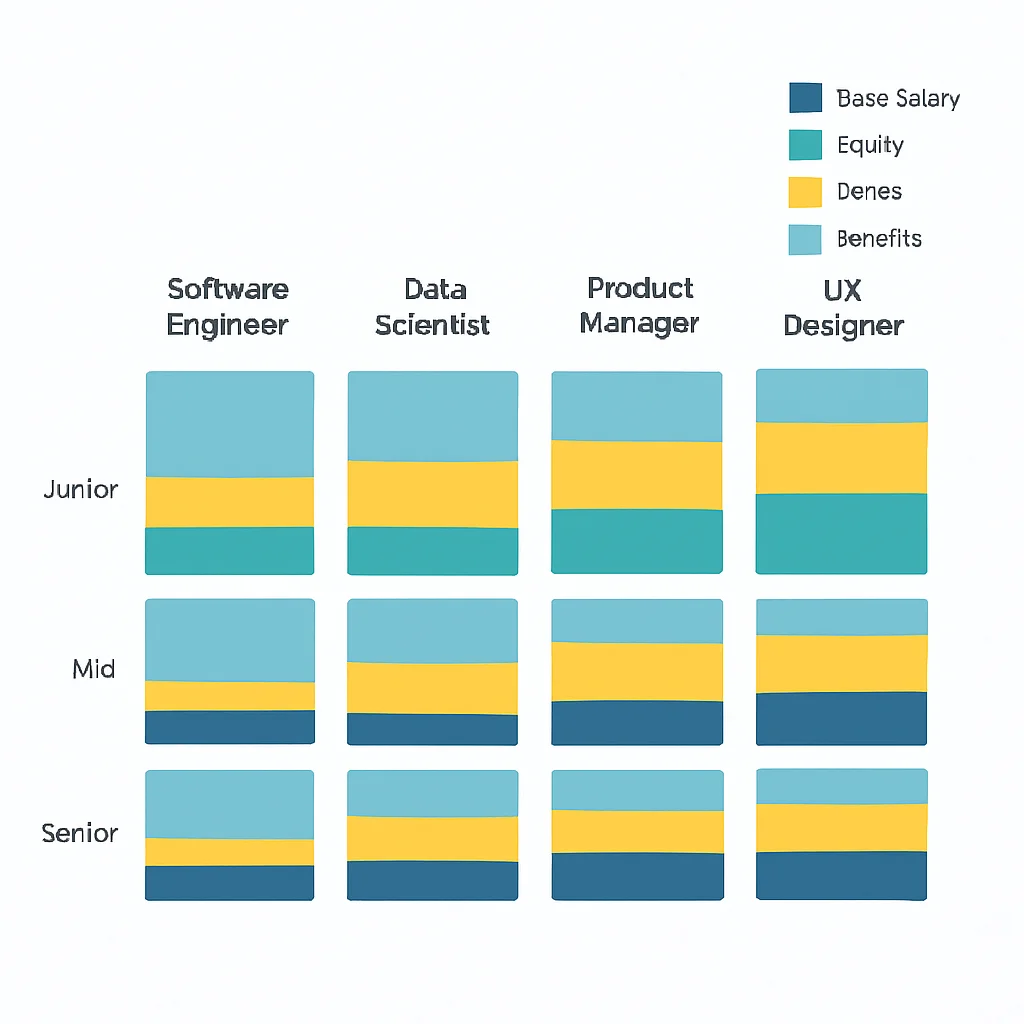
When you present your counter-offer, always focus on the Total Compensation (TC), not just the base salary. This includes base salary, annual bonus, stock/equity (RSUs, options), signing bonus, relocation assistance, and benefits (health, 401k match, PTO, learning stipends). Sometimes, a company might have a fixed base salary range but flexibility in other areas.
Your counter-offer should be a specific number or a narrow range, backed by your research and value proposition. For example, “Based on my extensive experience in [specific skill] and my understanding of the market rate for a [Your Role] in [Location], I was expecting a total compensation package closer to $X,000. Is there flexibility to reach that figure?” If you have a competing offer, you can subtly mention it: “I also have another offer for $Y,000 TC, and while I’m very excited about [Company Name], I’d need to see a more competitive package to make the move.”
Total Compensation Components
Base Salary — Your regular, fixed income.
Stock/Equity (RSUs/Options) — Ownership in the company, often vesting over several years.
Annual Bonus — Performance-based cash bonus, usually a percentage of base.
Signing Bonus — One-time cash payment upon joining.
Benefits — Health insurance, 401k match, unlimited PTO, relocation, learning stipends, gym memberships, etc.
Perks — Free food, transportation, home office setup budget.
Step 4: Handle Objections Gracefully
4
Navigate Pushbacks
Recruiters might push back. Stay calm, reiterate your value, and be prepared to compromise on non-essentials.
It’s rare for a company to immediately meet your counter-offer. They might say, “That’s outside our budget,” or “That’s the top of the band for this role.” This is where grace and persistence come in. Don’t take it personally. Reiterate your enthusiasm for the role and the company, then pivot back to your value.
For example, “I understand budget constraints are a reality. However, given my track record of [specific achievement] and my unique expertise in [key technology], I believe I can bring exceptional value to your team. While the base salary might be fixed, is there any flexibility in the signing bonus or equity package to help bridge that gap?” This shows you’re collaborative and focused on a mutually beneficial outcome, rather than being rigid.
“Negotiation is not a battle; it’s a conversation aimed at finding common ground where both parties feel valued.”
— Chris Voss, Former FBI Negotiator
Be prepared to walk away if your minimum acceptable offer isn’t met, but do so respectfully. Sometimes, saying “no” to the wrong offer opens the door to a much better one. However, always ensure you have a clear understanding of your bottom line before you enter negotiations.
APPLICATION
Practical Application: Crafting Your Negotiation Strategy
Negotiation isn’t a one-size-fits-all process. Your approach will vary depending on your career stage and the specific situation. Let’s look at a few common scenarios.
Scenario 1: First Job Offer (New Grad/Junior Developer)
New Grad Negotiation
Focus on growth potential and market alignment.
As a new grad or junior developer, your leverage might feel limited, but it’s not non-existent. Companies often have structured bands for entry-level roles, but there’s usually a range. Your goal is to land at the higher end of that range. Emphasize any relevant internships, side projects, academic achievements, or unique skills you bring.
For example, if the offer is $90,000, and your research shows similar roles in your area are paying $90,000 – $100,000, you could say: “I’m incredibly excited about the opportunity to start my career at [Company Name]. Based on my understanding of the market and my strong performance during my internship at [Previous Company] where I [quantifiable achievement], I was hoping for a starting salary closer to $95,000. Is there any room to adjust the base salary or perhaps offer a small signing bonus?” This shows you’ve done your homework and value your contributions, even as a junior.
KEY POINT
Even as a new grad, negotiating is expected. Focus on demonstrating your potential, relevant experiences (internships, projects), and market research to justify a higher offer within the typical junior range.
Scenario 2: Mid-Career Move (Experienced Developer)
Experienced Pro Negotiation
Leverage expertise, leadership, and proven impact.
This is where your negotiation power truly shines. With several years of experience, you have a track record of accomplishments. You should be negotiating beyond just base salary, focusing on the entire total compensation package. Your goal is to maximize base, equity, and bonus, and potentially a significant signing bonus.
When countering, articulate how your specific skills (e.g., “my 5 years of experience building scalable microservices with Kafka and Go”) directly address the company’s challenges. If you have competing offers, use them as leverage. “I’m currently evaluating an offer from [Competing Company] for a Staff Engineer role at $300,000 TC, with a strong equity component. While I’m very excited about the mission and team at [Current Company], I’d need to see a more competitive total package to make a move that aligns with my market value and career trajectory.”
Don’t forget about non-monetary benefits too. Can you negotiate for a specific training budget, a more flexible work schedule, or a title bump that better reflects your responsibilities? These can add significant long-term value.
Mid-Career Negotiation Checklist
☑ Researched precise market value for your specific tech stack and location
☑ Quantified past achievements and impact
☑ Prepared a clear target Total Compensation (TC) range
☑ Identified all components of the offer (base, equity, bonus, signing bonus, benefits)
☑ Prepared to leverage competing offers (if applicable)
☑ Considered non-monetary perks (flexibility, training, title)
☑ Practiced your counter-offer script
Scenario 3: Internal Promotion or Raise
Internal Compensation Review
Build a strong case based on performance and new responsibilities.
Negotiating an internal raise or promotion requires a different strategy. You already have a relationship and a performance history. The key here is building a strong, data-backed case for why you deserve more. Document your accomplishments since your last review or promotion. Show how you’ve exceeded expectations, taken on new responsibilities, mentored others, or delivered significant projects.
Research internal salary bands for your new role or equivalent level. If you’re taking on responsibilities typically assigned to a Senior or Staff Engineer, ensure your title and compensation reflect that. Frame your request around your increased value to the company. “Since my last review, I’ve successfully led the migration to [New Tech Stack], resulting in a 15% reduction in operational costs. I’ve also taken on mentorship for two junior developers. Based on these contributions and my research into market rates for a [New Title] at companies of our size, I’m requesting a salary adjustment to $X,000 and an increase in my equity grant.”
CAUTIONS
Common Pitfalls & Mistakes to Avoid
Even with the best intentions, it’s easy to stumble during negotiation. Being aware of these common mistakes can help you navigate the process more smoothly.
1. Revealing Salary History Too Early
This is a classic trap. Recruiters often ask for your current or past salary. In many places, it’s now illegal for them to ask, but they might try to infer it. Your best response is to politely deflect. “I’m focusing on opportunities that are a strong mutual fit and am open to compensation packages competitive with the market rate for this role.” Or, “My compensation expectations for this role are between $X,000 - $Y,000 TC, depending on the full scope of responsibilities.” Keep the focus on the future, not the past.
2. Not Negotiating at All
As discussed, this is the biggest mistake. Many candidates fear losing the offer, but in most reputable companies, withdrawing an offer simply because you negotiated is extremely rare. They’ve invested time and resources in you; they want you to join. Negotiation shows confidence and a clear understanding of your worth.
WARNING
Never give a specific number for your desired salary before the company has made an offer. If pressed, provide a broad range based on your market research, emphasizing total compensation.
3. Being Aggressive, Not Assertive
There’s a fine line between confident negotiation and being demanding or entitled. Maintain a collaborative, polite, and professional tone throughout. You want to build a positive relationship with your future employer, not start a contentious one. Frame your requests as a desire to find a mutually beneficial agreement.
4. Ignoring Total Compensation
Fixating solely on base salary means you might miss out on significant value. A lower base salary with substantial equity at a high-growth startup could be more lucrative long-term than a higher base at a stagnant company. Always look at the entire package, including benefits that might save you money (e.g., excellent health coverage, generous 401k match).
Pros of Negotiating
✔ Higher starting salary and total compensation
✔ Increased long-term earnings potential (compounding effect)
✔ Demonstrates confidence and self-worth
✔ Sets a stronger precedent for future raises/promotions
✔ Potentially better benefits, equity, or perks
Cons of Not Negotiating
✖ Leaving substantial money on the table
✖ Lower long-term financial trajectory
✖ Potential for feeling undervalued or regret
✖ Missing out on better benefits or equity packages

Frequently Asked Questions
Q. Is it always appropriate to negotiate a developer job offer in 2026?
A. Yes, almost always. Companies expect candidates to negotiate, and not doing so can leave significant money and benefits on the table. It’s a standard part of the hiring process in the tech industry.
Q. What if the company says there’s no room for negotiation?
A. If they truly have no flexibility on base salary, politely inquire about other components of the total compensation package. This could include a higher signing bonus, more equity, increased vacation time, professional development budget, or even a different job title that could lead to higher pay in the future.
Q. How long should I take to respond to an offer?
A. It’s standard to ask for 3-5 business days to review an offer. If you’re managing multiple offers or need more time, politely explain your situation and ask for an extension. Most companies are accommodating within reason.
Q. Can I lose a job offer by negotiating too aggressively?
A. While rare, it is possible if you are excessively demanding, unprofessional, or make unreasonable demands without proper justification. The key is to be assertive, not aggressive, and always maintain a positive, collaborative tone, backing your requests with data and your value proposition.
CONCLUSION
Wrap-Up: Your Future, Negotiated.
You’ve made it! By now, you should feel much more equipped to confidently approach salary negotiation. Remember, this isn’t about being greedy; it’s about advocating for your worth and ensuring you’re compensated fairly for the immense value you bring as a developer.
The tech industry values problem-solvers, and negotiation is just another complex problem to solve, albeit one with a very personal reward. Do your research, understand your value, build your leverage, and communicate clearly and professionally. Every negotiation is a learning experience, and with practice, you’ll become a master at maximizing your tech job offers.
Don’t leave money on the table in 2026. Go forth, negotiate with confidence, and secure the compensation you truly deserve. Your career and your bank account will thank you for it!

Ready to Level Up Your Earnings?
We hope this guide empowers you to confidently approach your next salary negotiation. Your skills are valuable, and it’s time your compensation reflects that.
Got questions or a successful negotiation story to share? Drop a comment below and let the Kwonglish community learn from your experience!