
SUMMARY
Ace Your Tech Interview in 2026: A Developer’s Guide to Success
Master the art of tech interviews in 2026 with this comprehensive guide for developers.
Keywords: Tech Interview, Developer Interview, Coding Interview
TABLE OF CONTENTS
1. Why It Matters: The Evolving Tech Interview Landscape in 2026
2. Core Methods: The Pillars of Interview Success
3. Practical Application: Your 2026 Preparation Roadmap
4. Common Pitfalls & Mistakes to Avoid
5. Frequently Asked Questions (FAQ)
6. Wrap-Up: Your Journey to Success
INTRODUCTION
Why It Matters: The Evolving Tech Interview Landscape in 2026
Hey there, future tech leader! Kwonglish here, and if you’re a developer eyeing that dream job in 2026, you know the interview process can feel like navigating a complex maze. The tech landscape is constantly shifting, and what worked a couple of years ago might not cut it today. Companies are looking for more than just coding prowess; they seek problem-solvers, collaborators, and innovators who can adapt to new challenges and contribute to a dynamic team culture.
In 2026, the demand for skilled software engineers remains incredibly high, but so does the competition. According to a recent report by LinkedIn, software development roles continue to be among the most in-demand globally, with a projected growth rate of 25% over the next decade. This means more opportunities, but also a more rigorous selection process. Recruiters and hiring managers are refining their interview techniques to identify candidates who possess a blend of technical mastery, strong communication skills, and a genuine passion for continuous learning.
Gone are the days when a simple data structures and algorithms test was enough. Today’s interviews are holistic, often involving multi-stage processes that include in-depth coding challenges, realistic system design scenarios, and thorough behavioral assessments. The goal isn’t just to see if you can write code, but if you can think critically, collaborate effectively, and thrive in a fast-paced environment. This guide is designed to equip you with the strategies, knowledge, and confidence to not just pass, but ace your tech interviews in 2026.
“The best way to predict the future is to create it. And in tech interviews, that means preparing relentlessly and strategically.”
KEY POINT
Tech interviews in 2026 demand a holistic approach: master coding, system design, and behavioral skills to stand out in a competitive market. Preparation is about more than just knowing answers; it’s about demonstrating your problem-solving process and cultural fit.
So, whether you’re a fresh graduate looking for your first big break, or an experienced engineer aiming for a senior role at a FAANG company or an innovative startup, this guide will walk you through the essential components of modern tech interviews. We’ll cover everything from sharpening your data structures and algorithms skills to designing scalable systems and articulating your experiences effectively. Let’s dive in and get you ready to shine!
CORE METHODS
Core Methods: The Pillars of Interview Success
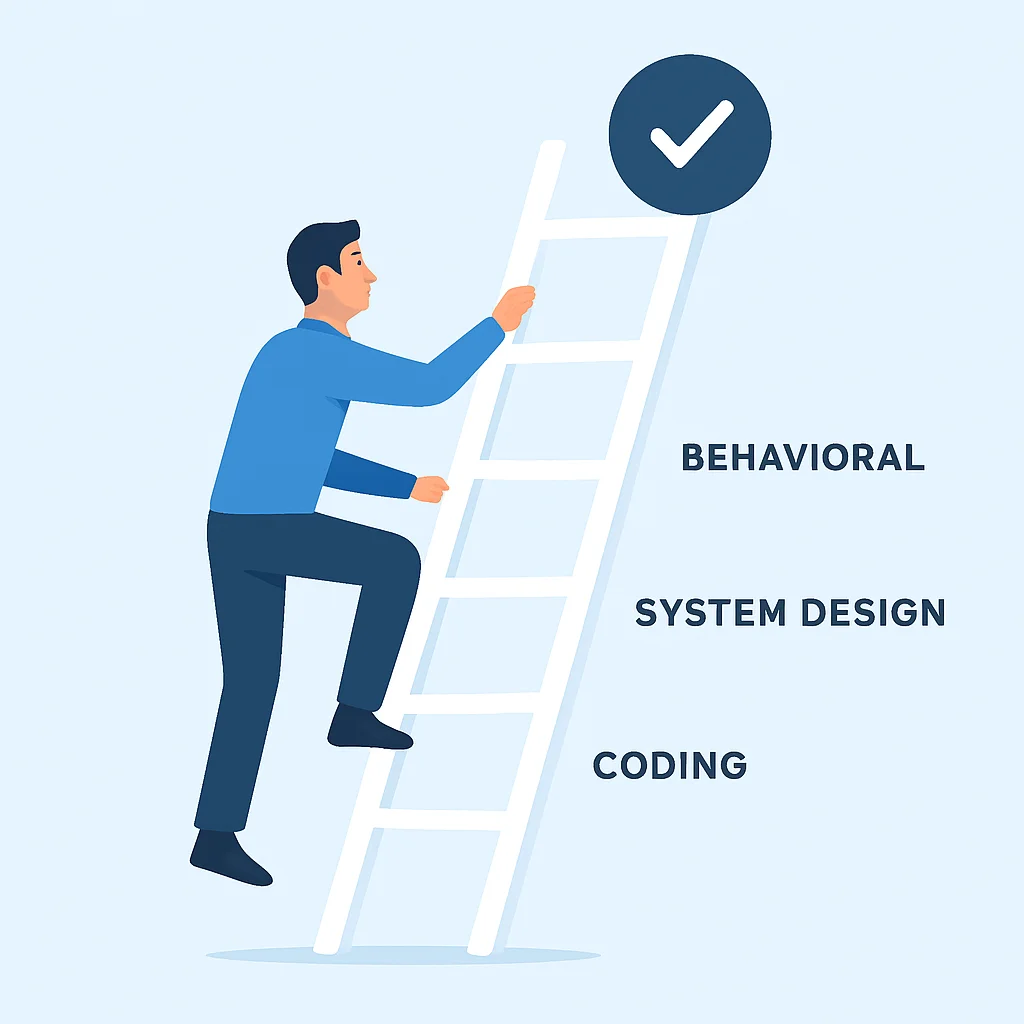
To truly ace your tech interview in 2026, you need to understand the three main pillars that most companies assess: coding, system design, and behavioral skills. Each pillar tests a different facet of your capability as a developer, and mastering all three is crucial for comprehensive success.
1. Coding Challenges: Data Structures & Algorithms
This is often the first hurdle, and for good reason. Coding challenges test your foundational computer science knowledge, problem-solving abilities, and your capacity to write efficient, clean code. Expect questions on arrays, linked lists, trees, graphs, hash maps, sorting algorithms, dynamic programming, and more.
The key isn’t just memorizing solutions, but understanding the underlying principles and trade-offs. Interviewers want to see your thought process: how you break down a problem, consider different approaches (brute force, optimized), analyze time and space complexity (Big O notation), and handle edge cases.
KEY POINT
For coding challenges, focus on understanding the “why” behind data structures and algorithms, not just the “how.” Articulate your thought process, analyze complexity, and handle edge cases.
Example: Finding Duplicates in an Array
Let’s consider a common coding problem: “Given an array of integers, return true if any value appears at least twice in the array, and return false if every element is distinct.”
CODE EXPLANATION
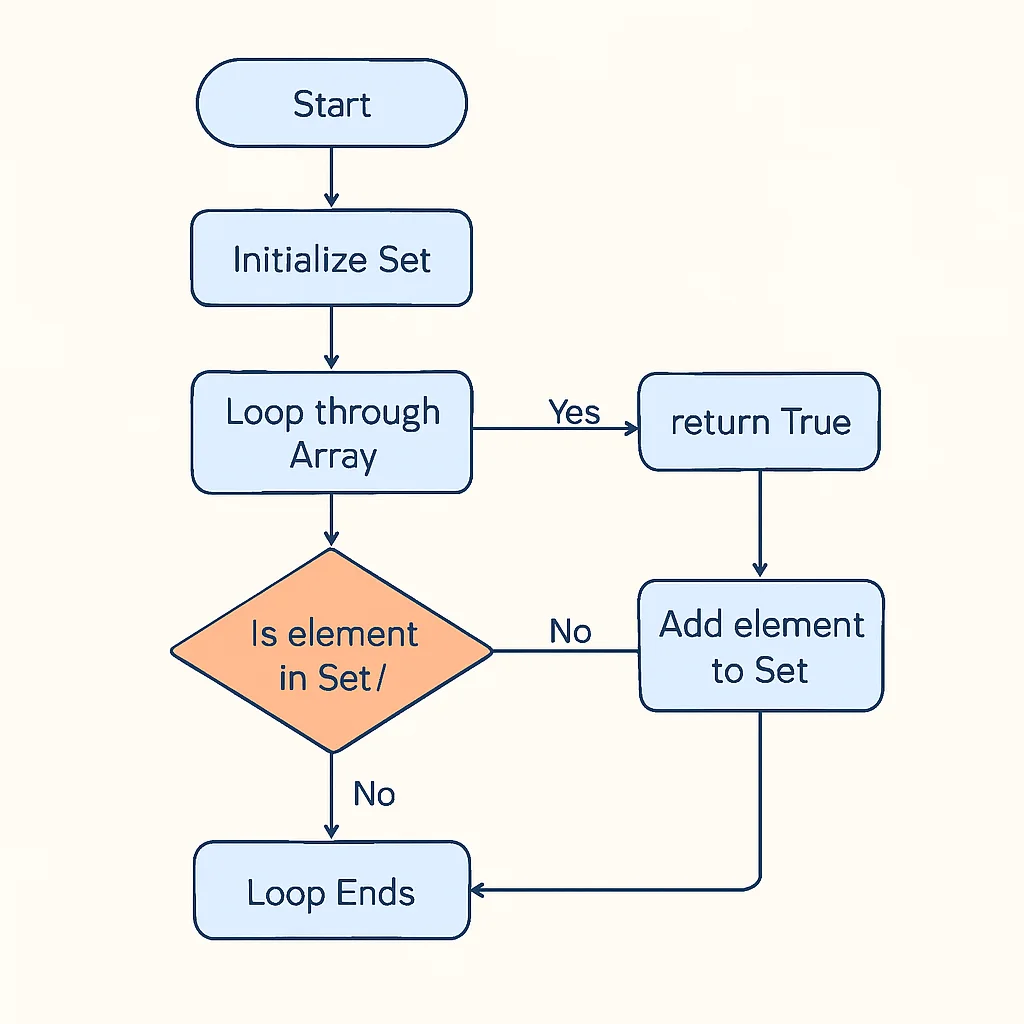
This Python code snippet demonstrates an efficient way to check for duplicates in an array using a hash set. It iterates through the array once, adding each element to the set. Before adding, it checks if the element is already in the set. If it is, a duplicate exists, and the function immediately returns True. If the loop completes without finding duplicates, it returns False.
def containsDuplicate(nums: list[int]) -> bool:
    seen = set() # Initialize an empty hash set
    for num in nums:
        if num in seen: # Check if the number is already in the set
            return True # Duplicate found
        seen.add(num) # Add the number to the set
    return False # No duplicates found

# Test cases
print(containsDuplicate([1,2,3,1])) # Expected: True
print(containsDuplicate([1,2,3,4])) # Expected: False
print(containsDuplicate([1,1,1,3,3,4,3,2,4,2])) # Expected: True
This approach has a time complexity of O(N) because, in the worst case, we iterate through the array once. The space complexity is also O(N) because, in the worst case, we store all unique elements in the hash set. This is generally more efficient than sorting (O(N log N)) or nested loops (O(N^2)).
2. System Design Interviews
System design interviews are typically for mid-level to senior roles and are designed to assess your ability to build large-scale, distributed systems. You’ll be asked to design a system like Twitter, Netflix, a URL shortener, or a ride-sharing service. This isn’t about writing code, but about discussing architectural choices, trade-offs, and how different components interact.
Key areas to focus on include:
- Scalability: How does the system handle increased load? (e.g., load balancers, horizontal scaling, caching)
- Reliability & Availability: How does it remain operational despite failures? (e.g., redundancy, fault tolerance, replication)
- Performance: How quickly does it respond? (e.g., CDN, database indexing, asynchronous processing)
- Data Storage: Choosing the right database (SQL vs. NoSQL), data partitioning, consistency models.
- APIs & Communication: Designing RESTful APIs, message queues, gRPC.
- Security: Authentication, authorization, data encryption.
The interview is a conversation. Start by clarifying requirements, then propose a high-level design, and iterate on specific components based on interviewer feedback. Always justify your choices with pros and cons.
Use Case: Designing a URL Shortener
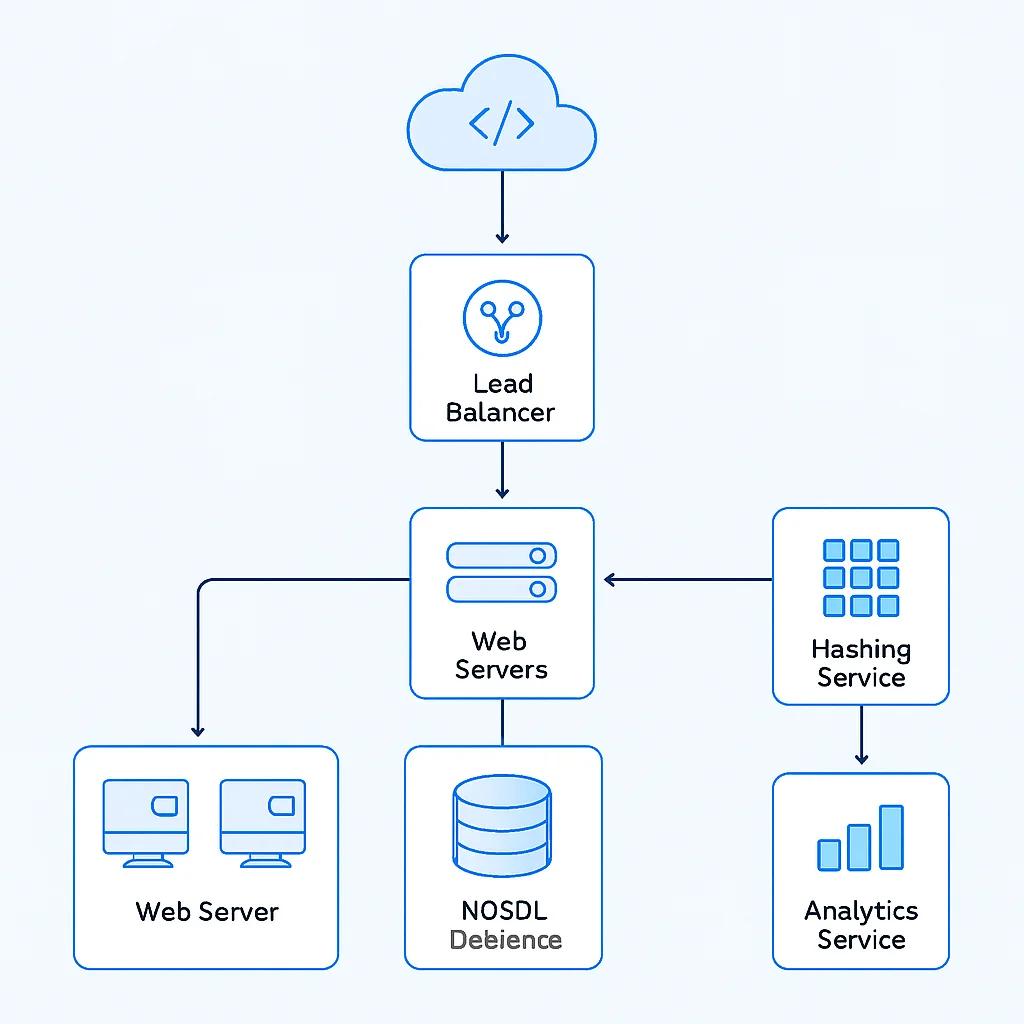
When designing a URL shortener like Bit.ly, you’d discuss components such as a web server, a database to store long URL-short URL mappings, a hashing algorithm for generating short codes, and considerations for uniqueness, collision handling, and redirection. You’d also consider analytics, custom short URLs, and rate limiting.
KEY POINT
For system design, focus on a structured approach: clarify requirements, propose a high-level architecture, dive deep into components, and always discuss trade-offs and justify your design decisions. Think about the “ilities”: scalability, reliability, availability, maintainability.
3. Behavioral & Cultural Fit Interviews
Often underestimated, behavioral interviews are critical. Companies want to hire individuals who not only have the skills but also fit into their team culture, communicate well, and handle workplace challenges effectively. These interviews explore your past experiences to predict your future behavior.
Common questions include:
- “Tell me about a time you faced a significant technical challenge and how you overcame it.”
- “Describe a situation where you had a disagreement with a team member. How did you resolve it?”
- “What’s your biggest weakness, and what are you doing to improve it?”
- “Why are you interested in this role/company?”
The best way to answer these questions is using the STAR method:
The STAR Method for Behavioral Questions
S – Situation: Briefly describe the context or background of the situation.
T – Task: Explain your specific role and responsibilities in that situation.
A – Action: Detail the actions you took to address the task or challenge.
R – Result: Conclude with the outcome of your actions and what you learned.
KEY POINT
Prepare 5-7 robust stories using the STAR method that highlight your problem-solving, teamwork, leadership, and learning abilities. Practice articulating them clearly and concisely, focusing on your impact and the lessons learned.
PREPARATION ROADMAP
Practical Application: Your 2026 Preparation Roadmap
Now that you know what to expect, let’s break down how to effectively prepare for your tech interviews in 2026. This isn’t a sprint; it’s a marathon. A structured, consistent approach will yield the best results.
1
Assess Your Current Skills & Knowledge Gaps
Before you start grinding, take stock. What are your strengths? Where do you need improvement? Try solving a few random LeetCode problems (easy, medium, hard) to gauge your coding proficiency. Review system design concepts you’re less familiar with. Reflect on your past projects and identify areas where you could have applied certain patterns or technologies. This self-assessment will help you create a targeted study plan.
2
Develop a Structured Learning Plan
Once you know your gaps, build a daily or weekly study schedule. Dedicate specific blocks of time to data structures, algorithms, system design topics, and behavioral questions. Consistency is key. For example, you might spend 1-2 hours daily: 45 minutes on a coding problem, 30 minutes reviewing a system design concept, and 15 minutes refining behavioral answers. There are many fantastic resources available in 2026:
Pros of Online Platforms (LeetCode, HackerRank, AlgoExpert)
✓ Vast library of problems, categorized by topic and difficulty.
✓ Immediate feedback on code correctness and performance.
✓ Community solutions and discussions for deeper understanding.
Cons of Over-reliance on Platforms
✗ Can lead to memorization rather than true problem-solving skill development.
✗ May not replicate the pressure or conversational aspect of a real interview.
✗ Can be overwhelming without a structured approach.
3
Practice, Practice, Practice – With Intent
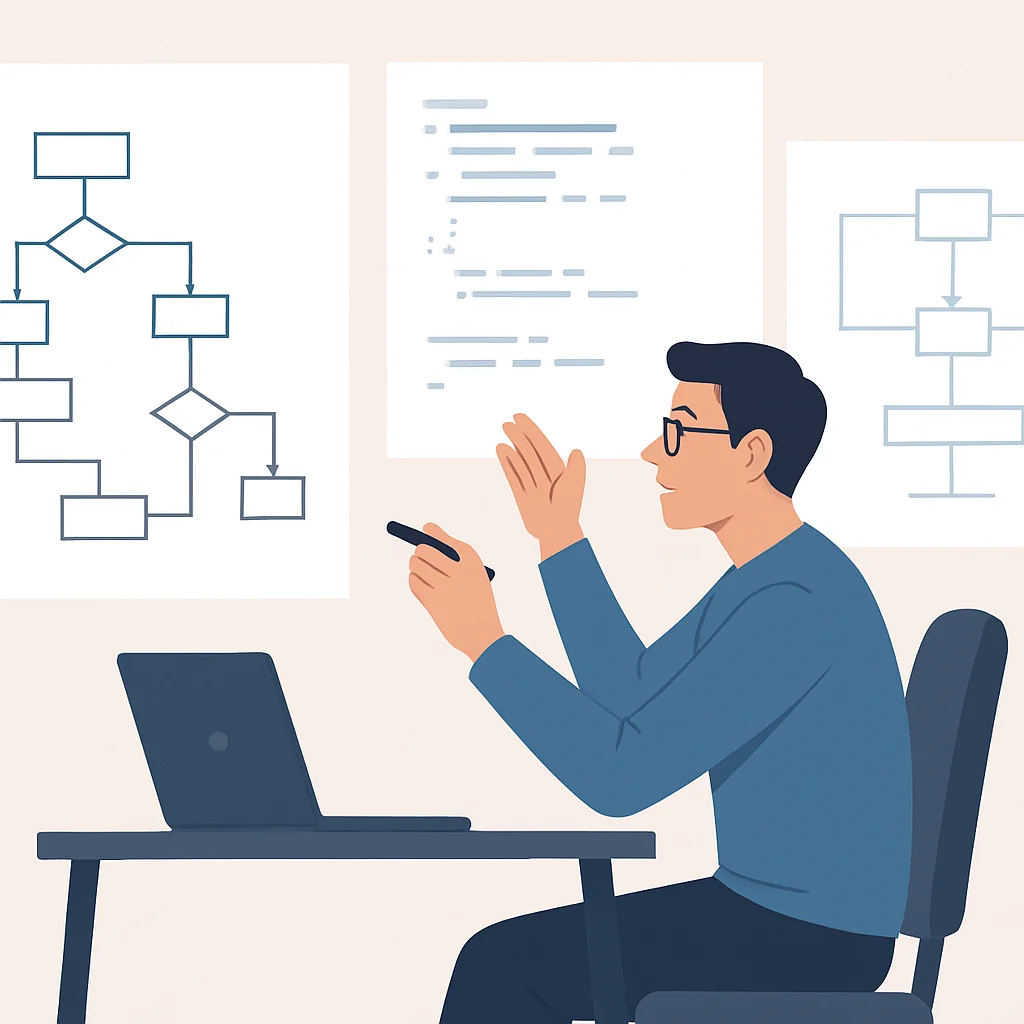
Solving problems isn’t enough; you need to practice the interview experience. When tackling a coding problem, articulate your thoughts aloud as if an interviewer is listening. Discuss your initial brute-force ideas, then optimize, analyze complexity, and walk through an example. For system design, draw diagrams, ask clarifying questions, and present your solution logically. For behavioral questions, rehearse your STAR stories until they flow naturally.
Aim to solve at least 200-300 coding problems across various topics for entry to mid-level roles, and focus on depth for senior roles. For system design, study 10-15 common designs in detail and be able to draw and explain them from scratch.
Don’t forget to practice in your preferred programming language. If you’re interviewing for a Python role, make sure your Python syntax is sharp and you’re familiar with its standard libraries and common idioms.
4
Mock Interviews & Feedback
This is arguably the most critical step. Mock interviews simulate the real experience, allowing you to practice under pressure and receive constructive feedback. Platforms like Pramp, Interviewing.io, or even a trusted friend/mentor can provide invaluable insights. Aim for at least 3-5 mock coding interviews and 2-3 mock system design interviews before your actual interviews.
WARNING
Don’t skip mock interviews! Many candidates feel confident after solving problems on their own but struggle with time pressure, communication, and whiteboard coding. Mock interviews expose these weaknesses in a low-stakes environment.
KEY POINT
Your preparation should be active: speak your thoughts aloud, draw diagrams, and seek feedback. Don’t just passively consume content or solve problems silently. Simulate the actual interview environment as closely as possible.
Your 2026 Tech Interview Preparation Checklist
✔ Completed a self-assessment of coding, system design, and behavioral skills.
✔ Created a structured, consistent study plan (e.g., daily 1-2 hour sessions).
✔ Solved a diverse set of coding problems (e.g., 50 Easy, 100 Medium, 50 Hard).
✔ Studied and practiced 10-15 common system design problems.
✔ Developed 5-7 STAR stories for behavioral questions.
✔ Conducted at least 3 mock coding interviews with feedback.
✔ Conducted at least 2 mock system design interviews with feedback.
✔ Researched the target company’s culture and specific technologies.
AVOID THESE
Common Pitfalls & Mistakes to Avoid
Even with thorough preparation, some common mistakes can derail your interview. Being aware of these pitfalls can help you steer clear of them.
PROBLEM 01
Jumping Straight to Coding Without Clarification
Many candidates, eager to show their coding skills, will immediately start writing code after hearing a problem. This often leads to misunderstanding requirements, missing edge cases, and ultimately, an incorrect or suboptimal solution. It also signals poor communication skills.
SOLUTION — Always clarify, ask questions, and think aloud.
Before writing any code, take a few minutes to ask clarifying questions about input constraints, expected output, edge cases, and potential ambiguities. For example, “Are the numbers always positive?”, “Can the array be empty?”, “What’s the maximum size of the input?”. Then, articulate your understanding of the problem and propose an initial approach, discussing its complexity, before writing a single line of code. This demonstrates critical thinking and good communication.
PROBLEM 02
Lack of Communication During System Design
In system design interviews, candidates sometimes present a monolithic design without explaining their reasoning or engaging the interviewer. This makes it difficult for the interviewer to understand your thought process and guide you.
SOLUTION — Treat it as a collaborative discussion.
System design is a conversation. Start with high-level components, then dive into details for specific areas. Continuously ask the interviewer for their focus or concerns (“Would you like me to elaborate on the database choice or the API design?”). Discuss trade-offs for every decision you make (e.g., “I’m choosing a NoSQL database here for its scalability, though it might sacrifice some strong consistency guarantees for certain operations.”). Use diagrams and explain each part clearly.
KEY POINT
Communication is paramount. Interviewers are assessing not just your technical answers, but how you arrive at them. Verbalize your thought process, ask clarifying questions, and engage in a dialogue rather than just presenting a solution.

Frequently Asked Questions (FAQ)
Q. How long should I prepare for a tech interview in 2026?
Preparation time varies greatly depending on your current skill level and target roles. For an entry-level position, 2-3 months of consistent, focused study (1-2 hours daily) might suffice. For mid-to-senior roles at top companies, 4-6 months, or even more, is common to master system design and advanced algorithms.
Q. Should I focus on one programming language for coding interviews?
Yes, it’s generally best to master one language (e.g., Python, Java, C++) for coding interviews. This allows you to focus on problem-solving rather than syntax. Ensure it’s a language you’re proficient in and that is commonly accepted by the companies you’re targeting.
Q. What if I get stuck on a coding problem during the interview?
If you get stuck, don’t panic. Verbalize your current thoughts and what you’re struggling with. Ask for a hint from the interviewer; it shows you’re collaborative and know when to seek help. Often, just talking through the problem aloud can help you uncover a solution.
Q. How important is the cultural fit aspect?
Cultural fit is extremely important in 2026. Companies invest heavily in their teams, and they want individuals who will thrive in their environment, contribute positively, and align with their values. Strong technical skills might get you an interview, but cultural fit often determines whether you get the offer.
WRAP-UP
Wrap-Up: Your Journey to Success
Acing your tech interview in 2026 is a challenging but entirely achievable goal. It requires dedication, a structured approach, and a willingness to learn and adapt. Remember that every interview is a learning experience, regardless of the outcome. Embrace the process, stay persistent, and celebrate your progress along the way.
The journey to your dream tech job is unique to you. By focusing on the core pillars of coding, system design, and behavioral skills, and by diligently following a practical preparation roadmap, you’ll be well-equipped to impress hiring managers and land the role you deserve. Kwonglish believes in your potential to succeed!
REFERENCES
LinkedIn: Most In-Demand Jobs in 2026 (Hypothetical)
Pramp: Mock Interview Platform
LeetCode: Coding Practice
Thanks for reading!
Keep learning, keep building, and keep pushing your boundaries. Your next big opportunity is just an interview away.
Got questions or your own interview tips? Drop a comment below and share your wisdom with the Kwonglish community!