SUMMARY
Achieving FIRE as a Developer: Your Step-by-Step Guide to Financial Independence 2026
A comprehensive guide for developers looking to achieve Financial Independence, Retire Early (FIRE).
Keywords: FIRE movement, financial independence, developer finance
TABLE OF CONTENTS
1. Overview: Why Developers Are Primed for FIRE
2. The Core Pillars of FIRE: Save, Invest, Optimize
3. Pillar 1: Supercharging Your Savings Rate
4. Pillar 2: Smart Investing Strategies for Developers
5. Pillar 3: Optimizing Your Developer Income
6. Real-World FIRE Paths for Developers
7. Caveats and Common Pitfalls
8. Frequently Asked Questions (FAQ)
OVERVIEW
Why Developers Are Primed for FIRE
The concept of Financial Independence, Retire Early (FIRE) has captivated many, promising freedom from the traditional 9-to-5 grind long before the conventional retirement age. For software developers and other tech professionals, this dream is not just attainable, but often significantly more accessible than for many other professions. Why? A combination of high earning potential, strong demand, and a culture that increasingly embraces remote work.
In 2026, the tech industry continues its robust growth, with average developer salaries in major tech hubs often ranging from $120,000 to $250,000+ annually, depending on experience, specialization, and location. This high income provides a crucial advantage: the ability to achieve exceptionally high savings rates, which is the cornerstone of the FIRE movement. A higher savings rate directly translates to a shorter timeline to financial independence.
Furthermore, the nature of developer work often allows for flexibility and remote opportunities, which can reduce living expenses (e.g., by moving to a lower cost of living area) and enable side hustles. Equity compensation, such as Restricted Stock Units (RSUs) or stock options, is also a common perk in the tech world, providing additional avenues for wealth accumulation that can accelerate the FIRE journey. This guide will walk you through the practical steps and strategies tailored for developers to achieve FIRE by 2026 and beyond.
KEY POINT
Developers possess a unique advantage for achieving FIRE due to their high earning potential, strong job market demand, and access to equity compensation. These factors enable accelerated savings and investment growth.
CORE GUIDE
The Core Pillars of FIRE: Save, Invest, Optimize
The path to FIRE, regardless of profession, rests on three fundamental pillars: saving aggressively, investing wisely, and optimizing your income. For developers, these pillars can be reinforced with specific strategies that leverage the unique advantages of the tech industry.
Think of it as a three-legged stool: if one leg is weak, the whole structure becomes unstable. A high income without aggressive saving won’t lead to FIRE. Aggressive saving without smart investing will see your money eroded by inflation. And investing without optimizing your income means you’re leaving money on the table that could be working harder for you.
In the following sections, we’ll dive deep into each pillar, providing actionable steps and insights specifically tailored for developers in 2026. From calculating your precise FIRE number to navigating complex equity compensation, we’ll cover everything you need to build a robust financial independence plan.
CORE GUIDE
Pillar 1: Supercharging Your Savings Rate
Your savings rate is the most critical factor in determining how quickly you can reach FIRE. It’s the percentage of your take-home pay that you save and invest. For developers with high incomes, aiming for a savings rate of 50% or even 70%+ is not just ambitious but often achievable.
Calculate Your FIRE Number
Before you can save, you need a target. Your “FIRE number” is the total amount of money you need invested to cover your annual expenses indefinitely. The widely accepted rule of thumb is the 25x rule, derived from the Trinity Study (a seminal paper on safe withdrawal rates in retirement). This suggests you need 25 times your annual expenses saved to safely withdraw 4% of your portfolio each year without running out of money.
Let’s put this into perspective for a developer:
If your desired annual expenses in early retirement are $60,000, your FIRE number would be: $60,000 × 25 = $1,500,000.
If you can live on $40,000 per year, your FIRE number drops to: $40,000 × 25 = $1,000,000.
This calculation is your starting point. It provides a clear, quantifiable goal.
Aggressive Budgeting & Expense Reduction
While your income as a developer is high, uncontrolled spending (often called “lifestyle creep”) can severely hinder your FIRE progress. Aggressive budgeting isn’t about deprivation; it’s about intentional spending that aligns with your values and FIRE goals. Start by tracking every dollar for a month or two to understand where your money is actually going.
Consider adopting a zero-based budget, where every dollar has a job, or adapting the 50/30/20 rule (50% needs, 30% wants, 20% savings) to a more aggressive 50/10/40 or even 30/20/50 split for high earners. Focus on reducing big-ticket expenses first:
• Housing: Can you rent a smaller place, get a roommate, or move to a slightly less expensive area? Even saving $500/month on rent frees up $6,000 annually for investing.
• Transportation: Do you need the latest luxury car, or can you opt for a reliable used vehicle, public transport, or cycling? Car payments, insurance, and fuel can easily consume hundreds of dollars monthly.
• Food: Eating out frequently adds up. Cooking at home is almost always cheaper and healthier. Planning meals and bulk buying can save significant amounts.
KEY POINT
Every dollar saved is a dollar that doesn’t need to be earned, and more importantly, a dollar that can be invested and start compounding towards your FIRE goal. Focus on reducing your largest expenses.
Automate Your Savings
The easiest way to ensure a high savings rate is to make it automatic. “Pay yourself first” should be your mantra. Set up direct deposits from your paycheck to automatically funnel funds into your 401(k), Roth IRA, HSA, and a taxable brokerage account before the money even hits your checking account. Then, set up automatic transfers from your checking account to your savings/investment accounts on specific dates.
This strategy removes the mental effort and temptation to spend. If you don’t see the money in your checking account, you’re less likely to spend it. Aim to max out tax-advantaged accounts first, then funnel excess into a taxable brokerage.
WARNING
Beware of lifestyle creep! As your developer salary increases, it’s easy to unconsciously increase your spending. Actively fight this by maintaining your current lifestyle or only modestly increasing it, and funnel the raises directly into savings and investments.

CORE GUIDE
Pillar 2: Smart Investing Strategies for Developers
Saving money is only half the battle; the other half is making that money work for you through intelligent investing. For developers, this often means leveraging tax-advantaged accounts and focusing on broad-market index funds for long-term growth.
Understanding Investment Vehicles
As a developer, you’ll likely have access to several powerful investment vehicles. Maxing these out in order of tax advantage is a common and effective strategy:
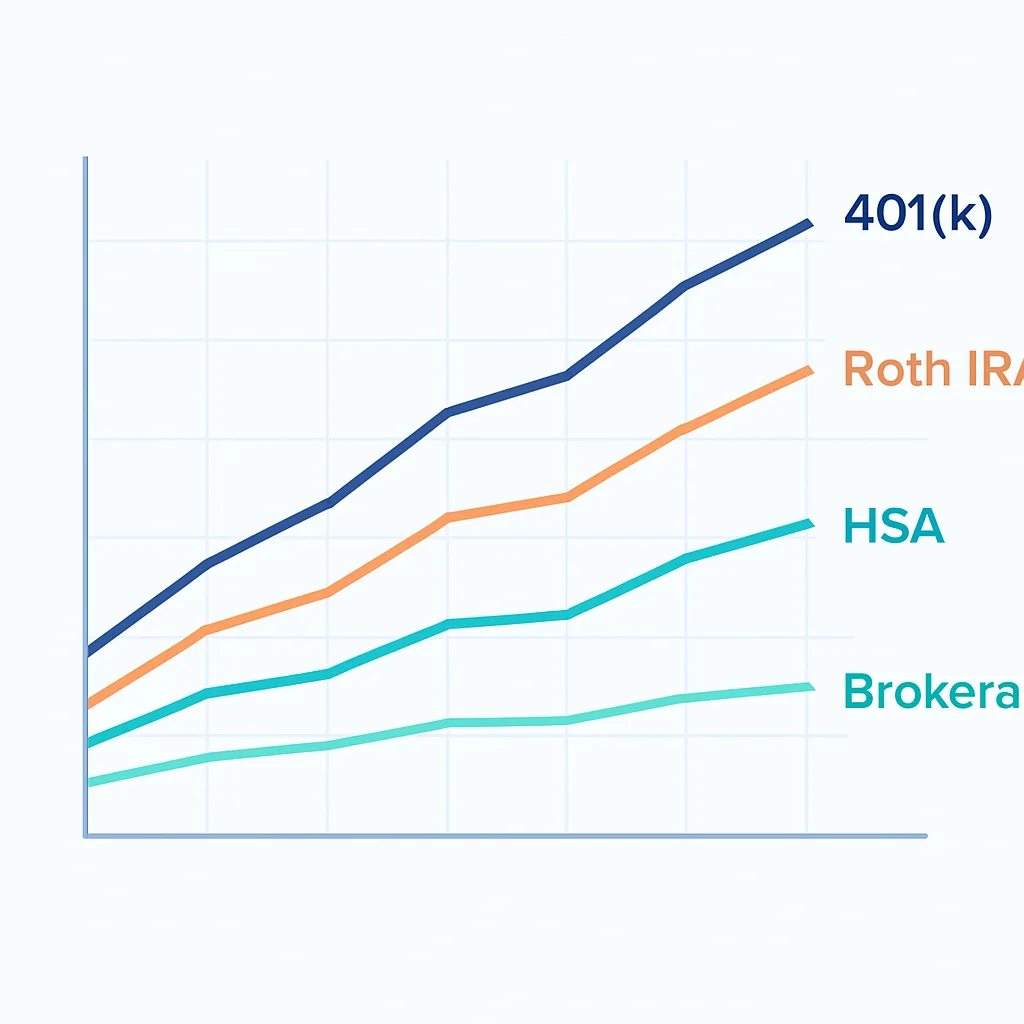
• 401(k) / 403(b): Employer-sponsored retirement plans. In 2026, the contribution limit is expected to be around $23,500 (up from $23,000 in 2024). Always contribute at least enough to get the full employer match – it’s free money! Contributions are pre-tax, reducing your taxable income now, and grow tax-deferred.
• Roth IRA: Contributions are made with after-tax dollars, but qualified withdrawals in retirement are completely tax-free. Ideal for those who expect to be in a higher tax bracket in retirement. The 2026 contribution limit is projected to be $7,000 (up from $6,500 in 2024), with income limits that might require a “backdoor Roth” strategy for high-earning developers.
• Health Savings Account (HSA): Often called the “triple-tax advantaged” account. Contributions are tax-deductible, growth is tax-free, and withdrawals for qualified medical expenses are also tax-free. In 2026, the contribution limit for individuals is projected to be around $4,400 (up from $4,150 in 2024), and for families, around $8,850 (up from $8,300 in 2024). If you’re healthy, invest the funds and let them grow for future medical costs or even general retirement expenses after age 65.
• Taxable Brokerage Account: Once you’ve maxed out your tax-advantaged accounts, any additional savings should go into a standard brokerage account. While not tax-advantaged, it offers maximum liquidity, which is crucial for early retirement before traditional retirement accounts can be accessed without penalty.
Asset Allocation & Diversification
For most FIRE seekers, a simple, diversified portfolio of low-cost index funds or ETFs is highly effective. These funds track broad market segments (like the S&P 500 or the total U.S. stock market) and offer instant diversification across hundreds or thousands of companies. Examples include VTSAX (Vanguard Total Stock Market Index Fund Admiral Shares) or VOO (Vanguard S&P 500 ETF).
A common allocation for those pursuing FIRE is a significant tilt towards equities (stocks) early on, given the long time horizon. A portfolio like 80% stocks / 20% bonds or even 90% stocks / 10% bonds is typical. Bonds provide stability but lower returns. Target-date funds are another option, automatically adjusting your allocation as you approach your target retirement year, though they might not be aggressive enough for early FIRE.
KEY POINT
Compound interest is your most powerful ally. The earlier and more consistently you invest, the more time your money has to grow exponentially. Even small, regular contributions add up significantly over time.
Tax-Efficient Investing
As a high-income earner, managing taxes on your investments is crucial. Strategies like asset location (placing tax-inefficient assets like bonds or REITs in tax-advantaged accounts and growth stocks in taxable accounts) can minimize your tax drag. Tax-loss harvesting involves selling investments at a loss to offset capital gains and even a limited amount of ordinary income, then repurchasing a similar (but not identical) asset.
Understanding the difference between short-term and long-term capital gains is also vital. Holding investments for more than a year typically qualifies for lower long-term capital gains tax rates. Always consult a tax professional for personalized advice, especially with complex strategies like these.
CODE EXPLANATION
This pseudo-code demonstrates a basic annual investment strategy, prioritizing tax-advantaged accounts before moving to a taxable brokerage. It highlights the allocation of savings based on contribution limits for 2026.